1.2 Kapitalisme: Het complexe systeem en de foutmodus
1.2 Capitalism: The Complex System and the Fault Mode
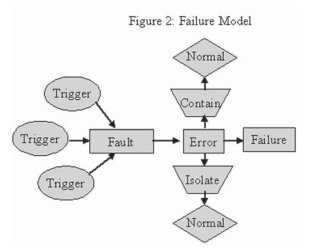
Kapitalisme is een complex sociaal-politiek-economisch systeem. Zoals bij elk ander systeem, mechanisch of sociaal, volgen faalmodi bepaalde modellen. Om de aard van falen te begrijpen of om een fout te detecteren zodra deze optreedt, is het zeer belangrijk om het model te begrijpen waarin fouten optreden en zich manifesteren. Een van de meest algemene modellen die worden gebruikt om systeemfouten te beschrijven, wordt afgebeeld in figuur 2. In het kernontwerp van het systeem kunnen één of meer defecten of fouten aanwezig zijn. Deze fouten worden, indien ze in de vroege stadia van de systeemontwikkeling worden gedetecteerd, verwijderd en/of hersteld. Als een fout in het systeem blijft bestaan door nalatigheid van de ontwerpers of een gebrek aan volledige kennis, wordt het een sluimerende fout. Een sluimerende fout zal geen schade toebrengen aan het systeem totdat deze wordt geactiveerd of uitgelokt door een trigger. Een trigger is een bepaalde conditie of omgeving die een bepaalde fout in het systeem uitlokt of activeert. In fysieke systemen worden sluimerende fouten aan het licht gebracht en gedetecteerd door middel van uitgebreid testen, waarbij het systeem wordt blootgesteld aan alle soorten condities en omgevingen. Helaas kunnen sociaal-politiek-economische systemen niet in een laboratorium worden getest! Daarom kunnen sluimerende fouten in dergelijke systemen alleen aan het licht komen wanneer het systeem daadwerkelijk wordt geïmplementeerd en gedurende een lange periode wordt toegepast, en wanneer de juiste condities optreden op een bepaald moment binnen een bepaalde omgeving. Zodra een fout wordt getriggerd, zal het systeem een fout (error) ervaren die ervoor zorgt dat het systeem afwijkt van zijn normale gedrag. Een fout kan leiden tot een volledig systeemfalen als deze niet tijdig wordt ingedamd en geïsoleerd. Het falen van het systeem maakt het systeem onmachtig om zijn hoofdfuncties uit te voeren of zijn doelstellingen te bereiken.
capitalism is a complex socio-politico-economic system. As in any other system, mechanical or social, failure modes follow certain models. In order to understand the nature of failure or to detect a failure once it occurs, it is very important to understand the model in which failures occur and manifest themselves. One of the most general models used for describing system failures is depicted in figure 2. At the core design of the system, there could be one or more defects or faults. These faults, if detected in the early stages of the system development, are removed and/or fixed. If a fault remains in the system due to oversight by the designers or lack of complete knowledge, it becomes a dormant fault. A dormant fault will not do any harm to the system until it gets excited or provoked by a trigger. A trigger is a certain condition or environment which provokes or excites a certain fault in the system. In physical systems, dormant faults are uncovered and detected through extensive testing which exposes the system to all types of conditions and environments. Unfortunately, social-political-economic systems cannot be tested in a lab! Therefore, dormant faults in such systems can only be exposed when the system is actually implemented and practiced over a long period of time and the proper conditions occur at a given time within a given environment. Once a fault is triggered, the system will experience an error which causes the system to deviate from its normal behavior. An error can lead to complete system failure if not contained and isolated in due time. The failure of the system renders the system unable to provide its main functions or achieve its objectives.
Denk als voorbeeld aan een zwak punt in het ontwerp van een huiskelder als het gebrek of de fout. Het zwakke punt is de plek waar overmatig water door regen of overstromingen het huis kan binnendringen. De voorwaarde die deze fout uitlokt, is te veel regen in een korte periode. De stroom van water het huis binnen via de kelder is de fout, omdat onder normale omstandigheden water niet het huis in zou moeten komen. Deze fout (water in het huis) kan worden gedetecteerd door de mensen die in het huis wonen of door een monitoringsapparaat. Zo wordt de fout geïdentificeerd en geïsoleerd. Om de fout te beheersen, zodat deze niet tot schade leidt, wordt een waterpomp gebruikt om het overtollige water uit de kelder te verwijderen en naar buiten te pompen. Als er geen waterpomp is, of als de pomp om een of andere reden niet aanslaat, zal de fout niet worden beheerst en blijft het overstromingswater in het huis aanwezig. Dit kan leiden tot ernstige schade, waaronder de instorting van het huis.
As an example, think of a weak spot in the design of a house basement as the defect or fault. The weak spot is where excessive water due to rain or floods can penetrate the house. The triggering condition for this fault is too much rain in a short period of time. The flow of water into the house through the basement is the error, because in normal circumstances water should not come into the house. This error (water in the house) can be detected by people living in the house or some monitoring device. This is how the error is identified and isolated. To contain the error such that it does not lead to damage, a water pump is used to remove the excess water from the basement and push it outside. If there is no water pump, or the pump fails to kick in for some reason, the error will not be contained and the floodwater persists in the house. This may lead to serious damages, including the collapse of the house.
Dit falenmodel komt zeer vaak voor in ons leven. Een zwak hart, gedeeltelijk geblokkeerde slagaders, defecte longen of ongezonde nieren veroorzaken alle soorten ziekten en pijnen, die, indien niet tijdig behandeld en ingedamd, kunnen leiden tot de dood. Mechanische defecten in onze auto's (lekke onderdelen, ongebalanceerde wielen, onregelmatige elektrische spanning) kunnen alle soorten problemen in de auto veroorzaken, wat kan leiden tot totale schade aan het voertuig of zelfs tot catastrofale ongelukken.
This failure model is very common in our life. A weak heart or partially blocked arteries or defective lungs or unhealthy kidneys cause all types of sicknesses and pains, which if not treated and contained in due time may lead to death. Mechanical defects in our cars (leaky parts, unbalanced wheels, irregular electric voltage) can cause all types of problems in the car which can lead to total damage of the vehicle or even to catastrophic accidents.