1.2 Kapitalisme: Sistem yang Kompleks dan Mode Kegagalannya
1.2 Capitalism: The Complex System and the Fault Mode
kapitalisme adalah sistem sosial-politik-ekonomi yang kompleks. Seperti halnya sistem lain, baik yang bersifat mekanis maupun sosial, pola kegagalannya mengikuti model tertentu. Untuk memahami sifat kegagalan atau mendeteksi kegagalan begitu ia terjadi, sangat penting untuk memahami model tempat kegagalan itu terjadi dan menampakkan dirinya. Salah satu model paling umum yang digunakan untuk menggambarkan kegagalan sistem ditunjukkan pada gambar 2. Pada desain inti sistem, bisa terdapat satu atau lebih cacat atau kesalahan. Kesalahan-kesalahan ini, jika terdeteksi pada tahap awal pengembangan sistem, dihilangkan dan/atau diperbaiki. Jika suatu kesalahan tetap ada dalam sistem karena kelalaian perancang atau kurangnya pengetahuan yang lengkap, kesalahan itu menjadi kesalahan laten. Kesalahan laten tidak akan membahayakan sistem selama belum terpicu atau teraktivasi oleh pemicu. Pemicu adalah kondisi atau lingkungan tertentu yang memancing atau mengaktifkan kesalahan tertentu dalam sistem. Pada sistem fisik, kesalahan laten diungkap dan dideteksi melalui pengujian ekstensif yang memaparkan sistem pada segala jenis kondisi dan lingkungan. Sayangnya, sistem sosial-politik-ekonomi tidak dapat diuji di laboratorium! Oleh karena itu, kesalahan laten dalam sistem semacam itu hanya dapat tersingkap ketika sistem benar-benar diterapkan dan dijalankan dalam jangka waktu yang lama dan kondisi yang tepat terjadi pada waktu tertentu dalam lingkungan tertentu. Begitu suatu kesalahan terpicu, sistem akan mengalami galat yang menyebabkan sistem menyimpang dari perilaku normalnya. Galat dapat berujung pada kegagalan total sistem jika tidak dibatasi dan diisolasi pada waktunya. Kegagalan sistem membuat sistem tidak mampu lagi menjalankan fungsi utamanya atau mencapai tujuannya.
capitalism is a complex socio-politico-economic system. As in any other system, mechanical or social, failure modes follow certain models. In order to understand the nature of failure or to detect a failure once it occurs, it is very important to understand the model in which failures occur and manifest themselves. One of the most general models used for describing system failures is depicted in figure 2. At the core design of the system, there could be one or more defects or faults. These faults, if detected in the early stages of the system development, are removed and/or fixed. If a fault remains in the system due to oversight by the designers or lack of complete knowledge, it becomes a dormant fault. A dormant fault will not do any harm to the system until it gets excited or provoked by a trigger. A trigger is a certain condition or environment which provokes or excites a certain fault in the system. In physical systems, dormant faults are uncovered and detected through extensive testing which exposes the system to all types of conditions and environments. Unfortunately, social-political-economic systems cannot be tested in a lab! Therefore, dormant faults in such systems can only be exposed when the system is actually implemented and practiced over a long period of time and the proper conditions occur at a given time within a given environment. Once a fault is triggered, the system will experience an error which causes the system to deviate from its normal behavior. An error can lead to complete system failure if not contained and isolated in due time. The failure of the system renders the system unable to provide its main functions or achieve its objectives.
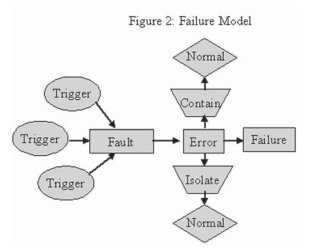
Sebagai contoh, bayangkan sebuah titik lemah dalam desain ruang bawah tanah sebuah rumah sebagai cacat atau kesalahan. Titik lemah tersebut adalah tempat air berlebih akibat hujan atau banjir dapat merembes masuk ke dalam rumah. Kondisi pemicu kesalahan ini adalah curah hujan yang terlalu banyak dalam waktu singkat. Aliran air yang masuk ke dalam rumah melalui ruang bawah tanah adalah kesalahannya, karena dalam keadaan normal air seharusnya tidak masuk ke dalam rumah. Kesalahan ini (air di dalam rumah) dapat dideteksi oleh penghuni rumah atau oleh suatu perangkat pemantau. Demikianlah kesalahan diidentifikasi dan diisolasi. Untuk membatasi kesalahan agar tidak menyebabkan kerusakan, sebuah pompa air digunakan untuk mengeluarkan air berlebih dari ruang bawah tanah dan mengalirkannya ke luar. Jika tidak ada pompa air, atau pompa gagal bekerja karena alasan tertentu, kesalahan tidak akan terkendali dan air banjir tetap berada di dalam rumah. Hal ini dapat menyebabkan kerusakan serius, termasuk runtuhnya rumah.
As an example, think of a weak spot in the design of a house basement as the defect or fault. The weak spot is where excessive water due to rain or floods can penetrate the house. The triggering condition for this fault is too much rain in a short period of time. The flow of water into the house through the basement is the error, because in normal circumstances water should not come into the house. This error (water in the house) can be detected by people living in the house or some monitoring device. This is how the error is identified and isolated. To contain the error such that it does not lead to damage, a water pump is used to remove the excess water from the basement and push it outside. If there is no water pump, or the pump fails to kick in for some reason, the error will not be contained and the floodwater persists in the house. This may lead to serious damages, including the collapse of the house.
Model kegagalan ini sangat umum dalam kehidupan kita. Jantung yang lemah, arteri yang tersumbat sebagian, paru-paru yang cacat, atau ginjal yang tidak sehat menyebabkan berbagai macam penyakit dan rasa sakit, yang jika tidak diobati dan dikendalikan tepat waktu dapat berujung pada kematian. Cacat mekanis pada mobil (bagian yang bocor, roda yang tidak seimbang, tegangan listrik yang tidak stabil) dapat menimbulkan berbagai masalah pada kendaraan yang dapat berujung pada kerusakan total kendaraan atau bahkan kecelakaan fatal.
This failure model is very common in our life. A weak heart or partially blocked arteries or defective lungs or unhealthy kidneys cause all types of sicknesses and pains, which if not treated and contained in due time may lead to death. Mechanical defects in our cars (leaky parts, unbalanced wheels, irregular electric voltage) can cause all types of problems in the car which can lead to total damage of the vehicle or even to catastrophic accidents.