1.4 「ムアーハー」(兄弟の契り)はいつ結ばれ、「サヒーファ」(マディーナの憲章)はいつ書かれたのか。
1.4 When was the “Mu’akhaah” (brotherhood pact) concluded and when was the Sahifah (of Al-Madinah) written?
これまでに提示されたテキストで十分であり、それらから次のことが導き出されます。
The texts that have already been presented should be sufficient and from them we deduce the following:
1) 正しい見解は、ムハージルーンとアンサールの間のこの兄弟関係が、アス・アド・ビン・ズラーラ(アッラーが彼を喜ばれますように)の死より前に行われた可能性はありえない、というものです。それは、預言者(彼に平安あれ)の到着から約7か月後、マスジドの建設中のことでした。彼がアンサールの長であり、('アカバの第二の誓約における)ナキーブ(アンサールの中から選ばれた指導者)の一人であったことを考えれば、彼の生前にその出来事が行われたのに、彼に言及がないということは考えられません。したがって、アブー・ウマル・イブン・アブド・アルバッルの言葉は、
1) The correct view is that this brotherhood between the Muhajirin and the Ansar could not possibly have taken place prior to the death of As’ad bin Zurarah (May Allah be pleased with him), during the building of the Masjid, about seven months following the arrival of the Prophet (peace be upon him). It is not conceivable that it took place in his lifetime without him having been mentioned in it, as he was chief of the Ansar and one of the Naqeebs (selected leaders of the Ansar at the second pledge of ‘Aqabah). Therefore, the statement of Abu ‘Umar ibn Abd AlBarr:
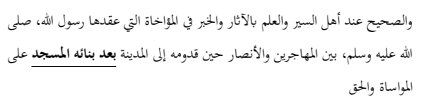
「セーラ(伝記)の学者たちが支持する正しい見解と伝承によれば、預言者ﷺがマディーナに到着した際、ムハージルーン(移住者)とアンサール(援助者)の間に結ばれた「ムアーハー(兄弟の契り)」は、ﷺのモスクの建設後に行われ、それは互いの援助・支援と権利(ハック)の提供を基礎としていた……」
“The correct view as held by the scholars of Seera and reports in respect to the “Mu’akhaah” (brotherhood) which the Messenger of Allah (peace be upon him) concluded between the Muhajirin (emigrants) and the Ansar (helpers), when he came to Al-Madinah, was that it took place after his building of the Masjid and it was upon the basis of the provision of assistance/support and the Haqq (truth) …” .
それは十分にあり得ることであり、特にモスクの建設完了と開所の祝いは、そのような措置を取る良い機会であったと思われます。さらに、この出来事はバドルの戦いより前に行われたに違いありません。というのも、そこにはウバイダ・ビン・アル=ハーリス(ビン・アル=ムッタリブ・ビン・アブド・マナーフ・ビン・クサイイ・アル=クラシー・アル=ムッタリビー)の名が挙げられており、その兄弟ウマイル・ビン・アル=フマーム(ビン・アル=ジャムーフ・ビン・ザイド・ビン・ハラーム・ビン・カアブ)とともに、二人ともバドルの戦いで殉教しているからです。アッラーが二人に御満足されますように。二人は生前も死去の際も兄弟であり、審判の日にも同じであるようアッラーに望みます。 2)正しい見解は、ムハージルーンとアンサールの間のこの兄弟関係は、その本質上文書として記録されるものではなかった、というものです。なぜなら、すべての伝承は例外なく、書面による文書についてまったく触れていないからです。セーラ(伝記)、歴史、ハディースの書を調べると、アル=マディーナのサヒーファより前には、いかなる憲章、文書、法典についての言及も見当たりません。その例外として含まれるものは次のとおりです。
is very conceivable, and particularly as the completion of the building of the Masjid and the celebration for its opening, represented a good occasion for such a step to be undertaken. I addition, it must have been undertaken prior to the battle of Badr because Ubaida bin Al- Harith (bin Al-Muttalib bin Abd Manaf bin Qusayy Al-Qurashi Al-Muttalibi) is mentioned in it along with his brother ‘Umair bin Al- Humam (bin Al-Jamuh bin Zaid bin Haram bin Ka’b) and they were both martyred at the battle of Badr, may Allah be pleased with them. They were brothers in life and at death, and we hope from Allah that they be like that also, on the Day of Judgement. 2) The correct view is that this brotherhood between the Muhajirin and the Ansar was not written in origin as its nature was incompatible with that. That is because all of the narrations, without exception, do not mention a written document at all. An examination of the books of Seera, history and Hadith reveal the absence of the mention of any charter, written document or code prior to the Sahifah of Al-Madinah. The exception to that included:
a) クルアーンの頁(サハーイフ):その中で最も有名なものの一つは、ウマルがイスラームを受け入れた件に関連して言及されている書面(サヒーファ)であり、そこにはスーラ・ターハーが含まれていた。また、ウマルが自ら書き、ヒシャーム・ブン・アル=アースに送ったサヒーファもある。そこには次のものが含まれていた。
a) The pages (Sahaa’if) of the Qur’an: From among the most well- known of these was the Sahifah (written document) mentioned in relation to Umar’s embracing of Islam which included Surah TaHa within it. Also, the Sahifah which ‘Umar wrote by hand and was sent to Hisham bin Al-‘Aas. It contained within it:
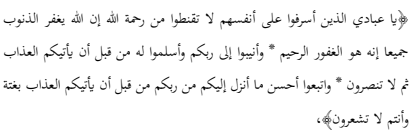
「言いなさい、『自分自身に対して(罪を犯すことによって)度を越してしまった私のしもべたちよ、アッラーの慈悲に絶望してはならない。まことに、アッラーはあらゆる罪を赦される。まことに、アッラーこそは寛容にして慈悲深き御方である』と。そして、(悔悟して)主に立ち返り、罰があなたがたに下る前に主に帰依しなさい。そうすれば、あなたがたは助けられることがないであろう。そして、あなたがたが気づかないうちに突然罰が下る前に、あなたがたの主から下された啓示の中で最善のものに従いなさい」(クルアーン 39:53-55)』
“Say, “O My servants who have transgressed against themselves [by sinning], do not despair of the mercy of Allah. Indeed, Allah forgives all sins. Indeed, it is He who is the Forgiving, the Merciful”. And return [in repentance] to your Lord and submit to Him before the punishment comes upon you; then you will not be helped. And follow the best of what was revealed to you from your Lord before the punishment comes upon you suddenly while you do not perceive” [TMQ 39:53-55].
b) ルクマーンの「マジャッラ」:アル=マジャッラ(al-Majallah)およびそれと同様にアッ=スィジッリー(as-Sijilli)は、ページがめくられる、あるいは(そのページが)めくられる書面(サヒーファ)である。これは、アル=バイハキーの『ダラーイル・アン=ヌブーワ』(2/419)に言及されている内容に似ている。(伝承経路の全体を挙げた後)「アースィム・ビン・ウマル・ビン・カターダ・アル=アンサーリーは、自らの一族の長老たち(シュユーフ)から伝えて、彼らがこう言ったと述べた。」
b) The Majallah of Luqman: Al-Majallah and likewise As-Sijli are a Sahifah (written document) that is turned or (its pages) turned over. That is like what came mentioned in “Dala’il An-Nubuwwah” of Al- Baihaqi (2/419). (After mentioning the full line of transmission) ‘Asim bin ‘Umar bin Qatadah Al-Ansaariy related from the Shuyukh (elders) of his people, that they said:
「バヌ・アムル・ビン・アウフの兄弟であるスワイド・ビン・アッ=サミトは、ハッジまたはウムラの巡礼者としてマッカに来た。スワイドは、その年齢、肌、髪のゆえに、人々から彼らの中の完璧な模範であると評されていた。」(伝承者は)言った。
“Suwaid bin As-Samit, the brother of Bani ‘Amr bin ‘Awf, came to Makkah as a pilgrim for Hajj of ‘Umrah. Suwaid was described by his people as being the model of perfection among them, due to his age, skin and hair. He (the narrator) said:
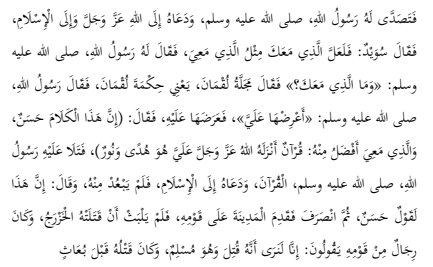
それから、アッラーの使徒(彼に平安あれ)ﷺは彼に近づき、アッラー、アッザ・ワ・ジャッルへと、そしてイスラームへと招きました。スワイドは言いました。「あなたが持っているものは、私が持っているものと同じようなものかもしれません」。そこで、アッラーの使徒(彼に平安あれ)ﷺは尋ねました。「では、あなたは何を持っているのか」。彼は、ルクマーンのマジャッラ、すなわちルクマーンの知恵(ヒクマ)を持っていると答えました。アッラーの使徒(彼に平安あれ)ﷺは「それを私に見せなさい」と言い、彼はそのとおりにしました。使徒(彼に平安あれ)ﷺは言いました。「この言葉は良いものだが、私が持っているものはそれより優れている。それはアッラー、アッザ・ワ・ジャッルが啓示されたクルアーンであり、導きであり光である」。アッラーの使徒(彼に平安あれ)ﷺは彼にクルアーンを朗誦し、イスラームへと招きました。彼はそれを避けることなく、「まことに、これは良い言葉である」と言いました。その後、彼は去り、やがてアル=マディーナの自分の民のもとへ戻りました。それから間もなく、彼はハズラジュ族によって殺されました。彼の民の中には、「我々は、彼がムスリムとして殺されたと見なしている」と言う者たちもいました。そして彼の殺害は、ブアースの戦いの前に起きたのです。【引用終わり】 c) クライシュ族が카アバ神殿の中に掛けた、(圧制的で呪われた)ボイコットの文書(サヒーファ)、その物語、それを白蟻が食い荒らした話、そしてその無効化に関する、よく知られたムタワートゥル(多数伝承)の物語。 d) アッラーの使徒(彼に平安あれ)ﷺが遠征軍の指揮官たちに与えた、指示を含む文書(スフフ)。それらは封印されていたか、継ぎ合わされていました。その例として、アル=ワーキディーの『キターブ・アル=マガーズィー』(1/13)に記されているものがあります。
Then, the Messenger of Allah (peace be upon him) approached him and invited him to Allah ‘Azza Wa Jalla and to Islam. Suwaid said: “It may be that what you have is like that which I have”. So, the Messenger of Allah (peace be upon him) asked: “And what do you have?” He responded by saying that he had the Majallah of Luqman, meaning the Hikmah (wisdom) of Luqman. The Messenger of Allah (peace be upon him) then said: “Show it to me” and so he did. He (peace be upon him) said: “This speech is good but what I have is better than it. It is a Qur’an that Allah ‘Azza Wa Jalla has revealed and it is guidance and light”. The Messenger of Allah (peace be upon him) then recited the Qur’an to him and invited him to Islam. He didn’t distance himself from it and said: “Verily, this is a good speech”. He then left and later arrived to Al-Madinah to his people. It was not long thereafter that he was killed by the Khazraj. There were men from his people who would say: “We view that he was killed whilst he was a Muslim” and his killing occurred before the war of Bu’ath” [End of Quote]. c) The Sahifah (written document) of the (oppressive and accursed) Boycott which the Quraish hung inside the Ka’ba along; its story, the story of the termites eating it and then its well-known Mutawatir story concerning its nullification. d) The pages (Suhuf) which the Messenger of Allah (peace be upon him) gave to the commanders of the military expeditions, containing instructions, and they were sealed or patched together. And example of that is what came stated in Al-Waqidi’s “Kitab ul-Maghazi” (1/13):
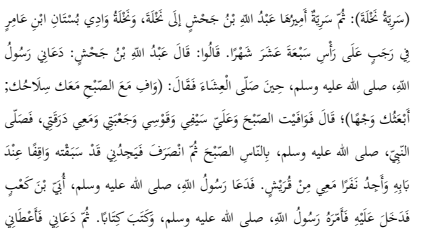
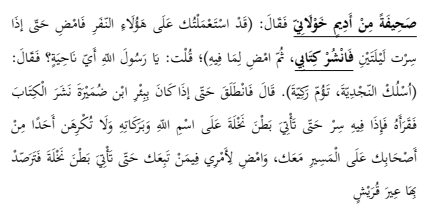
アブドゥッラー・ブン・ジャフシュが指揮したナフラへの遠征(ナフラはイブン・アーミルの果樹園にある渓谷である)は、ヒジュラ暦の第17の月であるラジャブの月に行われた。
“The expedition to Nakhla commanded by Abdullah bin Jahsh (Nakhla is a valley in the Bustan (Orchard) of Ibn ‘Amir) took place in the month of Rajab, the seventeenth month AH.
彼らは言った。アブドゥッラー・ブン・ジャフシュは言った。「アッラーの使徒ﷺが、イシャーの礼拝をされたとき、私を呼ばれ、こう言われた。『夜明けに武器を持って私のところに来なさい。あなたを任務に遣わすつもりだ』。そこで私は、剣、弓、矢筒、盾を持って夜明けに参上した。預言者ﷺは人々とともにスブフ(すなわちファジュル)の礼拝をされ、それから出て来られて、私を見つけられた。私は、先に来て既に預言者ﷺの戸口に立っていた。そしてそこには、私と一緒にクライシュ族(すなわちムハージルーン)の一団がいた。アッラーの使徒ﷺはウバイイ・ブン・カアブを呼び、文書を書くよう命じられた。それから私を呼び、ヒャウラーン産の革の書状を私に渡して言われた。『私はこの一団の指揮をあなたに任じる。二夜の旅程を進みなさい。その後、私の手紙を開き、そこに書かれていることを実行しなさい』。私は言った。『神の使徒よ、どの方角へ向かうのですか』。すると言われた。『ナジュディーヤの方へ、小さな井戸に着くまで進みなさい』。語り手は言った。アブドゥッラー・ブン・ジャフシュは急ぎ、イブン・ドゥマイラの井戸に着いた。そして手紙を開いて読んだ。そこにはこう書かれていた。『進みなさい。アッラーの御名において、その祝福とともに、ナフラの谷に着くまで。ただし、仲間の誰一人も無理にあなたと一緒に行かせてはならない。あなたに従う者とともに、ナフラの谷に着くまで私の命令に従って進み、そこからクライシュの隊商を待ち伏せしなさい』」[引用終わり]。
They said: Abdullah bin Jahsh said: The Messenger of Allah (peace be upon him) called for me when he prayed Ishaa’, and said: “Come to me at dawn with your weapons, as I will send you on a mission”. He said: So, I approached at dawn with my sword, my bow, my quiver and my shield. The Prophet prayed Subh (i.e. Fajr) with the people, and then he left and found me. He found me having preceded him already standing at his door whilst I found a group of the Quraysh (i.e. Muhajirun) with me there. The Messenger of Allah (peace be upon him) called for Ubayy bin Ka’b and commanded him to write a document. Then he called me and gave me the sheet of leather from Khawlan, saying: “I have appointed you over this group. Proceed until you have travelled for two nights. Then open my letter and do as it says”. I said: “O Messenger of God, in which direction?” He replied, “Go towards Najdiyya until you reach a small well”. The narrator said: Abdullah bin Jahsh hastened, until he reached the well of Ibn Dumayra. He then opened the letter and read it. It said: “Go, in the name of Allah and with His blessings, until you come to the valley of Nakhla, but do not force any one of your companions to go with you. Proceed according to my commands with whoever follows you, until you reach the valley of Nakhla and lie in wait for the caravan of Quraysh from there” [End of Quote].
3) 正しい見解は、この「ムアーハーカ」(兄弟盟約)は純粋に個人単位のものであった、すなわち、ある人物はその個人としての立場において、別のある人物と組まされたのだ、というものである。そこには部族、血讐金(血縁)、戦争や和平についての言及は一切なかった。したがって、それはマディーナの憲章(サヒーファ)とは根本的に異なるものであった。
3) The correct view is that this “Mu’ahkaah” (brotherhood pact) was purely on an individual basis i.e. This man in his personal individual description was paired with that man, in his personal individual description. There was no mention in it of tribes, blood money (relationship), war or peace. It was therefore fundamentally different to the Sahifah of al-Madinah.
まとめと結論
Summary Conclusion
そこで、ムハージルーンとアンサールの間のサヒーファ(文書)、あるいは血の代償(ディヤ)の権利、戦争や和平に関する記述が見られる箇所については、必然的に、この「ムアーハーア(兄弟契約)」とは関係がないと分かります。それらは「アル=マディーナのサヒーファ」に関係するか、そこで述べられたものより(ずっと)後に書かれたり生じたりしたものです。また、アフマド・アブー・ザイドの『アス=スィーラ・アン=ナバウィーヤ』(71頁)に、「ユダヤ人との条約(ムアーハダ)の文書が書かれた日付」という見出しの下で伝えられている次の記述にも妥当性はありません。「ある現代の研究者は、その文書は元来二つの文書であり、歴史家がそれを一つにまとめたのだと、より有力だと判断した。一方は、預言者ムハンマド(彼に平安あれ)とユダヤ人との条約を扱っており、大バドルの戦いの前に書かれた。もう一方は、ムハージルーンとアンサールのムスリムの義務、彼らの権利と責務を明らかにしている。私の見解では、ユダヤ人との和平協定(ムワーダア)の文書は大バドルの戦いの前に書かれたというのがより有力である。二つ目の文書は、その後に書かれた」。古典的な典拠も、このより有力な見解を支持する内容を述べている。アブー・ウバイド・アル=カースィム・ブン・サッラームは言った。「その文書(ワスィーカ)は二度の機会に書かれた。預言者(彼に平安あれ)がマディーナに到着した時、そしてイスラームが優勢となり強固になる前、またアフル・アル=キターブ(啓典の民)からジズヤを取るよう命じられる前である」。アル=バラーズリーは言った。「神の使徒(彼に平安あれ)がマディーナに到着すると、ユダヤ人と条約(ムワーダア)を結び、自分と彼らの間で文書を作成した。彼はユダヤ人に、彼の敵を支援したり味方したりしないこと、彼を攻撃する者に対して彼を支援すること、そして彼がアフル・アル=ズィンマ(保護民)を守るために戦うことはないことを定めた」。 彼はその後、誰かに対して戦争を仕掛けることもなく、人々が彼を誹謗することもなく、軍隊を派遣することもなかった。アッラー、アッザ・ワ・ジャッルがこう啓示なさるまでは。「戦うことを許された者たちには、不当に攻撃されたがゆえに、今や(戦うことが)許された。まことに、アッラーは彼らに勝利を授けることがおできになる。彼らは、正当な理由もなく自分たちの家から追放された者たちである」(TMQ 22:39-40)。
Wherever we find a narration about a Sahifah or a written document between the Muhajirin and the Ansar, or concerning blood money rights, war or peace, we know, by necessity, that it bears no relation to this “Mu’akhaah” (formation of brotherhood). It would either be related to the Sahifah of Al-Madinah or something that came or was written (much) later than it. There is also no validity in what came related in “As-Seera An- Nabawiyah” by Ahmad Abu Zaid (p. 71) under the heading “The date of the writing of the treaty (Mu’ahadah) with the Jews”: “One of the contemporary researchers found preponderant that the document was actually two documents in origin and then the historians combined them into one. One of them dealt with the treaty of the Messenger of Allah (peace be upon him) with the Jews and was written prior to the great battle of Badr. That is whilst the second clarified the commitments (duties) of the Muslims from the Muhajirin and the Ansar, their rights and obligations. He said: “It is preponderant in my view that the peace agreement (Muwada’ah) document with the Jews was written before the great battle of Badr. As for the second document, then it was written after it”. The classical sources have expressed that which supports this preponderance. Abu ‘Ubaid Al-Qasim bin Salam said: “The Wathiqa (document) was written on two occurrences, when the Prophet (peace be upon him) arrived in Al-Madinah, prior to the dominance of Islam and its becoming strong and before he was commanded to take the Jizyah from Ahl ul-Kitab (the people of the book)”. Al-Baladhari said: “When the Messenger of Allah (peace be upon him) arrived in Al-Madinah he made a treaty (Muwada’ah) with the Jews and wrote between himself and them a document. He stipulated upon them that they should not support or side with his enemies, to support him against those who attack him and that he would not fight in defence of the Ahl udh-Dhimmah. He did not then wage war against anyone, they did not defame him and he did not dispatch a military expedition, until Allah ‘Azza Wa Jalla revealed: “Permission [to fight] has been given to those who are being fought, because they were wronged. And indeed, Allah is capable of providing them victory. [They are] those who have been evicted from their homes without right” (TMQ 22:39- 40)”.

「被害を受けたがゆえに戦うことを許された人々に、〔戦うことの〕許可が与えられた。まことに、アッラーは彼らに勝利を与える力をお持ちである。」
“Permission [to fight] has been given to those who are being fought, because they were wronged. And indeed, Allah is capable of providing them victory.
「それらは、不当にも自分たちの家から追い出された人々である」 [TMQ 22:39-40]
[They are] those who have been evicted from their homes without right” [TMQ 22:39-40]
これは、「ムワーダア」(平和と休戦)が自然で本来の状態であり、それを確立するために招集を必要としないからです。そして、もし戦争が起こるなら、「ムワーダア」は途絶え、戦争が休戦、条約、または和平合意によって終結するまで回復しない、ということです。
That is because the “Muwada’ah” (peace and truce) is the natural and original situation and is not in need of being convened in order to establish it. Then, if war was to take place, the “Muwada’ah” would cease and it would not return until the war ends by way of a truce, treaty or peace agreement.
したがって、「ムワーダア」は存在することも存在しないこともありうる状態を表す。ゆえに、アッラーの使徒(ﷺ)の言葉、「アビシニアの人々は、彼らがあなたがたを放っておく限り、あなたがたも彼らを放っておけ」は、必然的に次の意味となる。すなわち、アビシニアがそうしている限り、ムワーダア(和平と休戦)という状態を肯定し、それを継続せよ、ということである。同様に、セーラの学者たちが用いる表現や、預言者(ﷺ)に関する伝承、たとえば「彼がアル=マディーナに到着した時、そこに住んでいたユダヤ教徒全員と和平を結んだ」といった表現についても、それによって彼が正式な「ムワーダア」を制定した、あるいは契約(正式な条約)を結んだと理解することは許されない。むしろそれは、両者の間に既に存在していた休戦と和平という元の状態を、彼が肯定し、継続したことを意味するのである。
Consequently, the “Muwada’ah” represents a status that could be present or absent. Therefore, the statement of the Messenger of Allah (peace be upon him): “Leave the Abyssinians be as long as they leave you be” means by necessity: Affirm and continue upon the status quo of the Muwada’ah (peace and truce) as long as Abyssinia does so. As such, in respect to the statement used by the scholars of Seera and reports concerning the Prophet (peace be upon him) like: “When he arrived in Al-Madinah he made peace with all of the Jews who were residing there”, it is not permissible to be understood to mean that he established an official “Muwada’ah” or contracted a covenant (official treaty). Rather, it means that he affirmed and continued upon the original status quo of the truce and peace existing between them.
もしも彼(ﷺ)から伝えられたこと、すなわち「もし彼と同じ意見を持つ他の者が守ったことを守っていたなら、彼は暗殺されなかっただろう。しかし彼は我々を侮辱し、詩によって我々を嘲笑した。お前たちのうち誰も、彼に剣があったのでなければ、そのようなことはしなかっただろう」という言葉に注意を払うならば、それが我々のこの見解を完全に裏付けていることがわかるだろう。なぜなら、そこにはカアブ・ビン・アル=アシュラフによって破られた契約や条約については何も述べられていないからである。むしろ彼は、他の者たちが守っていた平和協定(Muwada’ah)を守り続け、それを確認することをしなかったのである。イマーム・イブン・アル=カイイム(アッラーの慈悲が彼にありますように)は、このことの一部を認識していた。彼は著書『Ahkam Ahu dh-Dhimmah』(3/1404)でこう述べている。
If we were to pay attention to what was related from him (peace be upon him): “If had kept to what other than him, who shared his view, kept to, he would not have been assassinated. However, he abused us and ridiculed us through poetry, and none of you would have done that unless he had a sword” we would see that it confirms this view of ours perfectly. That is because there is nothing mentioned in it concerning a covenant or treaty that had been breached by Ka’b bin Al-Ashraf. Rather, he didn’t continue upon and affirm to the peace (Muwada’ah” that others had kept to. Imam Ibn ul-Qayyim (may Allah’s mercy be upon him) was aware of some of this. He stated in his book “Ahkam Ahu dh-Dhimmah” (3/1404):
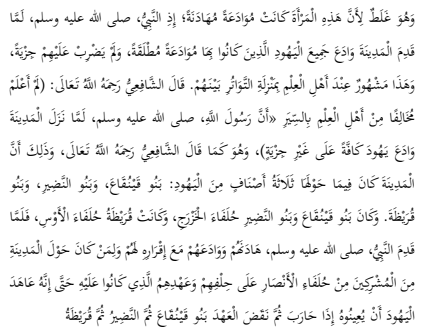
「そしてこれは誤りである。なぜなら、この女性は安全な状態にあり、休戦(ムハーダナ)の下にあったからである。というのも、預言者(ﷺ)がアル=マディーナに来られたとき、彼はそこに住むすべてのユダヤ教徒と、制限のない形で和平を結び、彼らに対してジズヤを課さなかったからである。このことは、学者たちの間では、彼らの間での確実な相伝の段階に至るまでよく知られている。アッ=シャーフィイー(アッラーのご慈悲がありますように)は次のように述べた。『私は、預言者伝記の学者の中で、「アッラーの使徒(ﷺ)がアル=マディーナに定住されたとき、ジズヤを課すことなく、すべてのユダヤ教徒と和平を結ばれた」という点で意見を異にする者を知らない。』それはアッ=シャーフィイー(アッラーのご慈悲がありますように)が述べたとおりである。というのも、アル=マディーナは三つのユダヤ教徒の集団に取り囲まれていたからである。バヌー・カイヌカーウ、バヌー・アン=ナディール、そしてバヌー・クライザである。バヌー・カイヌカーウとバヌー・アン=ナディールはハズラジュ族の同盟者であり、バヌー・クライザはアウス族の同盟者であった。そして、アッラーの使徒(ﷺ)がアル=マディーナに来られたとき、彼はそれらの者たちと、アル=マディーナの周辺にいた、アンサールの同盟者である多神教徒たちとともに、彼ら以前からあった同盟と誓約を基礎として、休戦と和平を結ばれ、それを承認された。さらに彼はユダヤ教徒から、もし彼が戦いを挑まれた場合には彼を支援するという誓約を取られた。その後、バヌー・カイヌカーウが誓約を破り、続いてアン=ナディール、そしてクライザが破った。」[引用終わり]
“And it is a mistake because this woman was at peace and under a truce (Muhadanah). That is because when the Prophet (peace be upon him) came to Al-Madinah he made peace with all of the Jews residing there an unrestricted manner and he did not impose Jizyah upon them. This is well-known by the people of knowledge to the level of Tawatur (decisive concurrent transmission) among them. Ash- Shafi’iy (may Allah’s mercy be upon him) said: “I do not of any from the people of knowledge of Seera who disagree upon the point “That when the Messenger of Allah (peace be upon him) settled in Al- Madinah, he made peace with all of the Jews without the imposition of the Jizyah”. It is as Ash-Shafi’iy (May Allah’s mercy be upon him) stated. That is because Al-Madinah had three groups of Jews surrounding it: Banu Qainuqaa’, Banu An-Nadir and Banu Quraizha. Banu Qainuqaa’ and Banu An-Nadir were allies of the Khazraj, while Banu Quraizha were allies of the Aws. Then when the Messenger of Allah (peace be upon him) came to Al-Madinah, he made a truce and peace with them with his approval of them, alongside those who were around Al-Madinah from the polytheists who were allies of the Ansar, upon the basis of their alliance and covenant that they had previously been upon. He even took a covenant from the Jews that they would support him if he was fought against. Then, Banu Qainuqaa’ broke the covenant, followed by An-Nadir and then Quraizha” [End of Quote].
たとえこの箇所で使われている表現の中には、必ずしも最も正確ではないものがあったとしても、例えば彼がそのユダヤ人の女性を「休戦」(ムハダナ)の状態にあると述べた言葉がそうです。実際にはまだ戦闘が一度も行われていなかったのに、その後に休戦が発効したのですから。これは単なる言い間違いだったのかもしれません。
That is even if some of the expressions used here were possibly not the most accurate, like his statement describing the Jewish woman as being under a “truce” (Muhadanah), as there had not even been any fighting, for a truce to have come into effect followed it. It may be that this was merely a slip of expression.
ウスタズ・アフマド・ビン・ザイドが言及した歴史家の発言や見解については、そのほとんどが無効であるか、結論を導けないものである。
As for what Ustadh Ahmad bin Zaid mentioned in terms of statements or views of the historians, then most of them are either invalid or inconclusive:

「ワサーカ(協定文書)は二度にわたって書かれた(ハダサーニ)。預言者(平安あれ)がアル・マディーナに到着した時、すなわちイスラームが優勢となり強固になる前、そして啓典の民(アフル・ル=キターブ)からジズヤを徴収するよう命じられる前のことである。」 Wait, I must follow the rules: write ﷺ after each mention of the Prophet, not the written-out honorific. Corrected: 「ワサーカ(協定文書)は二度にわたって書かれた(ハダサーニ)。預言者ﷺがアル・マディーナに到着した時、すなわちイスラームが優勢となり強固になる前、そして啓典の民(アフル・ル=キターブ)からジズヤを徴収するよう命じられる前のことである。」
“The Wathiqa (document) was written on two occurrences (Hadathani), when the Prophet (peace be upon him) arrived in Al- Madinah, prior to the dominance of Islam and its becoming strong and before he was commanded to take the Jizyah from Ahl ul-Kitab (the people of the book)” .
「Hadathani」という語は、確定した時間の枠組みを示さないため、曖昧である。イスラームが広く表れ、真に力を持つようになったのは、連合軍(アフザーブ、すなわち塹壕の戦い)が敗れた後である。それは、預言者(ﷺ)が人々に対して攻勢に出始め、人々が彼に対して攻勢に出ることがなくなったからである。さらに、預言者(ﷺ)が人々からジズヤを取るよう命じられたのがいつなのかも分かっていない。また、「啓典の民(アフル・ル=キターブ)からジズヤを取れ」という彼の言葉は、よく知られた誤りの繰り返しである。真実は、ジズヤは多神教徒、マジュース教徒を含む者からも取られていたのであり、これはサヒーフ・ムスリムその他の文献に記録されたアン=ヌウマーン・ブン・ムカッリンのハディースに述べられている通りである。2)アル=バラーズリーの言葉について、
is vague because the word “Hadathani” does not establish for us a determined time frame that can be taken into consideration. Islam only manifested in a prevalent manner and truly became powerful following the defeat of the confederates (Ahzab i.e. battle of the trench). That is because the Prophet (peace be upon him) began to go on the offensive against the people and they were no longer on the offensive against him. In addition, we do not know when he was commanded to take the Jizyah from the people. That is whilst his statement “take the Jizyah from Ahl ul-Kitab (the people of the book)” is a repetition of a well-known error, as the truth is that the Jizyah was taken even from the polytheists, including the Majus, as has come stated in the Hadith of An-Nu’man bin Muqarrin, recorded in Sahih Muslim and other collections. 2) As for the statement of Al-Baladhari
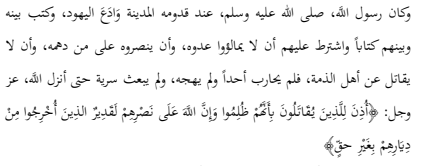
「預言者ムハンマド ﷺ がアル=マディーナに到着した時、彼はユダヤ教徒との間で協定(ムワーダア)を結び、自分たちの間で文書を書き記した。彼はユダヤ教徒に対し、彼の敵を支援したり味方したりしないこと、彼を攻撃する者に対して彼を支援すること、そしてアフル・ウッ=ディンマ(庇護民)を守るための戦いはしないことを条件とした。その後、彼は誰とも戦争を始めず、彼らは彼を中傷せず、彼は遠征軍を派遣しなかった。やがてアッラー・アッザ・ワ・ジャルは次の啓示を下された。『戦いを仕掛けられた者たちに、戦うことが許された。彼らは不当な扱いを受けたからである。まことにアッラーは、彼らに勝利を与える力を持っておられる。彼らは正当な理由なく、住まいから追放された者たちである』(TMQ 22:39-40)」</reasoning_effort>
“When the Messenger of Allah (peace be upon him) arrived in Al- Madinah he made a treaty (Muwada’ah) with the Jews and wrote between himself and them a document. He stipulated upon them that they should not support or side with his enemies, to support him against those who attack him and that he would not fight in defence of the Ahl udh-Dhimmah. He did not then wage war against anyone, they did not defame him and he did not dispatch a military expedition, until Allah ‘Azza Wa Jalla revealed: “Permission [to fight] has been given to those who are being fought, because they were wronged. And indeed, Allah is capable of providing them victory. [They are] those who have been evicted from their homes without right” (TMQ 22:39-40)”.
このスピーチは矛盾しています。預言者(ﷺ)は、啓示による節が下る以前には戦うことを許されておらず、いかなる者とも戦争状態にはありませんでした。また、アル=マディーナが攻撃されることが予想される状況にもありませんでした。したがって、彼のスピーチの中の「彼はユダヤ人に対し、彼の敵に味方したり加担したりしないこと、そして彼に攻撃を加える者から彼を支援することを条件とした」という一文は、『サヒーファ』に記されていた内容を要約したものですが、その時代においては考えられず、現実性もありません。さらに甚だしいのは、「そして彼は、ズィンマの民を守るためには戦わないとした」という文であり、印刷の誤りがないと仮定しての話ですが、まず第一に、当時そこにズィンマの民(Ahl udh-Dhimmah)は存在していませんでした。第二に、彼らが彼を攻撃する者から彼を支援する義務を負いながら、彼が彼らを攻撃する者から彼らを支援する義務を負わないなどということがどうして成り立つのでしょうか。 3)バラーズリーによるバヌー・カイヌカーウに関する記述について
This speech is contradictory because he (peace be upon him) had not been permitted in origin to engage in fighting prior to the revelation of the Aayah and was not in a state of war with anyone. There was also no expectation for Al-Madinah to be attacked. Therefore, the sentence from his speech: “He stipulated upon them that they should not support or side with his enemies, to support him against those who attack him”, which summarized some of what came stated in the “Sahifah”, is inconceivable and has no reality to it during that time period. Even more atrocious is the statement: “And that he would not fight in defence of the Ahl udh-Dhimmah”, assuming there was no error in the printing. Firstly, there were no “Ahl udh-Dhimmah” there in origin. Secondly, how could it be that they are obliged to support him against those who attack him, whilst he is not obliged to support them against those who attack them?! 3) The statement of Al-Baladhariy concerning Banu Qainuqaa’:
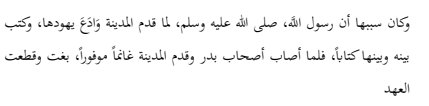
「その理由は、預言者ムハンマド(彼に平安あれ)がアル=マディーナに到着した際、そこのユダヤ教徒と和平協定を結び、自分たちと彼らとの間に文書を作成したことにある。その後、ムスリムたちがバドルで勝利し、大量の戦利品を携えてアル=マディーナに帰還すると、ユダヤ教徒たちは反旗を翻し、協定を破った」という説明にも、意味がない。なぜなら、「ムワーダア」(和平状態)こそが根本であり、それは公式に相互に契約されたり文書にされたりする必要がないからである。一方、カアブ・ビン・アル=アシュラフが最初に違反し、戦争を起こして「ムワーダア」(和平あるいは休戦状態)を断ち切った。それは前述のとおり、ムタワーティル(多くの伝承経路による確実な伝達)によって確立されているものである。彼はその後「サヒーファ」を書いたが、それは「ムワーダア」を確立する目的ではなく、「連合同盟(イッティハード・コンフェデラーリー)」を確立するためのものであった。その後、バヌー・カイヌカーウがこの「同盟」から離脱して戦争を始め、続いてバヌー・アン=ナディールが、そしてクライザ族が裏切った。4)アッ=タバリーの見解について。
“The reason for it was that the Messenger of Allah (peace be upon him), when he arrived in Al-Madinah, made a peace agreement with its Jews and wrote a document between himself and them. Then, when the Muslims were victorious at Badr and came back to Al- Madinah with abundant booty, the Jews rebelled and broke the covenant”, then this also has no meaning to it. That is because the “Muwada’ah” (state of peace) is the origin and does not need to be officially mutually contracted or write. That is while Ka’b bin Al-Ashraf was the first to transgress, war and cut the “Muwada’ah” (state of peace or truce) which, as previously mentioned, has been established via Mutawatir (decisive concurrent) transmissions and he then wrote the “Sahifah” which was not the purpose of establishing a “Muwada’ah” but rather to establish a “Confederal Union (Ittihad Confedarali)”. Thereafter, Bani Qainuqaa’ exited from the “union” and waged war, followed by Banu An-Nadir and then Quraizhah betrayed it. 4) Concerning the statement of At-Tabari:
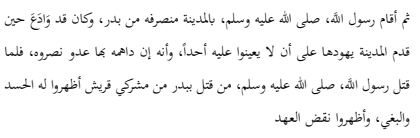
その後、アッラーの使徒ﷺはバドルからの帰還後もマディーナに留まられた。マディーナに到着されると、彼はそこのユダヤ教徒と和約を結ばれた。その条件は、彼らが何者かに対してムハンマドﷺを助けないこと、そして敵がマディーナで彼を襲撃した場合には、彼らが彼を支援することであった。その後、アッラーの使徒ﷺがクライシュの多神教徒のうち殺すべき者たちを殺されると、彼らは彼に対して妬みと反抗心を示し、契約違反の態度を明らかにした。
“Then the Messenger of Allah (peace be upon him) remained in Al- Madinah after his return from Badr. When he had arrived in Al- Madinah he had made a peace agreement with its Jews upon the stipulation that they do not assist anyone against him and that if he was attacked in Al-Madinah by an enemy, they would support him. Then when the Messenger of Allah (peace be upon him) killed those whom he had killed from the Mushrikin (polytheists) of Quraish, they demonstrated envy and rebelliousness towards him and demonstrated the breaching of the covenant”,
それでは、先ほどのアル=バラーズリーの発言と同じ線上にあり、それへの反論も同じだが、こちらの方がずっとよい。というのも、彼はバドル以前の古い「ムワーダアah」(和平・休戦の合意)が書面による文書であったと断言していないからである。アル=バラーズリーがうっかり述べた点であり、またその文章には「彼は庇護民(アフル・ウッ=ディンマ)を守るためには戦わないだろう」という、とんでもない文に相当するものも含まれていない。とはいえ、アト=タバリーの「契約違反(ナクド・アル=アハド)」という表現は、現実に合致するものではない。というのも、元来「アハド」(契約)は存在せず、むしろその原初の状態における「ムワーダアah」があったにすぎないからである。ただし、それを受け入れ遵守したことを暗黙の「アハド」(契約・条約)とみなすのであれば話は別だが。アフマド・アブー・ザイドの次の発言のとおりである。
then it is in line with the speech of Al-Baladhariy above and the refutation to it is the same, although it is much better. That is because he did not assert that the old “Muwada’ah” (agreement of peace/truce), prior to Badr, was a written document, as Al-Baladhariy slipped up in, just as his text does not include something equal to the atrocious sentence “And that he would not fight in defence of the Ahl udh-Dhimmah”. Despite that, the statement of At-Tabari “breaching of the covenant (Naqdh Al‘Ahd)” is not something that fits with reality. That is because there was no prior “Ahd” (covenant) in origin but rather a “Muwada’ah” upon its original state. That is unless we were to consider its acceptance and adherence to it as being an “Ahd” (Covenant/treaty) implicitly?! As the statement of Ahmad Abu Zaid:

これらのムタワatir(多くの経路による伝承で確実性を示すもの)の証言には、ユダヤ教徒との和平協定文書が放ヒジュラ元年に書かれたと結論づけるのに十分な蓋然性があります。さらに、その条項と本文を分析すると、預言者ﷺとユダヤ教徒との間に緊張関係があったことを示すものではないことがわかります。したがって、これらすべてを根拠として、イスラーム百科事典の主張は崩れ、その疑念は反証されたと言えます。」というのは、重大な、というより致命的な誤りがあります。
“In these Mutawatir (concurrent transmissions indicating decisiveness) testimonies, there is enough to establish preponderance to conclude that the peace agreement document with the Jews was written in the first year of the Hijrah. In addition, an analysis of its articles and texts indicate that they are not indicative of any tension between the Prophet (peace be upon him) and the Jews. As such, due to all of this, the claims of the Islamic encyclopaedia fall down and their doubts are refuted”, then there are significant, indeed fatal errors in it.
1) 歴史家の記述や見解は、同時代の(直接の)目撃者によるものでない限り、証言(シャハーダ)とは呼ばれない。そうでなければ、そのような見解は、正しいか誤っているかわからない情報や前提に基づく一つの意見にすぎない。多数の一致または類似した意見があっても、それはタワートゥル(複数の伝承経路によって確実に立証されること)とは呼ばれず、確実な肯定の証言としての価値も持たない。
1) The statements or views of the historians are not called testimonies (shahada) unless it is from a contemporary (first-hand) witness. Otherwise, such a view is merely an opinion based upon correct or incorrect information or premises. A large number of conforming or similar opinions is not called Tawatur (i.e. established definitely by concurrent transmission) and they do not hold the value of Tawatur (decisive) testimonies of affirmation.
2) 内戦の後に制定された憲法であっても、その条文には当事者間の緊張関係がまったく示されていないことがある。それは、憲法の目的が国家の体制(すなわち単一制か連邦制かなど)を定めることにあるからである。したがって、憲法の制定に先立って生じた緊張や対立の時期は、そこに記されることも言及されることもない。よって、「(条文は)預言者(彼の上に平安あれ)とユダヤ教徒との間のいかなる緊張も示してはいない」という主張について言えば、その逆もまた正しいことになる。すなわち、連邦制の憲法や国際条約を作成したという事実それ自体は、それに先立つ緊張、対立、戦争が存在したことの証拠にはならない。存在したかもしれないし、しなかったかもしれない。それを知るには、当該文書とは独立に検討される他の歴史的な指標、あるいは、紛争の終結や戦闘の停止、賠償金や血の代償(ディヤ)の問題の解決などを示す文書本文の記述に頼るほかない。 ウスタズ・アフマド・アブー・ザイドは、彼がそれより少し前に『As-Seera An-Nabawiyah』(アフマド・アブー・ザイド著、70頁)で示した「イスラム百科事典」の主張を、次のように反駁しようとしている。
2) Some constitutions could be written following a civil war and yet its texts do not reflect the existence of any tension between the parties involved. That is because the purpose of the constitution is to lay down the regulation of the state (i.e. Unitary or union form etc…). As such, the date of the tension or conflict that occurred leading up to it, is neither written or mentioned within it. Consequently, in respect to the statement “They (i.e. the texts) are not indicative of any tension between the Prophet (peace be upon him) and the Jews”, then the opposite is also correct. That is because the writing of a confederal constitution or international treaty in itself, is not an evidence for the existence of a tension, conflict or war proceeding it. There could have been just as there may well not have been. This would only be known via other historical indications which are looked at independently from the document that is under examination, or from the texts of the document itself which indicate to the ending of a conflict or cessation of fighting or the solving of problems of compensations and blood monies etc… Ustadh Ahmad Abu Zaid wishes to refute the claims of the “Islamic Encyclopaedia” which he had formulated shortly before that in “As- Seera An-Nabawiyah” by Ahmad Abu Zaid (p: 70) as follows:
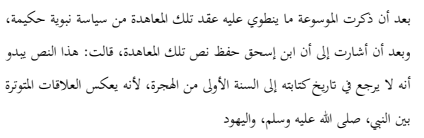
「百科事典が、その協定(ムアーハダ)の締結がどのような賢明な預言者的政策決定を含んでいたかを述べ、またイブン・イスハークがその協定の本文を保存していたことを示した後、次のように述べた。『この本文は、その作成の日付に関して、ヒジュラ暦元年にまで遡るものではないと思われる。なぜなら、それは預言者ﷺとユダヤ人との間の緊張した関係を反映しているからである』。」
“After the encyclopaedia mentioned what the contracting of that treaty (Mu’ahadah) contained in terms of wise prophetic policy making and after it indicated to Ibn Ishaq having preserved the text of that treaty, it stated: It appears that this text does not go back, in respect to the date of its writing, to the first year of the Hijrah, because it reflects the tense relations between the Prophet (peace be upon him) and the Jews”.
実際には、マディーナの憲章(サヒーファ)は、先に提示した伝承の歴史的証拠に基づき、ヒジュラ暦第3年の初めに書かれたものです。したがって、その百科事典はこの点について正しいのです。一方、その百科事典の執筆者である東洋学者たちが導き出した推論、すなわちその文書(サヒーファ)は
The truth is that the Sahifah of Al-Madinah was written at the beginning of the third year of Hijrah based upon the evidence of the historical transmitted texts that we have presented earlier. As such, the encyclopaedia was correct regarding this matter. As for the deduction of the orientalists, who are the authors of the encyclopaedia, that the text (i.e. Sahifah)

預言者ﷺとユダヤ教徒との間の緊張した関係を反映している。
“reflected tense relations between the Prophet (peace be upon him) and the Jews”, .
だから、それは説得力がなく、場違いです。人々はここで想像力に任せて語ってきました。歴史とは過ぎ去った出来事と現実にすぎず、その伝承は当時の目撃者と同時代の記録から取られなければなりません。想像や、論理的な推論からではありません。確かに、サヒーファ(憲章)が書かれた状況は、一部のユダヤ教徒(特にカアブ・ブン・アル=アシュラフ)との関係に緊張が生じたことにより書かれたことを明らかにしています。しかし、その文面には、それ以前の緊張や対立を示すものは、まったく、少しも含まれていません!
then this is not convincing and out of place. People have given free reign to their imaginations here. That is whilst history is merely events and realities that have passed by and its reports must be taken from first-hand witnesses and records of those living at the time, not from imaginations or even logical deductions. Yes, it is true that the circumstances surrounding the writing of the Sahifah reveal that it was written due to the occurrence of a tension in the relations with some of the Jews (Ka’b in Al-Ashraf specifically). However, its text does not include anything indicating to any prior tension or conflict and not even remotely!