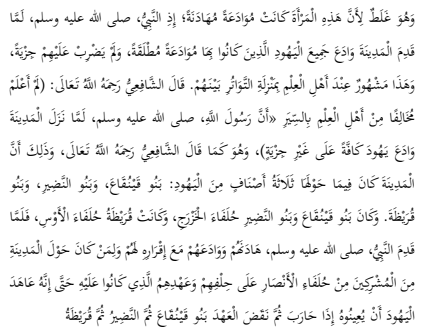
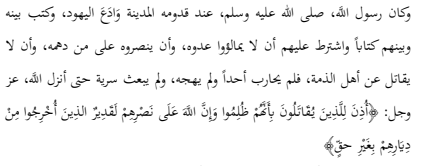
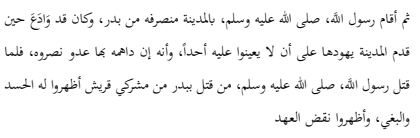
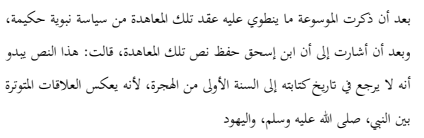
Wherever we find a narration about a Sahifah or a written document between the Muhajirin and the Ansar, or concerning blood money rights, war or peace, we know, by necessity, that it bears no relation to this “Mu’akhaah” (formation of brotherhood). It would either be related to the Sahifah of Al-Madinah or something that came or was written (much) later than it. There is also no validity in what came related in “As-Seera An- Nabawiyah” by Ahmad Abu Zaid (p. 71) under the heading “The date of the writing of the treaty (Mu’ahadah) with the Jews”: “One of the contemporary researchers found preponderant that the document was actually two documents in origin and then the historians combined them into one. One of them dealt with the treaty of the Messenger of Allah (peace be upon him) with the Jews and was written prior to the great battle of Badr. That is whilst the second clarified the commitments (duties) of the Muslims from the Muhajirin and the Ansar, their rights and obligations. He said: “It is preponderant in my view that the peace agreement (Muwada’ah) document with the Jews was written before the great battle of Badr. As for the second document, then it was written after it”. The classical sources have expressed that which supports this preponderance. Abu ‘Ubaid Al-Qasim bin Salam said: “The Wathiqa (document) was written on two occurrences, when the Prophet (peace be upon him) arrived in Al-Madinah, prior to the dominance of Islam and its becoming strong and before he was commanded to take the Jizyah from Ahl ul-Kitab (the people of the book)”. Al-Baladhari said: “When the Messenger of Allah (peace be upon him) arrived in Al-Madinah he made a treaty (Muwada’ah) with the Jews and wrote between himself and them a document. He stipulated upon them that they should not support or side with his enemies, to support him against those who attack him and that he would not fight in defence of the Ahl udh-Dhimmah. He did not then wage war against anyone, they did not defame him and he did not dispatch a military expedition, until Allah ‘Azza Wa Jalla revealed: “Permission [to fight] has been given to those who are being fought, because they were wronged. And indeed, Allah is capable of providing them victory. [They are] those who have been evicted from their homes without right” (TMQ 22:39- 40)”.
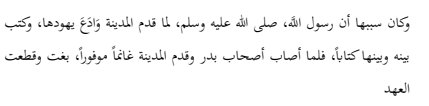
In this way Al-Baladhari clarifies that the peace agreement (Muwada’ah) with the Jews was written before the sending of the first raiding party (Saraya). That is whilst it is known that the Sariya (raiding party) of Hamza took place in Ramadan of the first year of Hijrah i.e. a year and some days before the battle of Badr. The battalion of Hamza was the first battalion formed by the Prophet (peace be upon him). Al-Baladhari stated in another place when talking about the expedition of Bani Qainuqaa’: “The reason for it was that the Messenger of Allah (peace be upon him), when he arrived in Al-Madinah, made a peace agreement with its Jews and wrote a document between himself and them. Then, when the Muslims were victorious at Badr and came back to Al-Madinah with abundant booty, the Jews rebelled and broke the covenant”. In this manner, Al- Baladhari asserted that the peace agreement with the Jews took place prior to Badr. At-Tabari said: “Then the Messenger of Allah (peace be upon him) remained in Al-Madinah after his return from Badr. When he had arrived in Al-Madinah he had made a peace agreement with its Jews upon the stipulation that they do not assist anyone against him and that if he was attacked in Al-Madinah by an enemy they would support him. Then when the Messenger of Allah (peace be upon him) killed those whom he had killed from the Mushrikin (polytheists) of Quraish, they demonstrated envy and rebelliousness towards him and demonstrated the breaching of the covenant”. In these Mutawatir (concurrent transmissions indicating decisiveness) testimonies, there is enough to establish preponderance to conclude that the peace agreement document with the Jews was written in the first year of the Hijrah. In addition, an analysis of its articles and texts indicate that they are not indicative of any tension between the Prophet (peace be upon him) and the Jews. As such, due to all of this, the claims of the Islamic encyclopaedia fall down and their doubts are refuted” [End of Quote].
As such, we find that this researcher, who has not been named, reversing the timing of the issues, placing the “Mu’akhaah” (formation of brotherhood) after Badr and the Sahifah prior to Badr, just as he has confused the issues objectively:
1) He, therefore took the “Mu’akhaah” (formation of brotherhood), through pure imagination, to be an independent document, which is contrary to the Mutawatir (decisive concurrent) transmissions which do not make any mention of a written document at all. 2) He then took this imaginary written document to be one of the two documents which the historians, according to his claim, forged into one single document. If he had only read the texts of the “Sahifah” related to the believers (i.e. the Muhajirin and the Ansar) he would not have found a single letter related to the “Mu’akhaah”, the inheritance between them or what resembles that in terms of individual affairs. Rather, he would have that it related to the regulation of the constitutional tribal relationships, general (public) security affairs, issues of blood money, the freeing of captives and what is similar to these. 3) He also mixed between the case of the original situation of peace and truce (Muwada’ah) with the Jews and others including all of states, nations, authorities, collectives, societies and tribes of the worlds and between the “confederal union” with the Jewish tribes which arose from the Sahifah. He came up with this mixing up without any basis.
The “Muwada’ah” (peace and truce) represents the original situation that the Prophet (peace be upon him) and his companions were upon with the whole world, including the criminal and hostile Quraish, when he arrived at Al-Madinah and prior to the revelation the statement of Allah ‘Azza Wa Jalla: