1.4 ¿Cuándo se concluyó la «Mu'ájaah» (pacto de hermandad) y cuándo se redactó la Sahifah (de Al-Madinah)?
1.4 When was the “Mu’akhaah” (brotherhood pact) concluded and when was the Sahifah (of Al-Madinah) written?
Los textos que ya se han presentado deberían ser suficientes, y de ellos deducimos lo siguiente:
The texts that have already been presented should be sufficient and from them we deduce the following:
1) La opinión correcta es que esta hermandad entre los Muhajirin y los Ansar no pudo haber tenido lugar antes de la muerte de As'ad bin Zurarah (que Allah esté complacido con él), durante la construcción de la Mezquita, unos siete meses después de la llegada del Profeta ﷺ. No es concebible que tuviera lugar en vida de As'ad sin que se le mencionara en ella, pues era el jefe de los Ansar y uno de los Naqeebs (líderes seleccionados de los Ansar en el segundo juramento de 'Aqabah). Por tanto, la afirmación de Abu 'Umar ibn Abd AlBarr:
1) The correct view is that this brotherhood between the Muhajirin and the Ansar could not possibly have taken place prior to the death of As’ad bin Zurarah (May Allah be pleased with him), during the building of the Masjid, about seven months following the arrival of the Prophet (peace be upon him). It is not conceivable that it took place in his lifetime without him having been mentioned in it, as he was chief of the Ansar and one of the Naqeebs (selected leaders of the Ansar at the second pledge of ‘Aqabah). Therefore, the statement of Abu ‘Umar ibn Abd AlBarr:
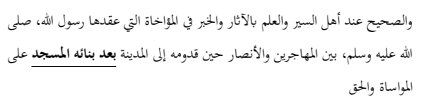
“La opinión correcta, tal como la sostienen los eruditos de la Seera y los relatos al respecto, es que la «Mu’akhaah» (fraternidad) que el Mensajero de Allah ﷺ concluyó entre los Muhajirin (emigrantes) y los Ansar (auxiliares), cuando llegó a Al-Madinah, tuvo lugar después de la construcción de la Mezquita por su parte, y se basó en la provisión de ayuda y apoyo y en el Haqq (la verdad)…”
“The correct view as held by the scholars of Seera and reports in respect to the “Mu’akhaah” (brotherhood) which the Messenger of Allah (peace be upon him) concluded between the Muhajirin (emigrants) and the Ansar (helpers), when he came to Al-Madinah, was that it took place after his building of the Masjid and it was upon the basis of the provision of assistance/support and the Haqq (truth) …” .
es muy concebible, y en particular, como culminación de la construcción de la mezquita y la celebración de su inauguración, representó una buena ocasión para llevar a cabo tal paso. Además, debió haberse realizado antes de la batalla de Badr, porque en él se menciona a Ubaida bin Al-Harith (bin Al-Muttalib bin Abd Manaf bin Qusayy Al-Qurashi Al-Muttalibi) junto con su hermano ‘Umair bin Al-Humam (bin Al-Jamuh bin Zaid bin Haram bin Ka’b), y ambos fueron martirizados en la batalla de Badr, que Allah esté complacido con ellos. Fueron hermanos en vida y en la muerte, y esperamos de Allah que también lo sean así el Día del Juicio. 2) La opinión correcta es que esta fraternidad entre los Muhajirin y los Ansar no fue escrita en origen, pues su naturaleza era incompatible con ello. Esto se debe a que todas las narraciones, sin excepción, no mencionan en absoluto un documento escrito. Un examen de los libros de Seera, historia y Hadiz revela la ausencia de cualquier mención de una carta, documento escrito o código anterior a la Sahifah de Al-Madinah. La excepción a eso incluyó:
is very conceivable, and particularly as the completion of the building of the Masjid and the celebration for its opening, represented a good occasion for such a step to be undertaken. I addition, it must have been undertaken prior to the battle of Badr because Ubaida bin Al- Harith (bin Al-Muttalib bin Abd Manaf bin Qusayy Al-Qurashi Al-Muttalibi) is mentioned in it along with his brother ‘Umair bin Al- Humam (bin Al-Jamuh bin Zaid bin Haram bin Ka’b) and they were both martyred at the battle of Badr, may Allah be pleased with them. They were brothers in life and at death, and we hope from Allah that they be like that also, on the Day of Judgement. 2) The correct view is that this brotherhood between the Muhajirin and the Ansar was not written in origin as its nature was incompatible with that. That is because all of the narrations, without exception, do not mention a written document at all. An examination of the books of Seera, history and Hadith reveal the absence of the mention of any charter, written document or code prior to the Sahifah of Al-Madinah. The exception to that included:
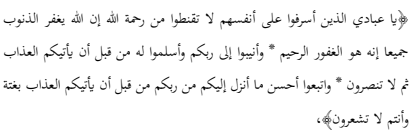
«Di: “¡Oh, Mis siervos que se han excedido contra sí mismos [pecando]! No desesperéis de la misericordia de Allah. Ciertamente, Allah perdona todos los pecados. Ciertamente, Él es el Perdonador, el Misericordioso”. Y volved [arrepentidos] a vuestro Señor y someteos a Él antes de que os alcance el castigo, pues entonces no seréis socorridos. Y seguid lo mejor de lo que os fue revelado de vuestro Señor antes de que os sobrevenga el castigo de repente, sin que lo percibáis» [TMQ 39:53-55].
“Say, “O My servants who have transgressed against themselves [by sinning], do not despair of the mercy of Allah. Indeed, Allah forgives all sins. Indeed, it is He who is the Forgiving, the Merciful”. And return [in repentance] to your Lord and submit to Him before the punishment comes upon you; then you will not be helped. And follow the best of what was revealed to you from your Lord before the punishment comes upon you suddenly while you do not perceive” [TMQ 39:53-55].
b) La Majallah de Luqmán: Al-Majallah y asimismo As-Sijli son un Sahifah (documento escrito) que se da vuelta, o (sus páginas) que se dan vuelta. Eso es como lo que aparece mencionado en “Dala’il An-Nubuwwah” de Al-Baihaqi (2/419). (Tras mencionar la cadena completa de transmisión) ‘Asim bin ‘Umar bin Qatadah Al-Ansaariy relató de los Shuyukh (ancianos) de su gente, quienes dijeron:
b) The Majallah of Luqman: Al-Majallah and likewise As-Sijli are a Sahifah (written document) that is turned or (its pages) turned over. That is like what came mentioned in “Dala’il An-Nubuwwah” of Al- Baihaqi (2/419). (After mentioning the full line of transmission) ‘Asim bin ‘Umar bin Qatadah Al-Ansaariy related from the Shuyukh (elders) of his people, that they said:
"Suwaid bin As-Samit, el hermano de los Bani ‘Amr bin ‘Awf, llegó a La Meca como peregrino para el Hayy o la ‘Umrah. Su gente lo describía como el modelo de perfección entre ellos, por su edad, su piel y su cabello. Él (el narrador) dijo:"
“Suwaid bin As-Samit, the brother of Bani ‘Amr bin ‘Awf, came to Makkah as a pilgrim for Hajj of ‘Umrah. Suwaid was described by his people as being the model of perfection among them, due to his age, skin and hair. He (the narrator) said:
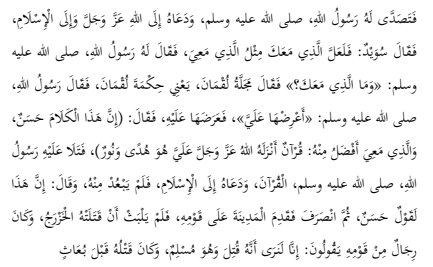
Entonces, el Mensajero de Allah ﷺ se acercó a él y lo invitó a Allah ‘Azza Wa Jalla y al Islam. Suwaid dijo: “Puede que lo que tú tienes sea como lo que yo tengo”. Entonces, el Mensajero de Allah ﷺ preguntó: “¿Y qué tienes tú?”. Él respondió que tenía la Majallah de Luqman, es decir, la Hikmah (sabiduría) de Luqman. El Mensajero de Allah ﷺ entonces dijo: “Muéstramela”, y así lo hizo. Él ﷺ dijo: “Este discurso es bueno, pero lo que yo tengo es mejor que él. Es un Corán que Allah ‘Azza Wa Jalla ha revelado, y es guía y luz”. Luego, el Mensajero de Allah ﷺ le recitó el Corán y lo invitó al Islam. Él no se apartó de ello y dijo: “Verdaderamente, este es un buen discurso”. Luego se marchó y más tarde llegó a Al-Madinah, con su gente. No mucho después, fue asesinado por los Khazraj. Había hombres de su gente que decían: “Consideramos que fue asesinado mientras era musulmán”, y su asesinato ocurrió antes de la guerra de Bu’ath” [Fin de la cita]. c) El Sahifah (documento escrito) del boicot (opresivo y maldito) que los Quraish colgaron dentro de la Ka’ba; su historia, la historia de las termitas que lo comieron y luego su conocida historia mutawatir acerca de su anulación. d) Las páginas (Suhuf) que el Mensajero de Allah ﷺ entregó a los comandantes de las expediciones militares, que contenían instrucciones, y que estaban selladas o unidas con parches. Un ejemplo de ello es lo que se menciona en el “Kitab ul-Maghazi” de Al-Waqidi (1/13):
Then, the Messenger of Allah (peace be upon him) approached him and invited him to Allah ‘Azza Wa Jalla and to Islam. Suwaid said: “It may be that what you have is like that which I have”. So, the Messenger of Allah (peace be upon him) asked: “And what do you have?” He responded by saying that he had the Majallah of Luqman, meaning the Hikmah (wisdom) of Luqman. The Messenger of Allah (peace be upon him) then said: “Show it to me” and so he did. He (peace be upon him) said: “This speech is good but what I have is better than it. It is a Qur’an that Allah ‘Azza Wa Jalla has revealed and it is guidance and light”. The Messenger of Allah (peace be upon him) then recited the Qur’an to him and invited him to Islam. He didn’t distance himself from it and said: “Verily, this is a good speech”. He then left and later arrived to Al-Madinah to his people. It was not long thereafter that he was killed by the Khazraj. There were men from his people who would say: “We view that he was killed whilst he was a Muslim” and his killing occurred before the war of Bu’ath” [End of Quote]. c) The Sahifah (written document) of the (oppressive and accursed) Boycott which the Quraish hung inside the Ka’ba along; its story, the story of the termites eating it and then its well-known Mutawatir story concerning its nullification. d) The pages (Suhuf) which the Messenger of Allah (peace be upon him) gave to the commanders of the military expeditions, containing instructions, and they were sealed or patched together. And example of that is what came stated in Al-Waqidi’s “Kitab ul-Maghazi” (1/13):
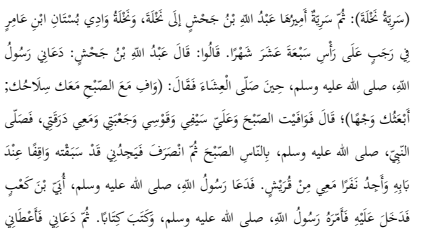
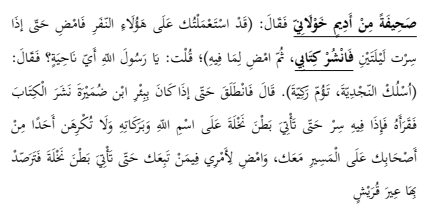
La expedición a Nakhla, comandada por Abdullah bin Jahsh (Nakhla es un valle en el Bustán (Huerto) de Ibn ‘Amir), tuvo lugar en el mes de Rayab, el decimoséptimo mes del calendario islámico (AH).
“The expedition to Nakhla commanded by Abdullah bin Jahsh (Nakhla is a valley in the Bustan (Orchard) of Ibn ‘Amir) took place in the month of Rajab, the seventeenth month AH.
Dijeron: Abdullah bin Jahsh dijo: El Mensajero de Allah ﷺ me llamó cuando oró la 'Isha', y me dijo: "Ven a mí al amanecer con tus armas, pues te enviaré en una misión". Dijo: Así que me presenté al amanecer con mi espada, mi arco, mi carcaj y mi escudo. El Profeta ﷺ hizo la oración del Subh (es decir, el Fayr) con la gente, y luego salió y me encontró. Me encontró ya delante de su puerta, habiéndose adelantado, mientras yo encontré allí conmigo a un grupo de los Quraysh (es decir, los Muhayirun). El Mensajero de Allah ﷺ llamó a Ubayy bin Ka'b y le ordenó que escribiera un documento. Luego me llamó a mí y me entregó la hoja de cuero de Khawlan, diciendo: "Te he designado al frente de este grupo. Avanza hasta haber viajado durante dos noches. Entonces abre mi carta y haz lo que dice". Le dije: "Oh Mensajero de Dios, ¿en qué dirección?". Él respondió: "Ve hacia Najdiyya hasta llegar a un pequeño pozo". El narrador dijo: Abdullah bin Jahsh se apresuró, hasta llegar al pozo de Ibn Dumayra. Entonces abrió la carta y la leyó. Decía: "Ve, en el nombre de Allah y con Sus bendiciones, hasta llegar al valle de Nakhla, pero no obligues a ninguno de tus compañeros a ir contigo. Procede según mis órdenes con quien te siga, hasta llegar al valle de Nakhla y acechar allí la caravana de los Quraysh" [Fin de la cita].
They said: Abdullah bin Jahsh said: The Messenger of Allah (peace be upon him) called for me when he prayed Ishaa’, and said: “Come to me at dawn with your weapons, as I will send you on a mission”. He said: So, I approached at dawn with my sword, my bow, my quiver and my shield. The Prophet prayed Subh (i.e. Fajr) with the people, and then he left and found me. He found me having preceded him already standing at his door whilst I found a group of the Quraysh (i.e. Muhajirun) with me there. The Messenger of Allah (peace be upon him) called for Ubayy bin Ka’b and commanded him to write a document. Then he called me and gave me the sheet of leather from Khawlan, saying: “I have appointed you over this group. Proceed until you have travelled for two nights. Then open my letter and do as it says”. I said: “O Messenger of God, in which direction?” He replied, “Go towards Najdiyya until you reach a small well”. The narrator said: Abdullah bin Jahsh hastened, until he reached the well of Ibn Dumayra. He then opened the letter and read it. It said: “Go, in the name of Allah and with His blessings, until you come to the valley of Nakhla, but do not force any one of your companions to go with you. Proceed according to my commands with whoever follows you, until you reach the valley of Nakhla and lie in wait for the caravan of Quraysh from there” [End of Quote].
Conclusión del resumen
Summary Conclusion
Siempre que encontramos una narración sobre una Sahifah o un documento escrito entre los Muhajirin y los Ansar, o relativo a los derechos de la diya (precio de la sangre), la guerra o la paz, sabemos, por necesidad, que no guarda relación con esta “Mu’akhaah” (formación de la hermandad). Estaría relacionado con la Sahifah de Al-Madinah o con algo que surgió o fue escrito mucho después de ella. Tampoco tiene validez lo que se relata en “As-Seera An-Nabawiyah” de Ahmad Abu Zaid (p. 71), bajo el epígrafe “La fecha de la redacción del tratado (Mu’ahadah) con los judíos”: “Uno de los investigadores contemporáneos consideró预ponderante que el documento era, en origen, dos documentos, y que después los historiadores los unieron en uno. Uno de ellos trataba del tratado del Mensajero de Allah ﷺ con los judíos y fue escrito antes de la gran batalla de Badr, mientras que el segundo aclaraba los compromisos (deberes) de los musulmanes, de los Muhajirin y de los Ansar, sus derechos y obligaciones. Dijo: ‘En mi opinión es preponderante que el documento del acuerdo de paz (Muwada’ah) con los judíos fue escrito antes de la gran batalla de Badr. En cuanto al segundo documento, fue escrito después de ella’”. Las fuentes clásicas han expresado lo que respalda esta preponderancia. Abu ‘Ubaid Al-Qasim bin Salam dijo: “El Wathiqa (documento) se redactó en dos ocasiones: cuando el Profeta ﷺ llegó a Al-Madinah, antes de la preeminencia del Islam y de su fortalecimiento, y antes de que se le ordenara tomar la Jizyah de Ahl ul-Kitab (la gente del Libro)”. Al-Baladhari dijo: “Cuando el Mensajero de Allah ﷺ llegó a Al-Madinah, hizo un tratado (Muwada’ah) con los judíos y escribió entre él y ellos un documento. Estipuló para ellos que no apoyarían ni se aliarían con sus enemigos, que le ayudarían contra quienes lo atacaran, y que él no combatiría en defensa de los Ahl udh-Dhimmah”. No luego hizo la guerra contra nadie, ni lo difamaron, ni envió una expedición militar, hasta que Allah ‘Azza Wa Jalla reveló: “Se ha dado permiso [para combatir] a quienes son combatidos, porque fueron oprimidos. Y ciertamente, Allah es capaz de concederles la victoria. [Son] aquellos que fueron expulsados de sus hogares sin razón alguna” (TMQ 22:39-40)”.
Wherever we find a narration about a Sahifah or a written document between the Muhajirin and the Ansar, or concerning blood money rights, war or peace, we know, by necessity, that it bears no relation to this “Mu’akhaah” (formation of brotherhood). It would either be related to the Sahifah of Al-Madinah or something that came or was written (much) later than it. There is also no validity in what came related in “As-Seera An- Nabawiyah” by Ahmad Abu Zaid (p. 71) under the heading “The date of the writing of the treaty (Mu’ahadah) with the Jews”: “One of the contemporary researchers found preponderant that the document was actually two documents in origin and then the historians combined them into one. One of them dealt with the treaty of the Messenger of Allah (peace be upon him) with the Jews and was written prior to the great battle of Badr. That is whilst the second clarified the commitments (duties) of the Muslims from the Muhajirin and the Ansar, their rights and obligations. He said: “It is preponderant in my view that the peace agreement (Muwada’ah) document with the Jews was written before the great battle of Badr. As for the second document, then it was written after it”. The classical sources have expressed that which supports this preponderance. Abu ‘Ubaid Al-Qasim bin Salam said: “The Wathiqa (document) was written on two occurrences, when the Prophet (peace be upon him) arrived in Al-Madinah, prior to the dominance of Islam and its becoming strong and before he was commanded to take the Jizyah from Ahl ul-Kitab (the people of the book)”. Al-Baladhari said: “When the Messenger of Allah (peace be upon him) arrived in Al-Madinah he made a treaty (Muwada’ah) with the Jews and wrote between himself and them a document. He stipulated upon them that they should not support or side with his enemies, to support him against those who attack him and that he would not fight in defence of the Ahl udh-Dhimmah. He did not then wage war against anyone, they did not defame him and he did not dispatch a military expedition, until Allah ‘Azza Wa Jalla revealed: “Permission [to fight] has been given to those who are being fought, because they were wronged. And indeed, Allah is capable of providing them victory. [They are] those who have been evicted from their homes without right” (TMQ 22:39- 40)”.

«Se ha concedido permiso [para combatir] a quienes están siendo atacados, porque fueron agraviados. Y ciertamente, Allah es capaz de concederles la victoria.»
“Permission [to fight] has been given to those who are being fought, because they were wronged. And indeed, Allah is capable of providing them victory.
«[Son] aquellos que han sido expulsados de sus hogares sin derecho» [TMQ 22:39-40]
[They are] those who have been evicted from their homes without right” [TMQ 22:39-40]
Eso se debe a que la "Muwada'ah" (paz y tregua) es la situación natural y original, y no necesita ser convocada para establecerse. Entonces, si estallara una guerra, la "Muwada'ah" cesaría y no volvería hasta que la guerra terminara mediante una tregua, un tratado o un acuerdo de paz.
That is because the “Muwada’ah” (peace and truce) is the natural and original situation and is not in need of being convened in order to establish it. Then, if war was to take place, the “Muwada’ah” would cease and it would not return until the war ends by way of a truce, treaty or peace agreement.
En consecuencia, la «Muwada'ah» representa un estado que puede estar presente o ausente. Por lo tanto, la declaración del Mensajero de Allah ﷺ: «Dejad a los abisinios en paz mientras ellos os dejen en paz» significa necesariamente: afirmar y mantener el statu quo de la Muwada'ah (paz y tregua) mientras Abisinia lo haga. Así, en lo que respecta a la expresión empleada por los eruditos de la Sira y a los relatos sobre el Profeta ﷺ, como: «Cuando llegó a Al-Madinah hizo la paz con todos los judíos que residían allí», no es admisible entender que estableció una «Muwada'ah» oficial o que firmó un pacto (tratado oficial). Más bien, significa que afirmó y mantuvo el statu quo original de tregua y paz existente entre ellos.
Consequently, the “Muwada’ah” represents a status that could be present or absent. Therefore, the statement of the Messenger of Allah (peace be upon him): “Leave the Abyssinians be as long as they leave you be” means by necessity: Affirm and continue upon the status quo of the Muwada’ah (peace and truce) as long as Abyssinia does so. As such, in respect to the statement used by the scholars of Seera and reports concerning the Prophet (peace be upon him) like: “When he arrived in Al-Madinah he made peace with all of the Jews who were residing there”, it is not permissible to be understood to mean that he established an official “Muwada’ah” or contracted a covenant (official treaty). Rather, it means that he affirmed and continued upon the original status quo of the truce and peace existing between them.
Si prestáramos atención a lo que se transmite de él (la paz sea con él): «Si hubiera mantenido lo que mantuvo quien compartía su opinión distinta a la suya, no lo habrían asesinado. Sin embargo, nos insultó y se burló de nosotros mediante poesía, y ninguno de ustedes habría hecho eso a menos que tuviera una espada», veríamos que confirma perfectamente esta postura nuestra. Esto se debe a que no se menciona nada en ello sobre un pacto o tratado que Ka'b bin Al-Ashraf hubiera quebrantado. Más bien, no persistió en la paz (muwada'ah) ni la ratificó, como sí habían hecho otros. El Imam Ibn ul-Qayyim (que la misericordia de Allah sea con él) conocía parte de esto. Lo expuso en su libro «Ahkam Ahu dh-Dhimmah» (3/1404):
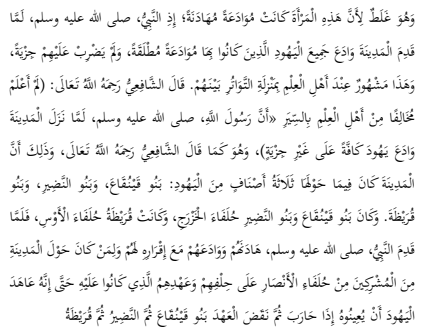
“Y esto es un error, porque esta mujer estaba en paz y bajo una tregua (Muhadanah). Esto se debe a que cuando el Profeta ﷺ llegó a Al-Madinah, hizo la paz con todos los judíos que residían allí, sin restricciones, y no les impuso la Jizyah. Esto es bien conocido por los eruditos hasta el nivel de Tawatur (transmisión concurrente decisiva) entre ellos. Ash-Shafi’iy (que la misericordia de Allah sea con él) dijo: ‘No conozco a ninguno de los eruditos de la Sira que discrepe sobre el punto de que cuando el Mensajero de Allah ﷺ se estableció en Al-Madinah, hizo la paz con todos los judíos sin imponerles la Jizyah’. Es como dijo Ash-Shafi’iy (que la misericordia de Allah sea con él). Esto se debe a que Al-Madinah tenía tres grupos de judíos a su alrededor: Banu Qainuqaa’, Banu An-Nadir y Banu Quraizha. Banu Qainuqaa’ y Banu An-Nadir eran aliados de los Jazray, mientras que Banu Quraizha eran aliados de los Aus. Luego, cuando el Mensajero de Allah ﷺ llegó a Al-Madinah, hizo una tregua y paz con ellos, con su aprobación, junto con quienes en torno a Al-Madinah eran politeístas y aliados de los Ansar, sobre la base de la alianza y el pacto que tenían previamente. Incluso tomó un juramento a los judíos de que lo apoyarían si era atacado. Después, Banu Qainuqaa’ rompió el pacto, seguido por An-Nadir y luego Quraizha’.” [Fin de la cita]”
“And it is a mistake because this woman was at peace and under a truce (Muhadanah). That is because when the Prophet (peace be upon him) came to Al-Madinah he made peace with all of the Jews residing there an unrestricted manner and he did not impose Jizyah upon them. This is well-known by the people of knowledge to the level of Tawatur (decisive concurrent transmission) among them. Ash- Shafi’iy (may Allah’s mercy be upon him) said: “I do not of any from the people of knowledge of Seera who disagree upon the point “That when the Messenger of Allah (peace be upon him) settled in Al- Madinah, he made peace with all of the Jews without the imposition of the Jizyah”. It is as Ash-Shafi’iy (May Allah’s mercy be upon him) stated. That is because Al-Madinah had three groups of Jews surrounding it: Banu Qainuqaa’, Banu An-Nadir and Banu Quraizha. Banu Qainuqaa’ and Banu An-Nadir were allies of the Khazraj, while Banu Quraizha were allies of the Aws. Then when the Messenger of Allah (peace be upon him) came to Al-Madinah, he made a truce and peace with them with his approval of them, alongside those who were around Al-Madinah from the polytheists who were allies of the Ansar, upon the basis of their alliance and covenant that they had previously been upon. He even took a covenant from the Jews that they would support him if he was fought against. Then, Banu Qainuqaa’ broke the covenant, followed by An-Nadir and then Quraizha” [End of Quote].
Incluso si algunas de las expresiones utilizadas aquí no eran quizás las más precisas, como su afirmación de que la mujer judía estaba bajo una "tregua" (Muhadanah), cuando en realidad ni siquiera había habido combate alguno para que una tregua entrara en vigor después. Puede que esto fuera simplemente un desliz de expresión.

"La Wathiqa (documento) fue redactada en dos ocasiones (Hadathani), cuando el Profeta ﷺ llegó a Al-Madinah, antes de la preponderancia del Islam, de que se fortaleciera y antes de que se le ordenara cobrar la Jizyah a Ahl ul-Kitab (la gente del Libro)."
“The Wathiqa (document) was written on two occurrences (Hadathani), when the Prophet (peace be upon him) arrived in Al- Madinah, prior to the dominance of Islam and its becoming strong and before he was commanded to take the Jizyah from Ahl ul-Kitab (the people of the book)” .
La palabra «Hadathani» no nos establece un marco temporal determinado que pueda tomarse en consideración, por lo que resulta vaga. El Islam solo se manifestó de forma generalizada y verdaderamente se volvió poderoso tras la derrota de los coligados (al-Ahzab, es decir, la batalla de la trinchera). Esto se debe a que el Profeta ﷺ comenzó a pasar a la ofensiva contra la gente, y ellos ya no estaban a la ofensiva contra él. Además, no sabemos cuándo se le ordenó tomar la yizya de la gente. Mientras tanto, su afirmación «toma la yizya de los Ahl al-Kitab (la gente del Libro)» es la repetición de un error conocido, pues la verdad es que la yizya se tomaba incluso a los politeístas, incluidos los majus, como se indica en el hadiz de An-Nu'man bin Muqarrin, recogido en el Sahih de Muslim y en otras colecciones. 2) En cuanto a la afirmación de al-Baladhari
is vague because the word “Hadathani” does not establish for us a determined time frame that can be taken into consideration. Islam only manifested in a prevalent manner and truly became powerful following the defeat of the confederates (Ahzab i.e. battle of the trench). That is because the Prophet (peace be upon him) began to go on the offensive against the people and they were no longer on the offensive against him. In addition, we do not know when he was commanded to take the Jizyah from the people. That is whilst his statement “take the Jizyah from Ahl ul-Kitab (the people of the book)” is a repetition of a well-known error, as the truth is that the Jizyah was taken even from the polytheists, including the Majus, as has come stated in the Hadith of An-Nu’man bin Muqarrin, recorded in Sahih Muslim and other collections. 2) As for the statement of Al-Baladhari
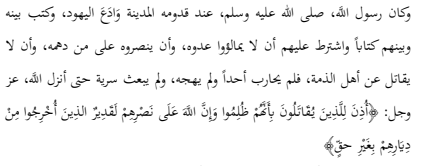
Cuando el Mensajero de Allah ﷺ llegó a Al-Madinah, hizo un pacto (Muwada’ah) con los judíos y redactó entre él y ellos un documento. Estipuló para ellos que no apoyarían ni se aliarían con sus enemigos, que le ayudarían contra quienes lo atacaran, y que él no lucharía en defensa del Ahl udh-Dhimmah. Entonces no declaró la guerra a nadie, ellos no lo difamaron y él no envió ninguna expedición militar, hasta que Allah ‘Azza Wa Yalla reveló: “Se ha permitido [combatir] a quienes son atacados, porque han sido agraviados. Y, ciertamente, Allah tiene poder para darles la victoria. [Son] aquellos que fueron expulsados de sus hogares sin razón alguna” (TMQ 22:39-40)”.
“When the Messenger of Allah (peace be upon him) arrived in Al- Madinah he made a treaty (Muwada’ah) with the Jews and wrote between himself and them a document. He stipulated upon them that they should not support or side with his enemies, to support him against those who attack him and that he would not fight in defence of the Ahl udh-Dhimmah. He did not then wage war against anyone, they did not defame him and he did not dispatch a military expedition, until Allah ‘Azza Wa Jalla revealed: “Permission [to fight] has been given to those who are being fought, because they were wronged. And indeed, Allah is capable of providing them victory. [They are] those who have been evicted from their homes without right” (TMQ 22:39-40)”.
Este discurso es contradictorio, porque el Profeta ﷺ no había recibido en origen permiso para participar en combates antes de la revelación del aleya, y no se encontraba en estado de guerra con nadie. Tampoco había expectativa de que Al-Madinah fuera atacada. Por tanto, la frase de su discurso: "Estipuló con ellos que no apoyarían ni se aliarían con sus enemigos, para apoyarle contra quienes le atacaran", que resumía parte de lo establecido en la "Sahifah", es inconcebible y carece de realidad en aquel período. Aún más atroz es la afirmación: "Y que él no combatiría en defensa de los Ahl udh-Dhimmah", suponiendo que no hubiera error en la impresión. En primer lugar, no había en origen "Ahl udh-Dhimmah" allí. En segundo lugar, ¿cómo puede ser que ellos estén obligados a apoyarle contra quienes le atacan, mientras que él no está obligado a apoyarlos contra quienes los atacan? 3) La afirmación de Al-Baladhariy acerca de Banu Qainuqaa':
This speech is contradictory because he (peace be upon him) had not been permitted in origin to engage in fighting prior to the revelation of the Aayah and was not in a state of war with anyone. There was also no expectation for Al-Madinah to be attacked. Therefore, the sentence from his speech: “He stipulated upon them that they should not support or side with his enemies, to support him against those who attack him”, which summarized some of what came stated in the “Sahifah”, is inconceivable and has no reality to it during that time period. Even more atrocious is the statement: “And that he would not fight in defence of the Ahl udh-Dhimmah”, assuming there was no error in the printing. Firstly, there were no “Ahl udh-Dhimmah” there in origin. Secondly, how could it be that they are obliged to support him against those who attack him, whilst he is not obliged to support them against those who attack them?! 3) The statement of Al-Baladhariy concerning Banu Qainuqaa’:
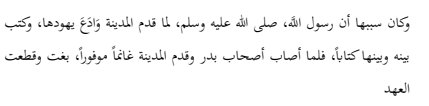
«La razón de ello fue que el Mensajero de Allah ﷺ, cuando llegó a Al-Madina, firmó un acuerdo de paz con sus judíos y redactó un documento entre él mismo y ellos. Luego, cuando los musulmanes fueron victoriosos en Badr y regresaron a Al-Madina con abundante botín, los judíos se rebelaron y rompieron el pacto», entonces esto tampoco tiene sentido. Esto se debe a que la «Muwada'ah» (estado de paz) es el origen y no necesita ser contratada mutuamente de manera oficial ni ser puesta por escrito. Mientras tanto, Ka'b bin Al-Ashraf fue el primero en transgredir, en hacer la guerra y en cortar la «Muwada'ah» (estado de paz o tregua), la cual, como se mencionó anteriormente, ha sido establecida mediante transmisiones Mutawatir (concurrentes y decisivas), y luego redactó la «Sahifah», que no tenía por objeto establecer una «Muwada'ah», sino más bien establecer una «Unión Confederal (Ittihad Confedarali)». Después, Banu Qainuqa' salió de la «unión» y declaró la guerra, seguidos por Banu An-Nadir, y luego Quraiza la traicionó. 4) Con respecto a la afirmación de At-Tabari:
“The reason for it was that the Messenger of Allah (peace be upon him), when he arrived in Al-Madinah, made a peace agreement with its Jews and wrote a document between himself and them. Then, when the Muslims were victorious at Badr and came back to Al- Madinah with abundant booty, the Jews rebelled and broke the covenant”, then this also has no meaning to it. That is because the “Muwada’ah” (state of peace) is the origin and does not need to be officially mutually contracted or write. That is while Ka’b bin Al-Ashraf was the first to transgress, war and cut the “Muwada’ah” (state of peace or truce) which, as previously mentioned, has been established via Mutawatir (decisive concurrent) transmissions and he then wrote the “Sahifah” which was not the purpose of establishing a “Muwada’ah” but rather to establish a “Confederal Union (Ittihad Confedarali)”. Thereafter, Bani Qainuqaa’ exited from the “union” and waged war, followed by Banu An-Nadir and then Quraizhah betrayed it. 4) Concerning the statement of At-Tabari:
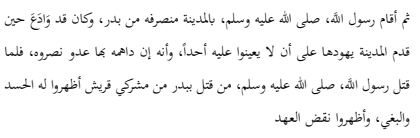
«Luego el Mensajero de Allah ﷺ permaneció en Al-Madinah tras su regreso de Badr. Cuando había llegado a Al-Madinah, había hecho un pacto de paz con sus judíos, con la condición de que no ayudaran a nadie contra él y de que, si un enemigo lo atacaba en Al-Madinah, ellos lo apoyarían. Entonces, cuando el Mensajero de Allah ﷺ mató a aquellos de los mushrikin (politeístas) de Quraysh a quienes mató, ellos mostraron envidia y rebeldía hacia él y mostraron la violación del pacto».
“Then the Messenger of Allah (peace be upon him) remained in Al- Madinah after his return from Badr. When he had arrived in Al- Madinah he had made a peace agreement with its Jews upon the stipulation that they do not assist anyone against him and that if he was attacked in Al-Madinah by an enemy, they would support him. Then when the Messenger of Allah (peace be upon him) killed those whom he had killed from the Mushrikin (polytheists) of Quraish, they demonstrated envy and rebelliousness towards him and demonstrated the breaching of the covenant”,
Así pues, esto concuerda con el discurso de Al-Baladhariy citado arriba, y la refutación es la misma, aunque es mucho mejor. Esto se debe a que él no afirmó que la antigua «Muwada'ah» (acuerdo de paz/tregua), anterior a Badr, fuera un documento escrito, como Al-Baladhariy incurrió en el error, y tampoco su texto incluye nada equivalente a la atroz frase «Y que no lucharía en defensa de los Ahl udh-Dhimmah». Pese a ello, la afirmación de At-Tabari «violación del pacto (Naqdh Al‘Ahd)» no encaja con la realidad. Esto se debe a que no existía en origen un «Ahd» (pacto), sino una «Muwada'ah» en su estado original. A menos que consideremos que su aceptación y adhesión a ella equivalía implícitamente a un «Ahd» (pacto/tratado)?! Tal como sostiene Ahmad Abu Zaid:
then it is in line with the speech of Al-Baladhariy above and the refutation to it is the same, although it is much better. That is because he did not assert that the old “Muwada’ah” (agreement of peace/truce), prior to Badr, was a written document, as Al-Baladhariy slipped up in, just as his text does not include something equal to the atrocious sentence “And that he would not fight in defence of the Ahl udh-Dhimmah”. Despite that, the statement of At-Tabari “breaching of the covenant (Naqdh Al‘Ahd)” is not something that fits with reality. That is because there was no prior “Ahd” (covenant) in origin but rather a “Muwada’ah” upon its original state. That is unless we were to consider its acceptance and adherence to it as being an “Ahd” (Covenant/treaty) implicitly?! As the statement of Ahmad Abu Zaid:

"En estos testimonios mutawatir (transmisiones concurrentes que indican certeza), hay suficiente para establecer la preponderancia y concluir que el documento del acuerdo de paz con los judíos fue redactado en el primer año de la Hégira. Además, un análisis de sus artículos y textos indica que no evidencian ninguna tensión entre el Profeta ﷺ y los judíos. Así pues, por todo ello, las afirmaciones de la enciclopedia islámica se derrumban y sus dudas quedan refutadas", y en ella hay errores significativos, de hecho fatales.
“In these Mutawatir (concurrent transmissions indicating decisiveness) testimonies, there is enough to establish preponderance to conclude that the peace agreement document with the Jews was written in the first year of the Hijrah. In addition, an analysis of its articles and texts indicate that they are not indicative of any tension between the Prophet (peace be upon him) and the Jews. As such, due to all of this, the claims of the Islamic encyclopaedia fall down and their doubts are refuted”, then there are significant, indeed fatal errors in it.
1) Las afirmaciones u opiniones de los historiadores no se consideran testimonios (shahada), salvo que procedan de un testigo contemporáneo (de primera mano). De lo contrario, tal opinión no es más que una apreciación basada en información o premisas correctas o incorrectas. Un gran número de opiniones coincidentes o semejantes no se denomina Tawatur (es decir, establecido de manera definitiva por transmisión concurrente), y no tienen el valor de testimonios decisivos (Tawatur) de afirmación.
1) The statements or views of the historians are not called testimonies (shahada) unless it is from a contemporary (first-hand) witness. Otherwise, such a view is merely an opinion based upon correct or incorrect information or premises. A large number of conforming or similar opinions is not called Tawatur (i.e. established definitely by concurrent transmission) and they do not hold the value of Tawatur (decisive) testimonies of affirmation.
2) Algunas constituciones pueden redactarse tras una guerra civil y, sin embargo, sus textos no reflejan la existencia de tensión alguna entre las partes implicadas. Esto se debe a que la finalidad de la constitución es establecer la regulación del Estado (es decir, si es de forma unitaria o federal, etc.). Así pues, la fecha de la tensión o del conflicto que ocurrió antes de ella no se escribe ni se menciona en su interior. En consecuencia, en relación con la afirmación «Los textos no son indicativos de tensión alguna entre el Profeta ﷺ y los judíos», lo contrario también es correcto. Esto se debe a que la redacción de una constitución confederal o de un tratado internacional no constituye, por sí misma, una prueba de la existencia de una tensión, un conflicto o una guerra que la precediera. Pudo haberlos habido, como también pudo no haberlos habido. Esto solo podría conocerse mediante otros indicios históricos, que se examinan de forma independiente del documento objeto de estudio, o a partir de los propios textos del documento que indiquen el fin de un conflicto, el cese de las hostilidades o la solución de cuestiones de compensaciones y de precios de sangre, etc. El ustadh Ahmad Abu Zaid desea refutar las afirmaciones de la «Enciclopedia Islámica», que él mismo había formulado poco antes en «As-Seera An-Nabawiyah», de Ahmad Abu Zaid (p. 70), de la siguiente manera:
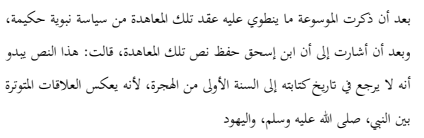
“Después de que la enciclopedia mencionara lo que la firma de aquel tratado (Mu’ahadah) contenía en cuanto a la sabia política profética, y después de indicar que Ibn Ishaq había conservado el texto de ese tratado, afirmó: Parece que este texto no se remonta, en cuanto a la fecha de su redacción, al primer año de la Hégira, porque refleja las tensas relaciones entre el Profeta ﷺ y los judíos”.
“After the encyclopaedia mentioned what the contracting of that treaty (Mu’ahadah) contained in terms of wise prophetic policy making and after it indicated to Ibn Ishaq having preserved the text of that treaty, it stated: It appears that this text does not go back, in respect to the date of its writing, to the first year of the Hijrah, because it reflects the tense relations between the Prophet (peace be upon him) and the Jews”.
En realidad, la Sahifah de Medina fue redactada a comienzos del tercer año de la Hégira, con base en la evidencia de los textos históricos transmitidos que presentamos anteriormente. Por tanto, la enciclopedia acertó en este asunto. En cuanto a la deducción de los orientalistas, autores de la enciclopedia, de que el texto (es decir, la Sahifah)
The truth is that the Sahifah of Al-Madinah was written at the beginning of the third year of Hijrah based upon the evidence of the historical transmitted texts that we have presented earlier. As such, the encyclopaedia was correct regarding this matter. As for the deduction of the orientalists, who are the authors of the encyclopaedia, that the text (i.e. Sahifah)

reflejaban las tensas relaciones entre el Profeta ﷺ y los judíos
“reflected tense relations between the Prophet (peace be upon him) and the Jews”, .
Entonces esto no resulta convincente y está fuera de lugar. La gente ha dado rienda suelta a su imaginación aquí. Pues la historia no es más que sucesos y realidades que ya han pasado, y sus relatos deben tomarse de testigos presenciales y de registros de quienes vivieron en aquella época, no de imaginaciones ni siquiera de deducciones lógicas. Es cierto que las circunstancias que rodearon la redacción de la Sahifah revelan que fue escrita debido a la aparición de una tensión en las relaciones con algunos judíos (Ka'b ibn al-Ashraf en concreto). Sin embargo, su texto no incluye nada que indique una tensión o conflicto previo, ¡ni siquiera remotamente!
then this is not convincing and out of place. People have given free reign to their imaginations here. That is whilst history is merely events and realities that have passed by and its reports must be taken from first-hand witnesses and records of those living at the time, not from imaginations or even logical deductions. Yes, it is true that the circumstances surrounding the writing of the Sahifah reveal that it was written due to the occurrence of a tension in the relations with some of the Jews (Ka’b in Al-Ashraf specifically). However, its text does not include anything indicating to any prior tension or conflict and not even remotely!