5.5 Equidad hacia Kathir bin Abdullah bin ‘Amr bin ‘Awf Al-Muzani
5.5 Fairness to Kathir bin Abdullah bin ‘Amr bin ‘Awf Al- Muzani
- Lo siguiente se encuentra en “Taqrib At-Tahdhib” [Ibn Hajar] (1/460/5617): [Kathir bin Abdullah bin ‘Amr bin ‘Awf Al-Muzani Al-Madani es Da’if (débil). Quienes le atribuyeron mentir fueron excesivos. (Pertenecía a) la séptima (es decir, generación o línea de transmisión)].
- The following came stated in in “Taqrib At-Tahdhib” [Ibn Hajar] (1/460/5617): [Kathir bin Abdullah bin ‘Amr bin ‘Awf Al-Muzani Al- Madani is Da’if (weak). Those who attributed lying to him were excessive. (He was from) the seventh (i.e. generation or line of transmission)].
- Sin embargo, en “Irwaa’ Al-Ghalil”, de Al-Albani (5/155), se afirmó lo siguiente: [Al-Hafizh (es decir, ibn Hajar) dijo [en Al-Fat’h – (4/371)]: [Y Kathir bin Abdullah es Da’if según la opinión de la mayoría; sin embargo, Al-Bukhari y quienes lo siguieron, como At-Tirmidhi e Ibn Khuzaimah, fortalecen su caso (o su estatus)].
- However, in “Irwaa’ Al-Ghalil”, by Al-Albani (5/155), the following was stated: [Al-Hafizh (i.e. ibn Hajar) said [in Al-Fat’h – (4/371)]: [And Kathir bin Abdullah is Da’if in the view of the majority however Al- Bukahri and those who followed him like At-Tirmidhi and Ibn Khuzaimah strengthen his affair (or status)].
- Lo siguiente aparece registrado en “At-Tarikh Al-Kabir” [Al-Bujari] (7/217/945): [Kazir bin Abdullah bin ‘Amr bin ‘Awf Al-Muzani Al-Madani escuchó (o recibió de) su padre, mientras que Marwan bin Mu’awiyah, Isma’il bin Abu Uwais y Yahya Al-Ansari transmitieron de él]. Aparece también en otra edición de “At-Tarikh Al-Kabir” de Al-Bujari (7/96/945). ¡Al-Bujari no lo calificó de Da’if (débil) y no habló de él, ni siquiera una sola letra! - Lo siguiente aparece declarado en “Al-Jarh Wa At-Ta’dil” [Ibn Abu Hatim] (7/154/858): [Kazir bin Abdullah bin ‘Amr bin ‘Awf Al-Muzani transmitió de su padre, además de Muhammad bin Ka’b y Rubaih bin Abdur Rahman, mientras que Abdul ‘Aziz bin Muhammad, Marwan bin Mu’awiyah, Ma’n bin ‘Eisa, Abdullah bin Wahb, Abdullah bin Nafi’ As-Sa’igh, Muhammad bin Khalid bin ‘Athma, Abu ‘Amir Al-‘Aqadiy, Khalid bin Makhlad, Ibn Qa’nab e Ibn Abu Uwais transmitieron de él. Oí a mi padre decir eso. Abdur Rahman nos transmitió de Muhammad bin Hamawaih bin Al-Hasan, quien dijo: Oí a Abu Talib decir: Pregunté a Ahmad (es decir, Ahmad bin Hanbal) acerca de Kazir bin Abdullah bin ‘Amr bin ‘Awf y dijo: “Munkar (es decir, rechazable por defecto en cuanto al Hadiz), sin valor”. Abdur Rahman nos transmitió: Dijo: Se leyó ante Al-‘Abbas bin Muhammad Ad-Dawri, de Yahya bin Ma’een, que dijo: “Kazir bin Abdullah Al-Muzani es Da’if (débil) en el Hadiz”. Abdur Rahman nos transmitió. Dijo: Le pregunté a Abu Zur’ah sobre Kazir bin Abdullah bin ‘Amr bin ‘Awf. Dijo: “Débil en el Hadiz y no fuerte”. Le dije: De Bahz bin Hakim, Abdul Muhaimin y Kazir bin Abdullah, ¿cuál de ellos es el más querido para ti? Dijo: “Bahz y Abdul Muhaiman me son más queridos que él”. Abdur Rahman nos transmitió: Dijo: Le preguntaron a mi padre sobre Kazir bin Abdullah bin ‘Amr bin ‘Awf, y dijo: “No es sólido/fuerte (Matin)”.
- The following came recorded in “At-Tarikh Al-Kabir” [Al-Bukhari] (7/217/945): [Kathir bin Abdullah bin ‘Amr bin ‘Awf Al-Muzani Al- Madani listened to (or received from) his father, while Marwan bin Mu’awiyah, Isma’il bin Abu Uwais and Yahya Al-Ansari related from him]. It is recorded in another edition of “At-Tarikh Al-Kabir” by Al- Bukhari (7/96/945). Al-Bukhari did not classify him as Da’if (weak) and he did not speak about him, not even a single letter! - The following came stated in “Al-Jarh Wa At-Ta’dil” [Ibn Abu Hatim] (7/154/858): [Kathir bin Abdullah bin ‘Amr bin ‘Awf Al-Muzani related from his father in addition to Muhammad bin Ka’b and Rubaih bin Abdur Rahman, while Abdul ‘Aziz bin Muhammad, Marwan bin Mu’awiyah, Ma’n bin ‘Eisa, Abdullah bin Wahb, Abdullah bin Nafi’ As-Sa’igh, Muhammad bin Khalid bin ‘Athma, Abu ‘Amir Al-‘Aqadiy. Khalid bin Makhlad, Ibn Qa’nab and Ibn Abu Uwais related from him. I heard my father saying that. Abdur Rahman related to us from Muhammad bin Hamawaih bin Al-Hasan who said: I heard Abu Talib who said: I asked Ahmad (meaning Ahmad bin Hanbal) concerning Kathir bin Abdullah bin ‘Amr bin ‘Awf and he said: “Munkar (i.e. rejectable due to defectiveness in respect to) Al-Hadith, of no worth”. Abdur Rahman related to us: He said: It was read to Al-‘Abbas bin Muhammad Ad- Dawri from Yahya bin Ma’een That he said: “Kathir bin Abdullah Al- Muzani is Da’if (weak) in Hadith”. Abdur Rahman related to us. He said: I asked Abu Zur’ah about Kathir bin Abdullah bin ‘Amr bin ‘Awf. He said: “Feeble/weak in Hadith and not strong”. I said to him: Out of Bahz bin Hakim, Abdul Muhaimin and Kathir bin Abdullah, which of them is the most beloved to you? He said: “Bahz and Abdul Muhaiman are more beloved to me than him”. Abdur Rahman related to us: He said: My father was asked about Kathir bin Abdullah bin ‘Amr bin ‘Awf and he said: “He is not solid/strong (Matin)”.
Esta afirmación "No es sólido/fuerte (Matin)" no es como la afirmación "No es Qawiy (fuerte)", y no es sinónimo de la afirmación "Da'if" (débil). Esto se debe a que el narrador "Matin" es quien ha alcanzado la cumbre en cuanto a fortaleza y fiabilidad. - Las afirmaciones contradictorias aparecen expuestas en "Tarikh ul-Islam" (10/224/330): [Kathir bin Abdullah bin 'Amr bin 'Awf bin Zaid bin Talha Al-Yashkuri Al-Muzani Al-Madani … Narró de su padre y de su abuelo (por transcripción), además de Nafi' y Muhammad bin Ka'b Al-Qurazhi. Y narraron de él lo siguiente: Ibn Wahb, Abdullah bin Nafi', Al-Qa'nabi, Isma'il bin Abi Uwais y Khalq.
I say: This statement “He is not solid/strong (Matin)” is not like the statement “He is not Qawiy (strong))” and it is not synonymous with the statement “Da’if” (weak). That is because the “Matin” narrator is the one who has reached the pinnacle in respect to strength and reliability. - Contradictory statements came stated in “Tarikh ul-Islam” (10/224/330): [Kathir bin Abdullah bin ‘Amr bin ‘Awf bin Zaid bin Talha Al-Yashkuri Al-Muzani Al-Madani … He related from his father and from his grandfather (by transcript), in addition to Nafi’ and Muhammad bin Ka’b Al-Qurazhi. And the following related from him: Ibn Wahb, Abdullah bin Nafi’, Al-Qa’nabi, Isma’il bin Abi Uwais and Khalq.
Estuvieron de acuerdo en su clasificación de debilidad, y Ahmad bin Hanbal rechazó sus hadices.
They agreed upon his classification of weakness and Ahmad bin Hanbal rejected his Hadith.
Ash-Shafi'iy dijo: Es uno de los pilares de Al-Kadhib (la mentira/falsedad). Abu Dawud dijo algo similar a eso.
Ash-Shafi’iy said: He is a pillar from among the pillars of Al-Kadhib (deceit/untruth). Abu Dawud said similar to that.
Abbas relató de Ibn Ma'een (es decir, Kathir es): «Da'if (débil)». Ad-Darimiy relató de Ibn Ma'een: No tiene valor alguno.
‘Abbas related from Ibn Ma’een (that he i.e. Kathir is): “Da’if (weak)”. Ad-Darimiy related from Ibn Ma’een: He has no worth.
An-Nasa'i dijo: "Es dejado de lado o desestimado (es decir, no se transmite de él)", y Ad-Daraqutniy dijo lo mismo.
An-Nasa’i said: “He is left or disregarded (i.e. not related from)” and Ad-Daraqutniy said the same.
En cuanto a At-Tirmidhi, entonces comenzó a dictar y dijo: «Le dije a Muhammad: Está el hadiz de Kathir bin Abdullah, de su padre, de su abuelo, relacionado con el (tema) del momento de la oración del Yumu'a. Él dijo: Es un hadiz Hasan, sin embargo Ahmad bin Hanbal clasifica a Kathir como Da'if (débil)».
As for At-Tirmidhi, then he began to dictate and said: “I said to Muhammad: There is the Hadith of Kathir bin Abdullah, from his father, from his grandfather, related to the (subject area) of the time of the Jumu’ah prayer. He said: It is a Hasan Hadith, however Ahmad bin Hanbal classifies Kathir as being Da’if (weak)”.
Ibn Hibban dijo: «Kathir narra de su padre, de su abuelo, un escrito fabricado. No es lícito mencionarlo salvo desde el ángulo del asombro». Yo digo: murió en el año 163 AH] [Fin de la cita].
Ibn Hibban said: “Kathir relates from his father, from his grandfather a fabricated transcript. It is not permissible to mention him except from the angle of astonishment”. I said: He died in the year 163 AH] [End of quote].
Digo: No tiene sentido (ni significado) la afirmación: "Estuvieron de acuerdo en su clasificación como débil" cuando existe un testimonio de credibilidad del líder de la justicia y la moderación, el Imam Al-Bujari, además del discurso insignificante de Abu Hatim, que es de los propensos al extremismo y a la obstinación. La verdad es que Ad-Daraqutni solo lo mencionó como parte de una lista, sin comentario alguno, entre un grupo de narradores, en su libro "Los débiles y los descartados" (Ad-Du'afa' Wa Al-Matrukin). La afirmación atribuida a Abu Dawud contradice el hecho de que publicó algunos de los hadices de Kazir bin Abdullah sin que surgiera ningún desacuerdo sobre ellos, cuando escribió con ellos a la gente de La Meca. La explicación más probable, en mi opinión, es que transmitió el discurso del Imam Ash-Shafi'i y lo siguió al principio, como se evidencia en "Tahdhib Al-Kamal" (24/136/4948) y en "Tahdhib At-Tahdhib" (8/377/753); cuyos textos se presentarán pronto. Luego, después de eso, se le hizo evidente la incorrección de la acusación y por ello registró sus narraciones en su Sunan. El propio Al-Hafiz bin Hayar parece estar dividido, pues su discurso en "Al-Fath" no es coherente con lo que afirmó en su resumen en "At-Taqrib". Por tanto, el asunto es ambiguo y, como tal, es necesario llevar a cabo un estudio preciso de las circunstancias o la condición de este hombre.
I say: There is no meaning (or significance) to the statement: “They agreed upon his classification of weakness” when there exists an attestation of credibility from the chief of fairness and moderation Imam Al-Bukhari, in addition to the insignificant speech of Abu Hatim, who is from the prone to extremity and stubbornness! The truth is that Ad-Daraqutni only mentioned him as part of a list, without commentary, amongst a group of narrators, in his book “The weak and disregarded” (Ad-Du’afa’ Wa Al-Matrukin”. The speech attributed to Abu Dawud contradicts the fact that he published some of the Hadith of Kathir bin Abdullah and no disagreement resulted over them, when he wrote with them to the people of Makkah. The most likely explanation in my view, is that he related the speech of Imam Ash-Shafi’iy and followed it in the beginning, as is evident in “Tahdhib Al-Kamal” (24/136/4948) and in “Tahdhib At-Tahdhib” (8/377/753); the texts of which will be presented soon. Then (after that), it the incorrectness of the accusation became evident to him and so he recorded his relations within his Sunan. Al-Hafizh bin Hajar himself appears to be of two minds as his speech in “Al-Fat’h” is not consistent with what he stated in his summary in “At-Taqrib”. The matter is therefore ambiguous and as such it is necessary to undertake a precise study of the circumstances or status of this man.
«Lo siguiente aparece registrado en «Ad-Du’afaa’ Al-Kabir» de Al-‘Uqailiy (4/4/1555): [Kathir bin Abdullah bin ‘Amr bin ‘Awf Al-Muzani. Ahmad bin Zukair Al-Hadrami nos relató, de Ahmad bin Sa’id Al-Fihriy, de Ibrahim bin Al-Mundhir, de Mutarrif bin Abdullah, quien dijo: “Vi a Kathir bin Abdullah bin ‘Amr bin Awf Al-Muzani. Era muy pendenciero y ninguno de nuestros compañeros tomaba nada de él”. Entonces, Ibn ‘Imran Al-Qadi le dijo: “¡Oh, Kathir, eres una persona necia, discutes sobre aquello que no conocemos. Reclamas lo que no tienes y no tienes pruebas de lo que buscas. Así que no te acerques a mí a menos que me veas dedicando tiempo a la gente necia o inactiva. Si ves a gente necia en mi compañía, entonces acércate”. Ibrahim dijo: Mutarrif me dijo: Un día Ibn ‘Imran estaba entre nosotros cuando Kathir bin Abdullah llegó hasta él, y entonces le dijo: “¿No te dije que no te acercaras a mí a menos que me vieras con gente necia (o inactiva)?”. Kathir entonces le respondió: “Has dicho la verdad, que Allah haga prosperar los asuntos del Qadi. En verdad, solo vine a ti cuando la gente necia vino a ti. Fulano y mengano vinieron a ti. Ambos son de la gente necia (o inactiva), por eso vine junto con ellos”. Abdullah bin Ahmad nos relató: Dijo: Escuché a mi padre decir: “Hussein bin Abdullah bin Dumairah y Kathir bin Abdullah bin ‘Amr bin ‘Awf no suman nada juntos, son semejantes, sin ningún valor”. Mi padre rechazó los Ahadeeth de Kathir bin Abdullah bin ‘Amr bin ‘Awf y, por ello, no nos los relató. Muhammad bin ‘Eisa nos relató, de ‘Abbas, quien dijo: Escuché a Yahya decir: Kathir bin Abdullah bin ‘Amr bin ‘Awf Al-Muzani, su abuelo tuvo compañía (Suhbah, es decir, con el Profeta ﷺ), pero Kathir es débil (Da’if) en lo referente al Hadiz». Ahmad bin Mahmud nos transmitió de Uthman bin Sa'id: Le dije a Yahya bin Ma'een: "Kathir bin Abdullah Al-Muzani, (aquel) de quien relata Ma'n, ¿cómo es (es decir, cuál es su condición)?" Él dijo: "No es nada ni tiene valor alguno".
- The following came recorded in “Ad-Du’afaa’ Al-Kabir” by Al- ‘Uqailiy (4/4/1555): [Kathir bin Abdullah bin ‘Amr bin ‘Awf Al-Muzani. Ahmad bin Zukair Al-Hadrami related to us from Ahmad bin Sa’id Al-Fihriy, from Ibrahim bin Al-Mundhir, from Mutarrif bin Abdullah, who said: “I saw Kathir bin Abdullah bin ‘Amr bin Awf Al-Muzani. He was very quarrelsome and none of our companions would take from him”. So, Ibn ‘Imran Al-Qadi said to him: “O Kathir, you are a foolish person, you quarrel in respect to that which we don’t know. You make claims to that which you don’t have and you don’t have evidence for what you seek. So, don’t approach me unless you see me making time for the people of foolishness or idleness. If you see the people of foolishness in my company then come on over”. Ibrahim said: Mutarrif said to me: Ibn ‘Imran was among us one day, when Kathir bin Abdullah came to him and so he said: “Did I not say to you, don’t approach me unless you see me with the foolish (or idle) people?” Kathir then said to him: “You have said the truth, may Allah make good the affair of the Qadi. Indeed, I only came to you when the people of foolishness came to you. So and so and so and so came to you. They are both from the people of foolishness (or idleness) and so I came along with them both”. Abdullah bin Ahmad related to us: He said: I heard my father saying: “Hussein bin Abdullah bin Dumairah and Kathir bin Abdullah bin ‘Amr bin ‘Awf do not add up to anything together, they are similar, not worth anything”. My father rejected the Ahadeeth of Kathir bin Abdullah bin ‘Amr bin ‘Awf and as such, he did not relate them to us. Muhammad bin ‘Eisa related to us from ‘Abbas who said: I heard Yahya saying: Kathir bin Abdullah bin ‘Amr bin ‘Awf Al-Muzani, his grandfather had companionship (Suhbah i.e. with the Prophet), (but) Kathir is weak (Da’if) in respect to the Hadith”. Ahmad bin Mahmud related to us from Uthman bin Sa’id: I said to Yahya bin Ma’een: “Kathir bin Abdullah Al-Muzani, (the one) who Ma’n relates from, how is he (i.e. his condition)?” He said: “He is nothing or of no worth”].
Lo siguiente se expuso en “Tahdhib Al-Kamal” [Al-Mizzi] (24/136/4948): [Kathir bin Abdullah bin ‘Amr bin ‘Awf bin Zaid bin Milhah Al-Muzani Al-Madani transmitió de Bakr bin Abdur Rahman Al-Muzani Al-Basari, Rabih bin Abdur Rahman bin Abu Sa’id Al-Khudri, su padre Abdullah bin ‘Amr bin ‘Awf Al-Muzani, Muhammad bin Ka’b Al-Qurazhi y Nafi’ el mawla de Ibn ‘Umar. Mientras que todos los siguientes transmitieron de él: Ibrahim bin ‘Ali Ar-Rafi’iy, Abu Ishaq Ibrahim bin Muhammad Al-Farazi, Ishaq bin Ibrahim Al-Hanini, Ishaq bin Ja’far Al-‘Alawiy, Isma’il bin Abu Uwais, Khalid bin Makhlad Al-Qatawani, Zaid bin Al- Habbab, Al-‘Abbas bin Abu Shamla At-Taimi, Abu Uwais Abdullah bin Al-Madani, Abdullah bin Kathir bin Ja’far bin Akhi (hermano de) Isma’il bin Ja’far, Abdullah bin Maslamah Al-Qa’nabi, Abdullah bin Nafi’ As- Sa’igh, Abdullah bin Wahb Al-Misriy, Abu Al-Ja’d Abdur Rahman bin Abdullah As-Silmiy, Abdul ‘Aziz bin Abu Thabit Az-Zuriy, Abdul ‘Aziz bin Muhammad Ad-Darawardi, Abu ‘Amir Abdul Malik bin ‘Amr Al- ‘Aqadiy, ‘Attaf bin Khalid Al-Makhzumi, Al-Qasim bin Abdullah bin ‘Umar Al-‘Umariy, Muhammad bin Isma’il bin Abu Fudaik, Muhammad bin Khalid bin ‘Athma, Muhammad bin ‘Umar Al-Waqidi, Muhammad bin Fulaih bin Sulaiman, Abu Ghaziya Muhammad bin Musa Al-Ansari (el Qadi de Al-Madinah), Marwan bin Mu’awiyah Al- Fazari, Al-Mu’afi bin ‘Imran Al-Musuli, Ma’n bin ‘Eisa Al-Qazzaz, Yahya bin Sa’id Al-Ansari (y este era mayor que él). Abu Talib dijo: Le pregunté a Ahmad bin Hanbal sobre él y dijo: “Munkar Al-Hadith (es decir, sus hadices son rechazados); no tiene ningún valor”. Abdullah bin Ahmad bin Hanbal dijo: “Mi padre descartó el hadiz de Kathir bin Abdullah en el Musnad y no transmitió de él”. Abu Khaithamah dijo: Ahmad bin Hanbal me dijo: “No transmitas nada de él”. ‘Abbas Ad-Dawri relató que Yahya bin Ma’een dijo a su abuelo: “Kathir es débil (Da’if) en el hadiz”. En otro lugar, dijo: “No tiene ningún valor”. Uthman bin Sa’id Ad-Darimi relató de Yahya bin Ma’een que dijo: “No tiene ningún valor”. Abu ‘Ubaid Al-Aajiri dijo: Le preguntaron a Abu Dawud sobre Kathir bin Abdullah bin ‘Amr bin ‘Awf Al-Muzani, y entonces dijo: “Era uno de los mentirosos. Escuché a Muhammad bin Al-Wazir Al-Misriy decir: Escuché a Ash-Shafi’iy, cuando se mencionó a Kathir bin ‘Amr bin ‘Awf, decir: “Ese es uno de los mentirosos o uno de los pilares de la mentira/engaño”. Abdur Rahman bin Abu Hatim dijo: Le pregunté a Abu Zur’ah por él y dijo: “Es débil en el Hadiz y no es fuerte”. Le dije: “Bahz bin Hakim, Abdul Muhaiman y Kathir bin Abdullah: ¿cuál de ellos te es más querido?” Dijo: “Bahz y Abdul Muhaiman me son más queridos que él”. Abu Hatim dijo: “No es Matin (sólido/muy fuerte)”. At-Tirmidhi dijo: Le pregunté a Muhammad acerca del Hadiz de Kathir bin Abdullah, de su padre, de su abuelo, sobre el momento que se anhela el día del Yumu’ah: ¿Cómo es él (es decir, Kathir)? Dijo: “El Hadiz es Hasan, sin embargo Ahmad bin Hanbal clasifica a Kathir como Da’if (débil)”. Yahya ibn Sa’id Al-Ansari (a pesar de ser un Imam) relató de Kathir bin Abdullah. An-Nasa’i y Ad-Daraqutni dijeron que es Matruk (desechado) en cuanto al Hadiz. An-Nasa’i dijo en otro lugar: “No es Thiqah (digno de confianza, fiable)”. Abu Hatim bin Hibban dijo: “Él (es decir, Kathir) relató de su padre, de su abuelo, un manuscrito fabricado. No está permitido mencionarlos (es decir, sus Ahadeeth) en los libros ni relatar de él, salvo desde el ángulo del asombro”. Ibn ‘Adi dijo: “La mayoría de lo que relata no es seguido”. Ibrahim bin Al-Mundhir Al-Hizami relató de Mutarrif bin Abdullah Al-Madani, quien dijo: “Lo vi; era muy pendenciero y ninguno de nuestros compañeros solía tomar de él”. Entonces, Ibn ‘Imran Al-Qadi le dijo: “Oh Kathir, eres una persona necia, discutes sobre lo que no sabes. Me haces afirmaciones que no tengo y no tienes pruebas de lo que buscas. Así que no te acerques a mí a menos que me veas dedicando tiempo a la gente necia u ociosa. Si ves a la gente necia en mi compañía, entonces ven con ellos. Mutarrif dijo: Ibn 'Imran estaba entre nosotros un día, cuando Kathir bin Abdullah llegó hasta él, y le dijo: "¿No te dije que no te acercaras a mí a menos que me vieras con gente necia (u ociosa)?" Kathir le respondió: "Has dicho la verdad, que Allah enderece los asuntos del Qadi. En verdad, solo vine a ti cuando la gente necia llegó a ti. Fulano y fulano vinieron a ti. Ambos son de la gente necia (u ociosa), y por eso vine junto con ellos dos". Al-Bujari lo relató de él en el capítulo: "La recitación detrás del Imam", y en "Las acciones de los siervos", así como Abu Dawud, At-Tirmidhi e Ibn Majah también lo narraron de él.
- Lo siguiente aparece citado en "Tahdhib At-Tahdhib" (8/377/753):
- The following came stated in “Tahdhib At-Tahdhib” (8/377/753):
[Al-Bujari en la parte sobre la recitación, además de Abu Dawud, At-Tirmidhi e Ibn Maya: Kazir bin Abdulá bin 'Amr bin 'Awf bin Zayd bin Milhah Al-Yashkuri Al-Muzani Al-Madani transmitió de su padre, Muhammad bin Ka'b Al-Qurazhi, Nafi' el liberto de Ibn 'Umar, Rabih bin Abdur Rahman bin Abu Sa'id Al-Khudri y Bukair bin Abdur Rahman Al-Muzani. Y un grupo transmitió de él (entre ellos): Yahya bin Sa'id Al-Ansari, Abu Uwais, Zayd bin Al-Habbab, Abdulá bin Wahb, Abdulá bin Nafi', Ibrahim bin 'Ali Ar-Rafi', Ishaq bin Ja'far Al-'Alawiy bin Ishaq bin Ishaq Al-Hanini, Abu 'Amir Al-'Aqadiy, Marwan bin Mu'awiyah, Abu Al-Ja'd Abdur Rahman bin Abdulá As-Salmi, Muhammad bin Jalid bin 'Athamah, Jalid bin Majlad bin Abu Uwais, Al-Qa'nabi y otros. Abu Talib transmitió de Ahmad que dijo (acerca de Kazir): "Es Munkar Al-Hadith (es decir, sus hadices son rechazados) y no tiene valor alguno". Abdulá bin Ahmad dijo: "Mi padre rechazó el hadiz de Kazir bin Abdulá en su Musnad y no nos transmitió nada de él". Abu Jaizamah dijo: Ahmad me dijo: "No transmitas nada de él". Ad-Dawriy transmitió de Ibn Ma'in: "Su abuelo tuvo Suhbah (compañía con el Profeta ﷺ) y es débil en el hadiz". En una ocasión dijo: "No tiene valor alguno". Ad-Darimi también transmitió de Yahya bin Ma'in que dijo: "No tiene valor alguno". Abu 'Ubaid Al-Aajiri dijo: Se le preguntó a Abu Dawud por él y dijo: "Era uno de los mentirosos. Escuché a Muhammad bin Al-Wazir Al-Misriy, quien dijo: Escuché a Ash-Shafi'iy cuando se mencionó a Kazir bin 'Amr bin 'Awf, diciendo: "Ese es uno de los mentirosos o uno de los pilares de la mentira/engaño". Ibn Abu Hatim dijo: Le pregunté a Abu Zur'ah por él y dijo: "Es débil en el hadiz y no es fuerte". Le dije: "Bahz bin Hakim, Abdul Muhaiman y Kazir bin Abdulá: ¿Cuál de ellos te es más querido?" Dijo: Bahz y Abdul Muhaiman me son más queridos que él".] Abu Hatim dijo: "No es Matin (sólido/muy fuerte)". At-Tirmidhi dijo: Le pregunté a Muhammad acerca del hadiz de Kathir bin Abdullah, de su padre, de su abuelo, sobre el momento que se anhela el día del Jumu'ah: ¿Cómo es él? (es decir, Kathir). Dijo: "El hadiz es Hasan, sin embargo Ahmad bin Hanbal clasifica a Kathir como Da'if (débil)". Yahya bin Sa'id Al-Ansari transmitió de Kathir bin Abdullah. An-Nasa'i y Ad-Daraqutni dijeron que es Matruk (desechado) en lo referente al hadiz. An-Nasa'i dijo en otro lugar: "No es Thiqah (digno de confianza, fiable)". Ibn Hibban dijo: "Él (es decir, Kathir) transmitió de su padre, de su abuelo, un manuscrito fabricado. No es lícito mencionarlos (es decir, sus ahadices) en los libros ni transmitir de él, salvo desde el ángulo del asombro". Abu Ahmad bin 'Adi dijo: "La mayoría de lo que transmite no tiene seguimiento". Ibrahim bin Al-Mundhir Al-Hizami transmitió de Mutarrif bin Abdullah Al-Madani, quien dijo: "Vi a Kathir bin Abdullah bin 'Amr bin Awf Al-Muzani. Era muy pendenciero y ninguno de nuestros compañeros tomaba de él". Entonces, Ibn 'Imran Al-Qadi le dijo: "Oh Kathir, eres una persona necia, discutes sobre lo que no sabes. Haces afirmaciones sobre lo que no tienes y no tienes lo que se busca". Digo: Y Abu Na'eem dijo: "'Ali bin Al-Madini lo clasificó como Da'if (débil)". Ibn Sa'd dijo: "Tenía pocos hadices que fueron clasificados como débiles". Ibn As-Sakan dijo: "Transmite ahadices de su padre, de su abuelo, que requieren examen/escrutinio". Al-Hakim dijo: "Transmitió de su padre, de su abuelo, un manuscrito que contiene Manakir (es decir, hadices rechazados por defectos o contradicciones con hadices sahih)". Y As-Sajiy, Ya'qub bin Sufyan e Ibn Al-Barqiy lo clasificaron como Da'if (débil). Ibn Abdul Barr dijo: "Hay consenso sobre su debilidad". El discurso de Ibn Hazm contiene una precedencia respecto a Kathir bin Zaid, mientras que Al-Bujari lo mencionó entre "Al-Awsat" en el capítulo (o tema) "Los que murieron entre los años 150-160 AH] [Fin de la cita].
- Ibn Hibban fue excesivo en sus palabras sobre él, como señaló en su “Al-Majroohin” (Los examinados por defectos) (2/221/893): [Kathir bin Abdullah bin ‘Amr bin ‘Awf Al-Muzani narra de su padre, de su abuelo. Marwan bin Mu’awiyah e Isma’il bin Abu Uwais narraron de él. Es muy Munkar Al-Hadith (es decir, sus hadices son rechazados por defectos). Narra de su padre, de su abuelo, un manuscrito fabricado. No está permitido mencionarlo en los libros ni narrar de él].
- Ibn Hibban was excessive in his speech concerning him as he stated in his “Al-Majroohin” (Those examined for defects) (2/221/893): [Kathir bin Abdullah bin ‘Amr bin ‘Awf Al-Muzani relates from his father from his grandfather. Marwan bin Mu’awiyah, Isma’il bin Abu Uwais related from him. He is very Munkar Al-Hadith (i.e. his Hadith are rejected due to defects). He relates from his father from his grandfather a fabricated manuscript. It is not permissible to mention it in the books nor to narrate from him].
– Sin embargo, lo siguiente aparece citado en “Al-Kamil Fee Du’afaa’ Ar- Rijal” [Ibn ‘Adiy] (7/187/1599): [Kathir bin Abdullah bin ‘Amr bin ‘Awf Al-Muzani Al-Madani: Yahya bin Zakariya bin Hawawaih nos relató a nosotros de Ayub bin Sulaiman bin Safiri, quien dijo: Abu Khaithama me dijo: “Ahmad bin Hanbal no narra nada de Kathir bin Abdullah Al-Muzani”.
- However, the following came stated in “Al-Kamil Fee Du’afaa’ Ar- Rijal” [Ibn ‘Adiy] (7/187/1599): [Kathir bin Abdullah bin ‘Amr bin ‘Awf Al-Muzani Al-Madani: Yahya bin Zakariya bin Hawawaih related to us from Ayub bin Sulaiman bin Safiri who said: Abu Khaithama said to me: “Ahmad bin Hanbal does not narrate anything from Kathir bin Abdullah Al-Muzani”.
Ibn Abu ‘Usmah relató, de Abu Talib Ahmad bin Humaid, quien dijo: Le pregunté a Ahmad bin Hanbal sobre Kathir bin Abdullah bin ‘Amr bin ‘Awf, y dijo: (Es) “Munkar Al-Hadith (es decir, sus hadices son rechazados por tener defectos). No tiene ningún valor”.
Ibn Abu ‘Usmah related from Abu Talib Ahmad bin Humaid who said: I asked Ahmad bin Hanbal about Kathir bin Abdullah bin ‘Amr bin ‘Awf and he said: (He is) “Munkar Al-Hadith (i.e. his Hadith are rejected due to defects). He is not of any worth”.
Y le pregunté sobre Kazir bin Abdullah bin ‘Amr bin ‘Awf Al-Muzani, por medio de su padre, de su abuelo, quien dijo: “Escuché al Profeta ﷺ decir: ‘Quien desenvaine una espada (o arma) contra nosotros, no es de los nuestros’”. Dijo: “(Es) Munkar Al-Hadiz” (es decir, sus hadices son rechazados por tener defectos).
And I asked him about Kathir bin Abdullah bin ‘Amr bin ‘Awf Al- Muzani, from his father, from his grandfather who said: “I heard the Prophet (peace be upon him) saying: “Whoever draws a sword (or weapon) against us, he is not from us”. He said: “(He is) Munkar Al- Hadith” (i.e. his Hadith are rejected due to defects).
Ibn Hammad relató de Abdullah, de su padre, quien dijo: «Kathir bin Abdullah bin ‘Amr bin ‘Awf no equivale a (ni suma) nada». Abdullah dijo: «Mi padre rechazó los hadices de Kathir bin Abdullah en su Musnad y no los transmitió».
Ibn Hammad related from Abdullah, from his father who said: “Kathir bin Abdullah bin ‘Amr bin ‘Awf does not equal (or add up to) anything”. Abdullah said: “My father rejected the Hadith of Kathir bin Abdullah in his Musnad and he did not relate them”.
‘Alaan nos relató a través de Ibn Abu Maryam, quien dijo: Oí a Yahya bin Ma’een decir: “Kathir bin Abdullah Al-Muzani; sus hadices no tienen ningún valor o importancia y no se escriben (ni se registran)”. Muhammad bin ‘Ali nos relató a través de Uthman bin Sa’id (quien dijo): Le dije a Yahya bin Ma’een: “¿Y Kathir bin Abdullah Al-Muzani; cuál es su condición?”. Respondió: “No tiene ningún valor”.
‘Alaan related to us from Ibn Abu Maryam who said: I heard Yahya bin Ma’een saying: “Kathir bin Abdullah Al-Muzani; his Hadith are not of any worth/significance and they are not written (or recorded)”. Muhammad bin ‘Ali related to us from Uthman bin Sa’id (who said): I said to Yahya bin Ma’een: “And Kathir bin Abdullah Al-Muzani; how is he (i.e. his status/condition)?” He said: “He is not of any worth”.
Ibn Hammad relató de Mu'awiyah, de Yahya (quien dijo): Oí a Yahya bin Ma'een decir: "Kathir bin Abdullah Al-Madani es Da'if (débil)". Abdur Rahman bin Abu Bakr e Ibn Hammad nos relataron: Dijeron: 'Abbas nos relató de Yahya, quien dijo: "Kathir bin Abdullah bin 'Amr bin 'Awf; su abuelo tuvo Suhbah (es decir, compañía) con el Profeta ﷺ, y Kathir (es decir, él mismo) es Da'if (débil)".
Ibn Hammad related from Mu’awiyah from Yahya (who said): I heard Yahya bin Ma’een saying: “Kathir bin Abdullah Al-Madani is Da’if (weak)”. Abdur Rahman bin Abu Bakr and Ibn Hammad related to us: They said: ‘Abbas related to us from Yahya, who said: “Kathir bin Abdullah bin ‘Amr bin ‘Awf; his grandfather had Suhbah (i.e. companionship to the Prophet) and Kathir (i.e. himself) is Da’if (weak)”.
Al-Junaidi nos transmitió de Al-Bujari, quien dijo: Isma'il bin Abu Uwais nos transmitió. Dijo: «Escuché (o recibí de) Kazir bin Abdullah bin 'Amr bin 'Awf bin Yazid bin Milhah Al-Muzani en el año 158, luego en el año 161 o 162. Yahya bin Sa'id Al-Ansari transmitió de Kazir bin Abdullah». An-Nasa'i dijo: «Kazir bin Abdullah bin 'Amr bin 'Awf es Matruk Al-Hadiz (es decir, sus hadices se dejan y se desechan)».
Al-Junaidi related to us from Al-Bukhari, who said: Isma’il bin Abu Uwais related to us. He said: “I heard (or received from) Kathir bin Abdullah bin ‘Amr bin ‘Awf bin Yazid bin Milhah Al-Muzani in the year 158 then the year 161 or 162. Yahya bin Sa’id Al-Ansari related from Kathir bin Abdullah. An-Nasa’i said: “Kathir bin Abdullah bin ‘Amr bin ‘Awf is Matruk Al-Hadith (i.e. his Hadith are left and discarded)”.
- Bahlul bin Ishaq bin Bahlul nos transmitió de Muhammad bin Ja'far Al-Imam, de Isma'il bin Abu Uwais, de Kathir bin Abdullah bin 'Amr bin 'Awf bin Zaid bin Milhah Al-Mazina, de su padre, de su abuelo, quien dijo:
- Bahlul bin Ishaq bin Bahlul related to us from Muhammad bin Ja’far Al-Imam, from Isma’il bin Abu Uwais, from Kathir bin Abdullah bin ‘Amr bin ‘Awf bin Zaid bin Milhah Al-Mazina, from his father, from his grandfather, who said:

Salimos en una expedición militar con el Mensajero de Allah ﷺ, la primera expedición de Al-Abwaʼ (una montaña entre La Meca y Medina), hasta que llegamos a Ar-Rawhaʼ. Se detuvo en ʻAraq Az-Zhibya y luego oró. Después dijo: «¿Conocéis el nombre de esta montaña?». Ellos dijeron: «Allah y Su Mensajero lo saben mejor». Dijo: «Esta es Hamn. Es una montaña de las montañas del Paraíso (Jannah). ¡Oh Allah, bendícela y bendice a sus habitantes en ella!». Luego dijo: «Esta Rawhaʼ tiene una tierra moderada; su valle es uno de los valles del Paraíso. Setenta profetas oraron en esta mezquita antes que él. Musa ﷺ pasó por ella, vistiendo dos mantos con fibras cortas, montado en una camella gris, con setenta mil de los hijos de Israel, camino a realizar el Hayy a la Casa Sagrada. Y la Hora (es decir, el Día del Juicio) no llegará hasta que ʻĪsā ibn Maryam, siervo de Allah y Su Mensajero, pase por ella camino al Hayy o a la ʻUmrah, o Allah reúna ambas para él».
We went out on a military expedition with the Messenger of Allah (peace be upon him), the first expedition of the Abwaa’ (mountain between Makkah and Al-Madinah), until we reached Ar-Rawhaa’. He set down at ‘Araq Azh-Zhibya and then prayed. He then said: “Do you know the name of this mountain?” They said: “Allah and his Messenger know best”. He said: “This is Hamn. It is a mountain from among the mountains of Jannah (paradise). O Allah, bless it and bless its people in it”. He then said: “This Rawhaa’ (place) has moderate land, it’s valley is from the valleys of paradise. Seventy Prophets have prayed in this Masjid before him. Musa (peace be upon him) passed by it, wearing two cloaks with short fibres upon a grey she-camel, with seventy thousand from the children of Israel, going to perform Hajj to the sacred house. And the hour (i.e. Day of Judgement) will not come until ‘Eisa bin Maryam the slave of Allah and his Messenger will pass by it on the way to Hajj or ‘Umrah or Allah will combine that for him”..
- Bahlul nos relató de Isma'il bin Abu Uwais, de Kathir Al-Muzani, de su padre, de su abuelo, quien dijo:
- Bahlul related to us from Isma’il bin Abu Uwais, from Kathir Al- Muzani, from his father, from his grandfather, who said:

Escuché al Mensajero de Allah ﷺ decir: «Temo tres cosas para mi Ummah (nación) después de mi partida». Le preguntaron: «¿Cuáles son, oh Mensajero de Allah?». Él dijo: «El desliz (o error) del ʿĀlim (sabio), o el gobierno opresivo, o los deseos que se siguen».
I heard the Messenger of Allah (peace be upon him) saying: “I fear three actions (or matters) for my Ummah (nation) after my passing”. They asked: “What are they, O Messenger of Allah?” He said: “The slip (or error) of the ‘Alim (scholar), or the oppressive rule, or the desires which are followed”.
- Con la misma isnad (cadena de transmisión) desde su abuelo, que el Mensajero de Allah ﷺ dijo:
- With the same Isnad (chain of transmission) from his grandfather, that the Messenger of Allah (peace be upon him) said:

"Quien revive una tierra muerta sin tomar el derecho de un musulmán, entonces es suya y no de la vena (o raíz) injusta [es decir, la de quien toma injustamente posesión de lo que no le pertenece]".
“Whoever revives a dead land without taking the right of a Muslim, then it is his and not to the unjust vein (or root) [i.e. the one who unlawfully takes possession of that which isn’t his]”.
- Con la misma cadena de transmisión (isnad), de su abuelo, del Profeta ﷺ, quien dijo:
- With the same Isnad, from his grandfather, from the Prophet (peace be upon him), who said:

«No hay responsabilidad (ni precio de sangre) por el pozo (es decir, por quien muere accidentalmente), no hay responsabilidad por las heridas causadas por bestias ni por las minas, y se debe un quinto del Rikaz (tesoro enterrado)». . - Con la misma cadena de transmisión (isnad) desde su abuelo:
“There is no liability (or blood money) for the well (i.e. the one who dies accidentally), there is no liability for the wounds of beasts and for the mines, and a fifth is due from the Rikaz (buried treasure)”. . - With the same Isnad (chain of transmission) from his grandfather:

«Que el Mensajero de Allah ﷺ pronunciaba el Takbir en las dos oraciones del ‘Id con siete Takbirs en la primera rak‘a y con cinco Takbirs en la segunda rak‘a, antes de la recitación».
“That the Messenger of Allah (peace be upon him) used to make Takbir in the two ‘Eid prayers with seven Takbirs in the first Rak’ah and with five Takbirs in the second Rak’ah, before the recital”.
- Con la misma isnad (cadena de transmisión) desde su abuelo, que el Mensajero de Allah ﷺ dijo:
- With the same Isnad (chain of transmission) from his grandfather, that the Messenger of Allah (peace be upon him) said:

"No hay jalab ni janab (lo que significa que los animales no deben ser apartados de su lugar de pastoreo para entregárselos al recaudador de la zakat), no hay obstrucción y no hay comercio de un habitante de la ciudad con un beduino"
“There is no Jalab and no Janab (meaning that animals should not be moved away from their place of grazing to the collector of Zakah), there is no obstruction and there is no trade of a townsperson for a Bedouin”.
- Con la misma cadena de transmisión (isnad) desde su abuelo, quien dijo:
- With the same Isnad from his grandfather who said:


Oí al Mensajero de Allah ﷺ decir: «No morirá un alma hasta que haya una confederación de musulmanes». Le dijeron: «¡Oh, ‘Alí!». (Al-Muzanni dijo: se refiere a ‘Alí bin Abu Talib). Él respondió: «¡A tu servicio, oh Mensajero de Allah!». Dijo: «Sé que lucharás contra los hijos del pueblo amarillo, y que después de ti los creyentes del pueblo del Hiyaz lucharán contra ellos, emprendiendo la yihad en el camino de Allah y sin prestar atención a la reprensión del censor en el camino de Allah. Hasta que conquisten Constantinopla y Roma, acompañados de tasbih y takbir. Derribarán su fortaleza y obtendrán una gran riqueza, como nunca se ha obtenido. Hasta que os ocupéis del reparto de los escudos (es decir, de las armas), y entonces un pregonero clamará: “¡Oh, gente del Islam, el Dajjal está en vuestras tierras y entre vuestros seres queridos (o parientes)!”. La gente entonces abandonará la riqueza. Entre ellos habrá quien tome (parte del botín) y quien lo deje. Tanto el que tomó como el que dejó se arrepentirán. Entonces preguntarán: “¿Quién es el que clamó?”. Y no sabrán quién fue. Dirán entonces: “Enviad un destacamento a la tierra, y si el Masih (Dajjal) ha salido, vendrá a vosotros con su conocimiento (o señal)”. Llegarán e investigarán el asunto, pero no verán nada. Verán a la gente en silencio. Dirán entonces: “El que clamó no lo hizo sino por una gran noticia”. Así pues, se decidirán y luego quedarán satisfechos. Y decidieron que saldríamos todos juntos hacia Allah ‘Azza wa Jalla. Entonces, si el Masih Dajjal hubiera salido, lucharíamos contra él hasta que Allah decida entre nosotros y él, y Él es el mejor de los jueces. Si, por el contrario, es el otro caso (es decir, no ha salido), entonces esas son vuestras tierras, familias y ejército, si regresáis a ellas».
I heard the Messenger of Allah (peace be upon him) saying: “A soul will not depart until there is a confederation of Muslim”. They said: “O ‘Ali” (Al-Muzanni said: Meaning ‘Ali bin Abu Talib). He said: “At your service O Messenger of Allah”. He said: “I know that you will fight the sons of the yellow people and that after you believers from the people of the Hijaz will fight them; undertaking Jihad in the way of Allah and not paying any regard of the blame of the blamer in Allah’s way. That is until they conquer Constantinople and Rome accompanied by Tasbih and Takbir. They will bring down their fortress and gain great wealth, the like of which has never been gained. That is until you will be dealing with the (distribution) of the shields (i.e. weaponry) and then a caller will cry out “O people of Islam, the Dajjal is in your lands and among your loved ones (or kinfolk). The people will then disperse from the wealth. From among them will be those who take (some of the spoils) and from them will be some who leave (the spoils). Both the one who took and the one who left will be in regret. They will then ask: Who is this one who cried out? And they won’t know who it was. They will then say: Dispatch a detachment to the land and then if the Masih (Dajjal) has come out, then he will come to you with his knowledge (or sign). They will arrive and look into the matter but they will not see anything. They will see the people in silence. They will then say: The one who called out did not do so except due to great news. So, they will be resolved and then become satisfied. And so they resolved that we would go out altogether to Allah ‘Azza Wa Jalla. Then if the Masih Dajjal had come out, we would fight against him until Allah decides between us and him, and He is the best of judges. If, however it is the other (i.e. he has not come out), then they are your lands, families and army, if you return to them”..

Estábamos con el Profeta ﷺ cuando llegó a Al-Madinah. Oró hacia Bait ul-Maqdis durante 16 meses.
“We were with the Prophet (peace be upon him) when he came to Al- Madinah. He prayed towards Bait ul-Maqdis for 16 months”.
- Con la misma cadena de transmisión (isnad),
- With the same Isnad,

que el Mensajero de Allah ﷺ permitió cortar las fibras de la palmera y dos qāmah (unos 12 pies), y que las tierras altas (o meseta) son el palo del animal de montura.
that the Messenger of Allah (peace be upon him) permitted cutting the palm fibres and two Qaamah (about 12 foot) and the highlands (or plateau) is the stick of the riding animal.
- Con el mismo isnad, de su abuelo, quien dijo: El Mensajero de Allah ﷺ dijo:
- With the same Isnad, from his grandfather, who said: The Messenger of Allah (peace be upon him) said:

"Ciertamente, la religión (ad-Dīn) se replegará hacia el Hiŷāz como la serpiente se repliega hacia su agujero, y la religión buscará refugio en el Hiŷāz como la cabra montés busca refugio en la cima de la montaña. La religión comenzó siendo algo extraño y volverá a su estado original. Bienaventurados sean los extraños, que son aquellos que enmendarán lo que la gente después de mí ha corrompido de mi Sunnah".
“Verily, the Deen will retreat back to the Hijaz as a snake retreats back to its hole, and the Deen will seek refuge in the Hijaz as the mountain goat seeks refuge in the mountain top. The Deen began as something strange and will return to the state it began. Blessed are the strangers and they are those who will rectify what the people after me have corrupted from my Sunnah”.
- Con la misma cadena de transmisión (isnad), dijo:
- With the same Isnad, he said:
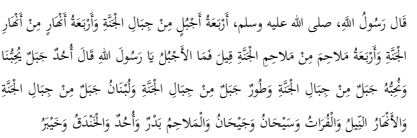
El Mensajero de Allah ﷺ dijo: «Cuatro montañas son de las montañas del Paraíso (Jannah), cuatro ríos son de los ríos del Paraíso, y cuatro grandes batallas feroces serán de las batallas del Paraíso». Se le preguntó: «¿Cuáles son las montañas, oh Mensajero de Allah?». Respondió: «Uhud, una montaña que nos ama y a la que amamos, es una montaña de las montañas del Paraíso; Tur es una montaña de las montañas del Paraíso; y Lubnán es una montaña de entre las montañas del Paraíso. Y los ríos son el Nilo, el Éufrates, el Saihán (Oxus) y el Jaihán (Jaxartes), mientras que las grandes batallas feroces son Badr, Uhud, Jandaq y Jaibar».
The Messenger of Allah (peace be upon him) said: “Four mountains are from the mountains of Jannah (paradise) and four rivers are from the rivers of paradise and four fierce great battles will be from the battles of paradise” It was asked: “Which mountains O Messenger of Allah?” He said: “Uhud, a mountain that loves us and we love it, is a mountain from the mountains of paradise, Tur is a mountain from the mountains of paradise and Lubnan is a mountain from among the mountains of paradise. And the rivers are the Nile, Euphrates, Saihan (Oxus) and Jaihan (Jaxartes), while the fierce great battles are Badr, Uhud, Khandaq and Khaibar”.
- Muhammad bin ‘Ali bin Mu’aim Al-Baladi nos transmitió de Muhammad bin Abdullah bin ‘Umar, de Ma’afa bin ‘Imran, de Kathir bin Abdullah bin ‘Amr, de su padre, de su abuelo: que el Profeta ﷺ dijo:
- Muhammad bin ‘Ali bin Mu’aim Al-Baladi related to us from Muhammad bin Abdullah bin ‘Umar, from Ma’afa bin ‘Imran, from Kathir bin Abdullah bin ‘Amr, from his father, from his grandfather: That the Prophet (peace be upon him) said:

“¡Oh, asamblea de los Quraish, acordaos de mí en lo que respecta a mis compañeros, a sus hijos y a los hijos de sus hijos!” ﷺ
“O gathering of the Quraish, keep me in mind in respect to my companions, their sons and the sons of their sons”.
- Muhammad bin Rabi' bin Sulaiman Al-Jiziy nos relató, de Abu Umayyah At-Tarsusiy, de Mu'awiyah bin 'Amr, de Abu Ishaq Al-Fazariy, de Ibn Kathir bin Abdullah, de su padre, de su abuelo, quien dijo:
- Muhammad bin Rabi’ bin Sulaiman Al-Jiziy related to us from Abu Umayyah At-Tarsusiy, from Mu’awiyah bin ‘Amr, from Abu Ishaq Al- Fazariy, from Ibn Kathir bin Abdullah, from his father, from his grandfather, who said:

El Mensajero de Allah ﷺ dijo: «No hay saqueo, ni pillaje, ni robo del botín, y quien robe del botín comparecerá el Día del Juicio con aquello que robó».
The Messenger of Allah (peace be upon him) said: “There is no plundering, no looting and no stealing from the spoils and whoever steals from the spoils will come on the Day of Judgement with that which he stole”.
- Muhammad bin Ahmad bin Al-Hussein Al-Ahwaziy nos transmitió de ‘Amr bin ‘Ali, de Muhammad bin Khalid bin ‘Athmah, de Kathir bin Abdullah Al-Muzani, de su padre, de su abuelo, quien dijo:
- Muhammad bin Ahmad Bin Al-Hussein Al-Ahwaziy related to us from ‘Amr bin ‘Ali, from Muhammad bin Khalid bin ‘Athmah, from Kathir bin Abdullah Al-Muzani, from his father, from his grandfather, who said:

El Mensajero de Allah ﷺ dijo: «No llegará la Hora hasta que Allah conquiste Constantinopla y Roma, acompañado de tasbih y takbir».
The Messenger of Allah (peace be upon him) said: “The final hour will not come until Allah conquers Constantinople and Rome accompanied by Tasbih and Takbir”.
- Ahmad bin Muhammad bin Abdul ‘Aziz bin Al-Ja’d nos relató, de Muhammad bin Ishaq Al-Masibi, de Abdullah bin Muhammad bin Salm, de Abdur Rahman bin Ibrahim, de Abdullah bin Nafi’, de Kathir bin Abdullah, de su padre, de su abuelo, del Profeta ﷺ:
- Ahmad bin Muhammad bin Abdul ‘Aziz bin Al-Ja’d related to us from Muhammad bin Ishaq Al-Masibi, from Abdullah bin Muhammad bin Salm, from Abdur Rahman bin Ibrahim, from Abdullah bin Nafi’, from Kathir bin Abdullah, from his father, from his grandfather, from the Prophet (peace be upon him):

«El que da la Zakat ha alcanzado el éxito». Dijo: Zakat ul-Fitr.
“The one who gives Zakah has attained success” He said: Zakat ul-Fitr.
- Ibn Salm nos relató de Abdur Rahman, de Abdullah bin Nafi', de Kathir bin Abdullah, de su padre, de su abuelo, que el Profeta ﷺ dijo:
- Ibn Salm related to us from Abdur Rahman, from Abdullah bin Nafi’, from Kathir bin Abdullah, from his father , from his grandfather, that the Prophet (peace be upon him) said:

“Cuídense del desliz o tropiezo del ‘Alim (sabio), y así esperen su reincidencia”. Ahmad bin Hafs nos transmitió de Az-Zubair bin Bakkar, de Abdullah bin Nafi’, lo mismo que lo anterior. Ahmad bin ‘Ali Al-Mada’ini nos transmitió, de Ahmad bin Muhammad Abu Bakr Al-Hatibi, de Ishaq Al-Janbiy, quien dijo: Kathir bin Abdullah Al-Muzani lo mencionó de su padre, de su abuelo, quien dijo: El Mensajero de Allah ﷺ dijo: Lo mismo que lo anterior (es decir, “Cuídense del desliz del ‘Alim”).
“Take guard from the slip or lapse of the ‘Aalim (scholar) and so await its recurrence”. Ahmad bin Hafs related to us from Az-Zubair bin Bakkar, from Abdullah bin Nafi’ the same as above. Ahmad bin ‘Ali Al-Mada’ini related to us, from Ahmad bin Muhammad Abu Bakr Al-Hatibi, from Ishaq Al-Janbiy who said: Kathir bin Abdullah Al-Muzani mentioned it from his father, from his grandfather, who said: The Messenger of Allah (peace be upon him) said: The same as above (i.e. “Take guard from the lapse of the ‘Aalim”).
- Ahmad bin ‘Ali nos relató, de Muhammad bin Khuraim Al-Qazzaz, de Hisham bin Khalid, de Marwan bin Mu’awiyah, de Kathir bin Abdullah Al-Muzani, de su padre, de su abuelo:
- Ahmad bin ‘Ali related to us from Muhammad bin Khuraim Al- Qazzaz, from Hisham bin Khalid, from Marwan bin Mu’awiyah, from Kathir bin Abdullah Al-Muzani, from his father, from his grandfather:

Que el Profeta ﷺ dijo a Bilal bin Al-Harith: “¡Oh Bilal, sabe!”. Él dijo: “¡Estoy listo para saber, oh Mensajero de Allah!”. Dijo (de nuevo): “¡Oh Bilal, sabe!”. Él dijo: “¡Estoy listo para saber, oh Mensajero de Allah!”. Dijo: “¡Oh Bilal, sabe que, en verdad, quien revive una Sunnah de mi Sunnah que ha caído en el olvido después de mí, tendrá una recompensa similar a la de quien actúe conforme a ella, sin que eso disminuya en nada sus recompensas. Y quien introduzca una innovación errónea con la que Allah no está complacido, ni Su Mensajero ﷺ, cargará con pecados similares a los de quien actúe conforme a ella, sin que eso disminuya en nada los pecados de la gente”.
“That the Prophet (peace be upon him) said to Bilal bin Al-Harith: “O Bilal, Know!”. He said: “I am ready to know O Messenger of Allah!” He said (again) “O Bilal, know!” He said: “I am ready to know O Messenger of Allah!” He said: “O Bilal, know that indeed whoever revives a Sunnah from my Sunnah which has died out after me, then for him is a reward similar to whoever acts upon it without diminishing anything from their rewards. And whoever introduces an erroneous innovation which Allah is not pleased with, nor His Messenger, then he shall receive sins similar to whoever acts upon it, without that diminishing anything from the sins of the people”.
- Con la misma cadena de transmisión (isnad) de su abuelo, quien dijo:
- With the same Isnad from his grandfather, who said:

«Memoricé del Mensajero de Allah ﷺ 16 fundamentos de los fundamentos de la religión (Deen)». Él dijo: El Mensajero de Allah ﷺ dijo:
“I memorised from the Messenger of Allah (peace be upon him) 16 foundations from the foundations of the Deen”. He said: The Messenger of Allah (peace be upon him) said:

No hay responsabilidad (diya) por los animales (es decir, por los daños que causen al atacar), no hay responsabilidad por los pozos (es decir, por los accidentes relacionados con ellos), y se debe un quinto del tesoro enterrado (rikaz).
“There is no liability (blood money) for beasts (i.e. from being attacked), there is no liability for wells (i.e. accidents related to them) and a fifth is due from the buried treasure (Rikaz)”.

Dijo: «No hay jalab ni janab (es decir, que los animales no deben ser apartados de su lugar de pastoreo para el cobrador de la zakat), no hay obstrucción y no hay comercio de un habitante de la ciudad».
He said: “There is no Jalab and no Janab (meaning that animals should not be moved away from their place of grazing to the collector of Zakah), there is no obstruction and there is no trade of a townsperson
para un beduino. Y no hay apropiación ilícita, ni saqueo, ni pillaje, ni robo del botín, y quien robe del botín vendrá el Día del Juicio con aquello que robó”.
for a Bedouin. And there is no unlawful taking of possession, no plundering, no looting and no stealing from the spoils and whoever steals from the spoils will come with that which he stole on the Day of Judgement”.

Dijo: «Quien se haga cargo de un mawla distinto de sus mawali, sobre él recaerá la maldición de Allah y Su ira, y no se aceptará nada de él».
He said: “Whoever takes charge of a Mawla from other than his Mawali, then the curse of Allah and His anger will be upon him, and nothing will be accepted from him”.

Dijo: «Quien cometa un delito (es decir, quien viole los derechos de otros o el pacto), entonces la maldición de Allah y Su ira recaerán sobre él, y no se aceptará de él nada».
He said: “Whoever commits a crime (i.e. breaching the rights of others or the covenant), then the curse of Allah and His anger will be upon him, and nothing will be accepted from him”.
Con la misma cadena de transmisión (isnad) desde su abuelo, dijo: El Mensajero de Allah ﷺ dijo:
- With the same Isnad from his grandfather, he said: The Messenger of Allah (peace be upon him) said:

Los musulmanes se atienen a sus condiciones, excepto aquella condición que convierte lo lícito (halal) en ilícito (haram) o una condición que convierte lo ilícito (haram) en lícito (halal).
“The Muslims are upon their conditions apart from the condition which makes the Halal (lawful) Haram (unlawful) or a condition that makes the Haram (unlawful) Halal (lawful)”.
- Abdul Wahhab bin Abu ‘Usmah nos relató de Isma’il bin Yazid Al-Asbahani, de Ma’n bin ‘Eisa, de Kathir bin Abdullah Al-Muzani, de su padre, de su abuelo, quien dijo:
- Abdul Wahhab bin Abu ‘Usmah related to us from Isma’il bin Yazid Al-Asbahani, from Ma’n bin ‘Eisa, from Kathir bin Abdullah Al- Muzani, from his father, from his grandfather who said:

Escuché al Mensajero de Allah ﷺ decir: «Se puso de pie, alabó a Allah y lo glorificó. Luego dijo: ¡Oh gente! Quienes realicen el Hach y la ‘Umrah, y quienes viajen por tierras desiertas, tienen más derecho al agua y a la sombra; por tanto, no impidáis a la gente el acceso a la tierra».
I heard the Messenger of Allah (peace be upon him): “He stood, praised Allah and extolled Him. He then said: O people, whoever from those undertaking Hajj and ‘Umrah and those who are travelling are upon deserted land have more right to water and shade and so do not prevent the people from the land (i.e. access)”.
Tras esto, en esta edición impresa aparecen varios ahadices sin relación alguna con Kathir bin Abdullah. Parece que el origen del error está en el propio manuscrito, y otros manuscritos podrían revisarse y compararse con este si pudieran encontrarse… (Tras la mención de esos ahadices no relacionados, Ibn Adiy continúa):
Following this, there came, in this printed edition, a number of unconnected Ahadeeth which had no relationship with Kathir bin Abdullah at all. It appears that the origin of the error is the manuscript itself and other manuscripts can be revised and compared to this one if they can be found … (Following the mention of those unrelated Ahadeeth Ibn Adiy continues):
- Él (Ibn ‘Adiy) dijo: Ahmad bin Hafs As-Sa’diy nos relató, de Ahmad bin Ibrahim Ad-Duraqiy, de Abdullah bin Nafi’, de Kathir bin Abdullah Al-Muzani, de su padre, de su abuelo, quien dijo:
- He (Ibn ‘Adiy) said: Ahmad bin Hafs As-Sa’diy related to us from Ahmad bin Ibrahim Ad-Duraqiy, from Abdullah bin Nafi’, from Kathir bin Abdullah Al-Muzani, from his father, from his grandfather, who said:

El Mensajero de Allah ﷺ dijo: «Dejad en paz a los abisinios mientras ellos os dejen en paz».
The Messenger of Allah (peace be upon him) said: “Leave be those Abyssinians as long as they leave you be”.
Muhammad bin Al-Hasan Al-Basriy relató de Muhammad bin Bakkar Al-‘Aishi, de Muhammad bin Isma’il bin Abu Fadaik, de Kathir bin Abdullah Al-Muzani, de su padre, de su abuelo, quien dijo:
- Muhammad bin Al-Hasan Al-Basriy related from Muhammad bin Bakkar Al-‘Aishi, from Muhammad bin Isma’il bin Abu Fadaik, from Kathir bin Abdullah Al-Muzani, from his father, from his grandfather, who said:

El Profeta ﷺ escuchó a un hombre llamarlo verde (exuberante), y entonces dijo: «Estamos a tu servicio. Hemos tomado y tú tienes de lo que hay entre vosotros».
“The Prophet (peace be upon him) heard a man calling it green (luscious) and so he said: We are at your service. We have taken and you have from what is among you” .
- Muhammad bin Al-Hasan Al-Basriy transmitió de Al-‘Abbas bin Abdul ‘Azhim, de Abdullah bin Ja’far bin Abu Kathir Al-Ansari, de Kathir bin Abdullah bin ‘Amr bin ‘Awf Al-Muzani, de su padre, de su abuelo, de Bilal bin Al-Harith Al-Muzani:
- Muhammad bin Al-Hasan Al-Basriy related from Al-‘Abbas bin Abdul ‘Azhim, from Abdullah bin Ja’far bin Abu Kathir Al-Ansari, from Kathir bin Abdullah bin ‘Amr bin ‘Awf Al-Muzani, from his father, from his grandfather, from Bilal bin Al-Harith Al-Muzani:

Que cuando el Profeta ﷺ quería aliviarse, se alejaba a una distancia.
“That when the Prophet (peace be upon him) wanted to relive himself, he would move away at a distance”.
- Abdullah bin Abdul Hamid Al-Wasitiy transmitió de An-Nadr bin Salamah, de Abu ‘Uziyyah Muhammad bin Musa Al-Ansari, el Qadi (Juez) de Al-Madinah, de Kathir bin Abdullah, de su padre, de su abuelo ‘Amr bin ‘Awf, quien dijo:
- Abdullah bin Abdul Hamid Al-Wasitiy related from An-Nadr bin Salamah, from Abu ‘Uziyyah Muhammad bin Musa Al-Ansari, the Qadi (Judge) of Al-Madinah, from Kathir bin Abdullah, from his father, from his grandfather ‘Amr bin ‘Awf, who said:

“Vi al Mensajero de Allah ﷺ de pie sobre el Maqam, y decía: ‘Oh gente, esta Qiblah es la Qiblah de la Mezquita, y la Mezquita es la Qiblah del Dunyaa (mundo)’.”
“I saw the Messenger of Allah (peace be upon him) standing upon the Maqam and he was saying: O people, this Qiblah, it is the Qiblah of the Masjid and the Masjid is the Qiblah of the Dunyaa (world)”.
- Muhammad bin Yusuf bin ‘Asim Al-Bujari nos transmitió de Ahmad bin Isma’il Al-Qurashi, de Abdullah bin Nafi’, de Kathir bin Abdullah, de su padre, de su abuelo:
- Muhammad bin Yusuf bin ‘Asim Al-Bukhari related to us from Ahmad bin Isma’il Al-Qurashi, from Abdullah bin Nafi’, from Kathir bin Abdullah, from his father, from his grandfather:

"Que el Mensajero de Allah ﷺ estaba en la Mezquita. Escuchó una voz detrás de él, y quien hablaba decía: “¡Oh Allah, ayúdame con aquello que me salvará de lo que me has hecho temer!”. Entonces el Mensajero de Allah ﷺ, al oírlo, dijo: “¿No incluirás también a su hermana junto con ella?”. El hombre dijo entonces: “¡Oh Allah, concédeme el anhelo de los veraces por aquello que les has hecho deseable!”. Luego el Mensajero de Allah ﷺ dijo a Anas bin Malik, que estaba con él: “Ve a él, oh Anas, y dile que el Mensajero de Allah ﷺ te dice: ‘Pide perdón por mí’”. Anas fue a él y le transmitió el mensaje. El hombre dijo: “Oh Anas, tú eres el mensajero del Mensajero de Allah ﷺ hacia mí”. Él respondió: “Igual que tú”. El hombre regresó para verificarlo. Entonces el Mensajero de Allah ﷺ dijo: “Dile que sí”. Así que el hombre le dijo: “Ve y dile que Allah te ha favorecido sobre los Profetas, como ha favorecido el mes de Ramadán sobre los demás meses, y que ha favorecido a tu Ummah (nación) sobre las naciones, como ha favorecido el día del Yumu'ah sobre todos los demás días”. Fueron a buscarlo y, he aquí, era Jadir, la paz sea con él".
“That the Messenger of Allah (peace be upon him) was in the Masjid. He heard speech behind him and the one saying it was saying: “O Allah assist me with which will save me from that which you have made me fearful of”. So, the Messenger of Allah (peace be upon him) said when he heard that: “Will you not include its sister alongside it?” The man then said: “O Allah bestow upon me the longing of the truthful to that which you have made desirable for them”. The Messenger of Allah (peace be upon him) then said to Anas bin Malik who was in his company: “Go to him O Anas and say to him that the Messenger of Allah (peace be upon him) says to you: “Seek forgiveness for me”. So, Anas went to him and conveyed that to him. The man then said: “O Anas, you are the messenger of the Messenger of Allah (peace be upon him), to me. He replied: “Just as you are”. He returned to verify it. The Messenger of Allah (peace be upon him) then said: “Say to him yes”. So, he (the man) said to him: “Go and say to him that Allah has favoured you over the Prophets like He has favoured the month of Ramadan over other months and that He has favoured your Ummah (nation) over the nations like He has favoured the day of Jumu’ah over all of the other days”. They went looking and behold it was Khadir, peace be upon him”.
- Ahmad bin Ja'far nos relató de Ya'qub bin Ibrahim Ad-Duraqi, de Ibrahim bin Abdullah Ar-Rafa'iy, de Kathir bin Abdullah, de su padre, de su abuelo:
- Ahmad bin Ja’far related to us from Ya’qub bin Ibrahim Ad-Duraqi, from Ibrahim bin Abdullah Ar-Rafa’iy, from Kathir bin Abdullah, from his father, from his grandfather:

Que el Mensajero de Allah ﷺ oró por el Negus de Abisinia (An-Najashi) y pronunció cinco takbirs.
“That the Messenger of Allah (peace be upon him) prayed over the Najashi (Negus of Abyssinia) and did five Takbirs”.
- ‘Imran bin Musa nos relató de Ibrahim bin Al-Mundhir, de Abu Al-Ja’d Abdur Rahman bin Abdullah As-Salmiy, de Kathir bin Abdullah Al-Muzani, de su padre, de su abuelo, quien dijo:
- ‘Imran bin Musa related to us from Ibrahim bin Al-Mundhir, from Abu Al-Ja’d Abdur Rahman bin Abdullah As-Salmiy, from Kathir bin Abdullah Al-Muzani, from his father, from his grandfather, who said:

El Mensajero de Allah ﷺ dijo: «El caballo es presentado el día de su abrevadero».
“The Messenger of Allah (peace be upon him) said: “the horse is offered the day of its watering”.
Todavía quedan algunos hadices narrados por Kazir bin Abdullah, de su padre, de su abuelo, y la mayoría de sus hadices que mencioné, y la mayor parte de lo que transmitió, no tiene nada que los respalde o confirme (es decir, él está solo al narrarlos). - Bahlul bin Ishaq nos transmitió de Isma'il bin Abu Uwais, de Kazir bin Abdullah Al-Muzani, de Rubaih bin Abdur Rahman bin Abu Sa'id Al-Kudri, de su padre, de su abuelo, quien dijo:
There are still a small number of Ahadeeth related by Kathir bin Abdullah from his father, from his grandfather remaining and most of his Ahadeeth which I mentioned and most of what he related, does not have that which conforms (or supports) them (i.e. he is alone in narrating them). - Bahlul bin Ishaq related to us from Isma’il bin Abu Uwais, from Kathir bin Abdullah Al-Muzani, from Rubaih bin Abdur Rahman bin Abu Sa’id Al-Kudri, from his father, from his grandfather, who said:

“Vi a unos hombres de entre los árabes (es decir, beduinos) acercarse al Mensajero de Allah ﷺ. Dijeron: «¡Oh Mensajero de Allah, somos gente que posee ganado, y de él sacamos nuestra sadaqa (es decir, zakat); ¿también eso nos cubre la zakat del Ramadán?». El Mensajero de Allah ﷺ dijo: «No, se toma del niño y del adulto, del libre y del esclavo. Es una purificación para vosotros»”. Abu Sa'id Al-Judri dijo: “Vi en el año en que los rebaños eran abundantes y los cultivos blancos disminuyeron más que los negros. Luego vi en el año siguiente que los cultivos eran abundantes y los rebaños negros disminuyeron más que los blancos”. No conozco a nadie que haya transmitido este hadiz de Rubaih aparte de Kazir bin Abdullah. [Fin de la cita de Ibn 'Adiy].
“I saw men from the Arabs (i.e. Bedouins) approaching the Messenger of Allah (peace be upon him). They said: “O Messenger of Allah, we are people possessing livestock and we take out from them our Sadaqah (i.e. Zakat) and so does that also cover for us the Zakat of Ramadan?” The Messenger of Allah (peace be upon him) said: “No, it is taken from the child and the adult, from the free and the slave. It is a purification for you”. Abu Sa’id Al-Khudri said: I saw in the year that the herds were plentiful and that the white crops diminished more than the black. I then saw in the year following that the crops were plentiful and that the black herds were diminished more than the white”. I do not know anyone relating this Hadith from Rubaih apart from Kathir bin Abdullah] [End of quote of Ibn ‘Adiy].
En cuanto a la afirmación de Ibn ‘Adiy: «Quedan todavía un pequeño número de ahadices narrados por Kathir bin Abdullah de su padre, de su abuelo, y la mayoría de sus ahadices que he mencionado y la mayor parte de lo que narró no tienen nada que los corrobore (o respalde)» (es decir, él está solo en su narración), entonces esto no significa la declaración de falta de fiabilidad ni la clasificación de debilidad. Esto se debe a que el mero hecho de estar solo en la narración de ahadices, «la mayor parte de lo que narró no tiene nada que los corrobore (o respalde)», especialmente en el caso de quien pertenece a los infames nietos de los Compañeros (como el caso de Bahz bin Hakim, por ejemplo), no implica debilidad ni falta de fiabilidad. Es como si Ibn ‘Adiy hubiera preferido mantenerse a salvo y evitar emitir un veredicto sobre el hombre. Esto es así porque, cuando quiere expresar la falta de fiabilidad o la deficiencia de un hombre, suele decir: «Y la debilidad es evidente en su hadiz», o palabras similares. En cambio, si quiere declarar la fiabilidad y solidez de un narrador, dice: «No encontré nada Munkar (censurable) en relación con él», o «No encontré nada Munkar de él, si un Ziqah (narrador fiable y digno de confianza) narró de él». Es evidente que de Al-Bujari no le llegó nada aparte de lo que su maestro Isma’il bin Abu Uwais le transmitió: «Oí (o recibí de) Kathir bin Abdullah bin ‘Amr bin ‘Awf bin Yazid bin Milhah Al-Muzani en el año 158, luego en el año 161 o 162».


"Que el Mensajero de Allah ﷺ estaba en la Mezquita. Escuchó una voz detrás de él, y quien hablaba decía: “¡Oh Allah, ayúdame con aquello que me salvará de lo que me has hecho temer!”. Entonces el Mensajero de Allah ﷺ, al oírlo, dijo: “¿No incluirás también a su hermana junto con ella?”. El hombre dijo entonces: “¡Oh Allah, concédeme el anhelo de los veraces por aquello que les has hecho deseable!”. Luego el Mensajero de Allah ﷺ dijo a Anas bin Malik, que estaba con él: “Ve a él, oh Anas, y dile que el Mensajero de Allah ﷺ te dice: ‘Pide perdón por mí’”. Anas fue a él y le transmitió el mensaje. El hombre dijo: “Oh Anas, tú eres el mensajero del Mensajero de Allah ﷺ hacia mí”. Él respondió: “Igual que tú”. El hombre regresó para verificarlo. Entonces el Mensajero de Allah ﷺ dijo: “Dile que sí”. Así que el hombre le dijo: “Ve y dile que Allah te ha favorecido sobre los Profetas, como ha favorecido el mes de Ramadán sobre los demás meses, y que ha favorecido a tu Ummah (nación) sobre las naciones, como ha favorecido el día del Yumu'ah sobre todos los demás días”. Fueron a buscarlo y, he aquí, era Jadir, la paz sea con él".
“That the Messenger of Allah (peace be upon him) was in the Masjid. He heard speech behind him and the one saying it was saying: “O Allah assist me with which will save me from that which you have made me fearful of”. So, the Messenger of Allah (peace be upon him) said when he heard that: “Will you not include its sister alongside it?” The man then said: “O Allah bestow upon me the longing of the truthful to that which you have made desirable for them”. The Messenger of Allah (peace be upon him) then said to Anas bin Malik who was in his company: “Go to him O Anas and say to him that the Messenger of Allah (peace be upon him) says to you: “Seek forgiveness for me”. So, Anas went to him and conveyed that to him. The man then said: “O Anas, you are the messenger of the Messenger of Allah (peace be upon him), to me. He replied: “Just as you are”. He returned to verify it. The Messenger of Allah (peace be upon him) then said: “Say to him yes”. So, he (the man) said to him: “Go and say to him that Allah has favoured you over the Prophets like He has favoured the month of Ramadan over other months and that He has favoured your Ummah (nation) over the nations like He has favoured the day of Jumu’ah over all of the other days”. They went looking and behold it was Khadir, peace be upon him”.
Buscamos esta narración en todos los lugares posibles, pero no pudimos encontrarla salvo por esta vía del Imam Ibn ‘Adiy. La narración también se le atribuye a él en el libro “Unais As-Saari Fee Takhrij Ahadeeth Fat’h ul-Baari” (9/6578/4610).
We searched for this narration in every conceivable place but we were unable to find it except from this path of Imam Ibn ‘Adiy. The narration is also attributed to him in the book “Unais As-Saari Fee Takhrij Ahadeeth Fat’h ul-Baari” (9/6578/4610):

‘Amr bin ‘Awf relató: «Que el Profeta ﷺ oyó una conversación mientras estaba en la mezquita y entonces dijo: “Oh Anas, ve con quien dijo eso y pídele que pida perdón por mí”. Anas fue con el hombre y este le dijo: “Dile (es decir, al Profeta ﷺ) que verdaderamente Allah te ha favorecido sobre los profetas con aquello con lo que ha favorecido a Ramadán sobre los demás meses”. Dijo: Entonces fueron a ver y resultó que era Jadir». Al-Hafiz (Ibn Hayar) dijo: «Es un hadiz débil, que Ibn ‘Adiy extrajo por la vía de Kazir bin ‘Amr bin ‘Awf, de su padre, de su abuelo, y es una cadena de transmisión (isnad) débil». Ibn ‘Asakir transmitió algo similar a él del hadiz de Anas, con una cadena de transmisión más débil que ella (7/245 – El libro de los hadices de los profetas – Capítulo: El hadiz de Al-Jadir con Musa, la paz sea con él). Es muy débil. Lo transmitió del hadiz de ‘Amr bin ‘Awf y del hadiz de Anas. En cuanto al hadiz de ‘Amr bin ‘Awf, Ibn ‘Adiy lo extrajo (6/2083) por la vía de Abdullah bin Nafi’ As-Sa’igh, de Kazir bin Abdullah, de su padre, de su abuelo: «Que el Mensajero de Allah ﷺ estaba en la mezquita y entonces oyó una conversación… etc…».
[‘Amr bin ‘Awf related: “That the Prophet (peace be upon him) heard speech whilst he was in the Masjid and then said: “O Anas, go to the one who said that and ask him to seek forgiveness for me”. Anas went to the man and he (the man) said to him: “Say (to him i.e. the Prophet) that verily Allah has favoured you over the Prophets by that which he has favoured Ramadan over the remaining months”. He said: They then went to see and behold it was Khadir”. Al-Hafizh (Ibn Hajar) said: “It is a weak Hadith which Ibn ‘Adiy extracted via the path of Kathir bin ‘Amr bin ‘Awf, from his father, from his grandfather, and it is a weak Isnad (chain of transmission)”. Ibn ‘Asakir related similar to it from the Hadith of Anas, with a chain of transmission which is weaker than it” (7/245 – The book of the Ahadeeth of the Prophets – Chapter: The Hadith of Al-Khadir with Musa, peace be upon him). It is very weak. He related from the Hadith of ‘Amr bin ‘Awf and the Hadith of Anas. As for the Hsdith of ‘Amr bin ‘Awf, then Ibn ‘Adiy extracted it (6/2083) via the path of Abdullah bin Nafi’ As-Sa’igh from Kathir bin Abdullah, from his father, from his grandfather: “That the Messenger of Allah (peace be upon him) was in the Masjid and then he heard speech … etc …].
Como puede verse, Al-Hafiz (Ibn Hayar) atribuyó la narración a Kazir bin Abdulah, mientras que Abu Hudaifah Nabil bin Mansur bin Ya'qub bin Sultán Al-Bisarah Al-Kuwaiti, autor de "Unais As-Sa'ari", la atribuyó a Abdulah bin Nafi' As-Sa'igh, de Kazir bin Abdulah. Sin embargo, ambos incurren en una grave falta en este sentido.
As can be seen, Al-Hafizh (Ibn Hajar) attributed the narration to Kathir bin Abdullah whilst Abu Hudhaifah Nabil bin Mansur bin Ya’qub bin Sultan Al-Bisarah Al-Kuwitiy, the author of “Unais As- Saari”, attributed it to Abdullah bin Nafi’ As-Sa’igh from Kathir bin Abdullah. However, both of them are guilty of an obscene shortcoming in respect to this.

Que el Mensajero de Allah ﷺ dijo: «Verdaderamente, la religión (ad-Din) se replegará hacia el Hiyaz como la serpiente se repliega hacia su agujero, y la religión buscará refugio en el Hiyaz como la cabra montés busca refugio en la cima de la montaña. La religión comenzó siendo algo extraño y volverá a ser algo extraño. Bienaventurados los extraños; aquellos que restaurarán lo que la gente después de mí ha corrompido de mi Sunnah».
That the Messenger of Allah (peace be upon him) said: “Verily, the Deen will retreat back to the Hijaz as a snake retreats back to its hole, and the Deen will seek refuge in the Hijaz as the mountain goat seeks refuge in the mountain top. The Deen began as something strange and will return as something strange. Blessed are the strangers; those who will rectify what the people after me have corrupted from my Sunnah”.
Algunos han hablado sobre Kathir; si hubieran callado sobre él, habría sido más beneficioso. En verdad, solo los ignorantes han hablado de él y de sus motivos (o relaciones). Escuché a Ibn Uwais decir: Malik me preguntó sobre su hadiz, y Yahya bin Sa'id Al-Ansari transmitió de él. No tengo duda de que escuché a Ibrahim bin Al-Mundhir (y si no lo escuché de él, un Thiqah me lo transmitió) que dijo: "Kathir solía afirmar que el Profeta ﷺ había concedido a su abuelo unas tierras, y discutía con los habitantes de esa zona. Se peleaba mucho. Fue a ver a Ibn 'Imran para discutir, y 'Imran le dijo: '¡Oh Kathir! En verdad eres un hombre ocioso que discute mucho sobre lo que no conoces, reclamas lo que no te pertenece y no tienes pruebas de lo que exiges. No te acerques a mí, y no permitiré que me veas a menos que veas que he liberado mi tiempo para la gente de la falsedad. Si ves eso, entonces ven'. Un día Ibn 'Imran estaba con nosotros y, de pronto, Kathir bin Abdullah se acercó a él. Él (Ibn 'Imran) dijo: '¿No te dije que no vinieras a mí a menos que vieras que había liberado mi tiempo para la gente de la falsedad?'. Kathir respondió: '¡Has dicho la verdad, que Allah haga bueno el asunto del Qadi! En verdad, solo vine a ti cuando la gente de la falsedad vino a ti. Fulano y mengano vinieron a ti. Ambos son gente de la falsedad, y por eso vine con ellos'". Esto fue por orden de Ibn 'Imran hacia él. Abu Yusuf dijo: "Ordenó que se mantuviera firme junto a la columna hasta que se levantara de los procesos judiciales". Abu Yusuf dijo: "Eran de los devotos de Ibn 'Imran". Esto también ha sido registrado en la transcripción de "Ash-Shamela Lil-Ma'rifah Wa At-Tarikh" (p. 62, según la numeración de la biblioteca electrónica Shamela).
Some have spoken about Kathir who had they been silent about him it would have been more beneficial. Indeed, only the ignorant have spoken about him and his motives (or relations). I heard Ibn Uwais saying: Malik asked me about his Hadith and Yahya bin Sa’id Al-Ansari related from him. I have no doubt that I heard Ibrahim bin Al- Mundhir (And if I didn’t hear it from him, then a Thiqah related it to me) that he said: “Kathir used to claim that the Prophet (peace be upon him) had granted his grandfather land and he used to dispute with those in that area. He used to quarrel a lot. He went to Ibn ‘Imran to quarrel and so ‘Imran said to him: “O Kathir, indeed you are an idle man who quarrels a lot in respect to that which you don’t know, you claim that which does not belong to you and you have no evidence from what you demand. So, don’t approach me and I will not let me see you unless you see that I have freed my time for the people of falsehood. If you see that, then come”. One day Ibn ‘Imran was with us and then behold Kathir bin Abdullah had approached him. He (Ibn ‘Imran) said: “Did I not tell you to not come to me unless you see me having freed my time for the people of falsehood?” Kathir then replied: ““You have said the truth, may Allah make good the affair of the Qadi. Indeed, I only came to you when the people of falsehood came to you. So and so and so and so person came to you. They are both people of falsehood and so I came along with them both”. It was from the command of Ibn ‘Imran to him. Abu Yusuf said: “He commanded to remain fast to the column until he had stood from judicial proceedings”. Abu Yusuf said: “They were from those devoted to Ibn ‘Imran]. This has also been recorded in the transcript of “Ash-Shamela Lil- Ma’rifah Wa At-Tarikh” (p. 62 – by the numbering of the Shamela E- library).