5.5 L'équité envers Kathir bin Abdullah bin ‘Amr bin ‘Awf Al-Muzani
5.5 Fairness to Kathir bin Abdullah bin ‘Amr bin ‘Awf Al- Muzani
- Ce qui suit est mentionné dans « Taqrib At-Tahdhib » [Ibn Hajar] (1/460/5617) : [Kathir bin Abdullah bin ‘Amr bin ‘Awf Al-Muzani Al-Madani est Da’if (faible). Ceux qui lui ont attribué le mensonge ont été excessifs. (Il était de) la septième (c'est-à-dire génération ou lignée de transmission)].
- The following came stated in in “Taqrib At-Tahdhib” [Ibn Hajar] (1/460/5617): [Kathir bin Abdullah bin ‘Amr bin ‘Awf Al-Muzani Al- Madani is Da’if (weak). Those who attributed lying to him were excessive. (He was from) the seventh (i.e. generation or line of transmission)].
- Cependant, dans « Irwaa’ Al-Ghalil », par Al-Albani (5/155), il a été mentionné ce qui suit : [Al-Hafizh (c'est-à-dire ibn Hajar) a dit [dans Al-Fat’h – (4/371)] : [Et Kathir bin Abdullah est Da’if selon l'avis de la majorité, cependant Al-Bukhari et ceux qui l'ont suivi comme At-Tirmidhi et Ibn Khuzaimah renforcent son statut]].
- However, in “Irwaa’ Al-Ghalil”, by Al-Albani (5/155), the following was stated: [Al-Hafizh (i.e. ibn Hajar) said [in Al-Fat’h – (4/371)]: [And Kathir bin Abdullah is Da’if in the view of the majority however Al- Bukahri and those who followed him like At-Tirmidhi and Ibn Khuzaimah strengthen his affair (or status)].
- Ce qui suit a été rapporté dans « At-Tarikh Al-Kabir » [Al-Bukhari] (7/217/945) : [Kathir bin Abdullah bin ‘Amr bin ‘Awf Al-Muzani Al-Madani a écouté (ou a reçu de) son père, tandis que Marwan bin Mu’awiyah, Isma’il bin Abu Uwais et Yahya Al-Ansari ont rapporté de lui]. Il est rapporté dans une autre édition de « At-Tarikh Al-Kabir » par Al-Bukhari (7/96/945). Al-Bukhari ne l'a pas classé comme Da’if (faible) et il n'a pas parlé de lui, pas même une seule lettre ! - Ce qui suit a été énoncé dans « Al-Jarh Wa At-Ta’dil » [Ibn Abu Hatim] (7/154/858) : [Kathir bin Abdullah bin ‘Amr bin ‘Awf a rapporté de son père en plus de Muhammad bin Ka’b et Rubaih bin Abdur Rahman, tandis qu'Abdul ‘Aziz bin Muhammad, Marwan bin Mu’awiyah, Ma’n bin ‘Eisa, Abdullah bin Wahb, Abdullah bin Nafi’ As-Sa’igh, Muhammad bin Khalid bin ‘Athma, Abu ‘Amir Al-‘Aqadiy, Khalid bin Makhlad, Ibn Qa’nab et Ibn Abu Uwais ont rapporté de lui. J'ai entendu mon père dire cela. Abdur Rahman nous a rapporté de Muhammad bin Hamawaih bin Al-Hasan qui a dit : J'ai entendu Abu Talib dire : J'ai interrogé Ahmad (signifiant Ahmad bin Hanbal) concernant Kathir bin Abdullah bin ‘Amr bin ‘Awf et il a dit : « Blâmable (Munkar) en ce qui concerne le hadith, sans valeur ». Abdur Rahman nous a rapporté : Il a dit : Il a été lu à Al-‘Abbas bin Muhammad Ad-Dawri de la part de Yahya bin Ma’een qu'il a dit : « Kathir bin Abdullah Al-Muzani est Da’if (faible) en hadith ». Abdur Rahman nous a rapporté. Il a dit : J'ai interrogé Abu Zur’ah au sujet de Kathir bin Abdullah bin ‘Amr bin ‘Awf. Il a dit : « Faible en hadith et non fort ». Je lui ai dit : Parmi Bahz bin Hakim, Abdul Muhaimin et Kathir bin Abdullah, lequel vous est le plus cher ? Il a dit : « Bahz et Abdul Muhaiman me sont plus chers que lui ». Abdur Rahman nous a rapporté : Il a dit : Mon père a été interrogé au sujet de Kathir bin Abdullah bin ‘Amr bin ‘Awf et il a dit : « Il n'est pas solide (Matin) »].
- The following came recorded in “At-Tarikh Al-Kabir” [Al-Bukhari] (7/217/945): [Kathir bin Abdullah bin ‘Amr bin ‘Awf Al-Muzani Al- Madani listened to (or received from) his father, while Marwan bin Mu’awiyah, Isma’il bin Abu Uwais and Yahya Al-Ansari related from him]. It is recorded in another edition of “At-Tarikh Al-Kabir” by Al- Bukhari (7/96/945). Al-Bukhari did not classify him as Da’if (weak) and he did not speak about him, not even a single letter! - The following came stated in “Al-Jarh Wa At-Ta’dil” [Ibn Abu Hatim] (7/154/858): [Kathir bin Abdullah bin ‘Amr bin ‘Awf Al-Muzani related from his father in addition to Muhammad bin Ka’b and Rubaih bin Abdur Rahman, while Abdul ‘Aziz bin Muhammad, Marwan bin Mu’awiyah, Ma’n bin ‘Eisa, Abdullah bin Wahb, Abdullah bin Nafi’ As-Sa’igh, Muhammad bin Khalid bin ‘Athma, Abu ‘Amir Al-‘Aqadiy. Khalid bin Makhlad, Ibn Qa’nab and Ibn Abu Uwais related from him. I heard my father saying that. Abdur Rahman related to us from Muhammad bin Hamawaih bin Al-Hasan who said: I heard Abu Talib who said: I asked Ahmad (meaning Ahmad bin Hanbal) concerning Kathir bin Abdullah bin ‘Amr bin ‘Awf and he said: “Munkar (i.e. rejectable due to defectiveness in respect to) Al-Hadith, of no worth”. Abdur Rahman related to us: He said: It was read to Al-‘Abbas bin Muhammad Ad- Dawri from Yahya bin Ma’een That he said: “Kathir bin Abdullah Al- Muzani is Da’if (weak) in Hadith”. Abdur Rahman related to us. He said: I asked Abu Zur’ah about Kathir bin Abdullah bin ‘Amr bin ‘Awf. He said: “Feeble/weak in Hadith and not strong”. I said to him: Out of Bahz bin Hakim, Abdul Muhaimin and Kathir bin Abdullah, which of them is the most beloved to you? He said: “Bahz and Abdul Muhaiman are more beloved to me than him”. Abdur Rahman related to us: He said: My father was asked about Kathir bin Abdullah bin ‘Amr bin ‘Awf and he said: “He is not solid/strong (Matin)”.
Je dis : Cette affirmation « Il n'est pas Matin (solide/fort) » n'est pas comme l'affirmation « Il n'est pas Qawiy (fort) » et elle n'est pas synonyme de l'affirmation « Da’if (faible) ». Cela est parce que le rapporteur « Matin » est celui qui a atteint le sommet en ce qui concerne la force et la fiabilité. — Des déclarations contradictoires ont été mentionnées dans « Tarikh ul-Islam » (10/224/330) : [Kathir bin Abdullah bin ‘Amr bin ‘Awf bin Zaid bin Talha Al-Yashkuri Al-Muzani Al-Madani … Il a rapporté de son père et de son grand-père (par transcription), en plus de Nafi’ et Muhammad bin Ka’b Al-Qurazhi. Et les suivants ont rapporté de lui : Ibn Wahb, Abdullah bin Nafi’, Al-Qa’nabi, Isma’il bin Abi Uwais et Khalq.
I say: This statement “He is not solid/strong (Matin)” is not like the statement “He is not Qawiy (strong))” and it is not synonymous with the statement “Da’if” (weak). That is because the “Matin” narrator is the one who has reached the pinnacle in respect to strength and reliability. - Contradictory statements came stated in “Tarikh ul-Islam” (10/224/330): [Kathir bin Abdullah bin ‘Amr bin ‘Awf bin Zaid bin Talha Al-Yashkuri Al-Muzani Al-Madani … He related from his father and from his grandfather (by transcript), in addition to Nafi’ and Muhammad bin Ka’b Al-Qurazhi. And the following related from him: Ibn Wahb, Abdullah bin Nafi’, Al-Qa’nabi, Isma’il bin Abi Uwais and Khalq.
Ils se sont accordés sur sa classification de faiblesse et Ahmad bin Hanbal a rejeté son hadith.
They agreed upon his classification of weakness and Ahmad bin Hanbal rejected his Hadith.
Ash-Shafi’iy a dit : Il est un pilier parmi les piliers d'Al-Kadhib (la tromperie/le mensonge). Abu Dawud a dit quelque chose de similaire.
Ash-Shafi’iy said: He is a pillar from among the pillars of Al-Kadhib (deceit/untruth). Abu Dawud said similar to that.
‘Abbas a rapporté d'après Ibn Ma’een (qu'il, c'est-à-dire Kathir, est) : « Da’if (faible) ». Ad-Darimiy a rapporté d'après Ibn Ma’een : Il n'a aucune valeur.
‘Abbas related from Ibn Ma’een (that he i.e. Kathir is): “Da’if (weak)”. Ad-Darimiy related from Ibn Ma’een: He has no worth.
An-Nasa’i a dit : « Il est délaissé ou ignoré (c'est-à-dire qu'il n'est pas rapporté) » et Ad-Daraqutniy a dit la même chose.
An-Nasa’i said: “He is left or disregarded (i.e. not related from)” and Ad-Daraqutniy said the same.
Quant à At-Tirmidhi, il commença alors à dicter et dit : « J'ai dit à Muhammad ﷺ : Il y a le hadith de Kathir bin Abdullah, de son père, de son grand-père, rapporté concernant le (domaine) de l'époque de la prière du Jumu’ah. Il a dit : C'est un hadith Hasan, cependant Ahmad bin Hanbal classe Kathir comme étant Da’if (faible) ».
As for At-Tirmidhi, then he began to dictate and said: “I said to Muhammad: There is the Hadith of Kathir bin Abdullah, from his father, from his grandfather, related to the (subject area) of the time of the Jumu’ah prayer. He said: It is a Hasan Hadith, however Ahmad bin Hanbal classifies Kathir as being Da’if (weak)”.
Ibn Hibban a dit : « Kathir rapporte de son père, de son grand-père, un récit fabriqué. Il n'est pas permis de le mentionner que sous l'angle de l'étonnement ». J'ai dit : Il est mort en l'an 163 AH [Fin de la citation].
Ibn Hibban said: “Kathir relates from his father, from his grandfather a fabricated transcript. It is not permissible to mention him except from the angle of astonishment”. I said: He died in the year 163 AH] [End of quote].
Je dis : Il n'y a aucun sens (ou signification) à l'affirmation : « Ils se sont accordés sur sa classification de faiblesse » alors qu'il existe un témoignage de crédibilité de la part du chef de l'équité et de la modération, l'imam Al-Bukhari, en plus du propos insignifiant d'Abu Hatim, qui fait partie de ceux enclins à l'extrémisme et à l'obstination ! La vérité est qu'Ad-Daraqutni l'a seulement mentionné en tant que partie d'une liste, sans commentaire, parmi un groupe de narrateurs, dans son livre « Ad-Du’afa’ Wa Al-Matrukin ». Le propos attribué à Abu Dawud contredit le fait qu'il a publié certains des hadith de Kathir bin Abdullah et qu'aucun désaccord n'en a résulté lorsqu'il les a transmis aux gens de Makkah. L'explication la plus probable à mon avis est qu'il a rapporté le propos de l'imam Ash-Shafi’iy et l'a suivi au début, comme cela est évident dans « Tahdhib Al-Kamal » (24/136/4948) et dans « Tahdhib At-Tahdhib » (8/377/753) ; dont les textes seront présentés bientôt. Ensuite (après cela), l'inexactitude de l'accusation lui est devenue évidente et il a donc enregistré ses transmissions au sein de sa Sunan. Al-Hafizh bin Hajar lui-même semble être partagé, car son propos dans « Al-Fat’h » n'est pas cohérent avec ce qu'il a déclaré dans son résumé dans « At-Taqrib ». La question est donc ambiguë et, à ce titre, il est nécessaire d'entreprendre une étude précise des circonstances ou du statut de cet homme.
I say: There is no meaning (or significance) to the statement: “They agreed upon his classification of weakness” when there exists an attestation of credibility from the chief of fairness and moderation Imam Al-Bukhari, in addition to the insignificant speech of Abu Hatim, who is from the prone to extremity and stubbornness! The truth is that Ad-Daraqutni only mentioned him as part of a list, without commentary, amongst a group of narrators, in his book “The weak and disregarded” (Ad-Du’afa’ Wa Al-Matrukin”. The speech attributed to Abu Dawud contradicts the fact that he published some of the Hadith of Kathir bin Abdullah and no disagreement resulted over them, when he wrote with them to the people of Makkah. The most likely explanation in my view, is that he related the speech of Imam Ash-Shafi’iy and followed it in the beginning, as is evident in “Tahdhib Al-Kamal” (24/136/4948) and in “Tahdhib At-Tahdhib” (8/377/753); the texts of which will be presented soon. Then (after that), it the incorrectness of the accusation became evident to him and so he recorded his relations within his Sunan. Al-Hafizh bin Hajar himself appears to be of two minds as his speech in “Al-Fat’h” is not consistent with what he stated in his summary in “At-Taqrib”. The matter is therefore ambiguous and as such it is necessary to undertake a precise study of the circumstances or status of this man.
- Ce qui suit est rapporté dans « Ad-Du’afaa’ Al-Kabir » par Al- ‘Uqailiy (4/4/1555) : [Kathir bin Abdullah bin ‘Amr bin ‘Awf Al-Muzani. Ahmad bin Zukair Al-Hadrami nous a rapporté, d'après Ahmad bin Sa’id Al-Fihriy, d'après Ibrahim bin Al-Mundhir, d'après Mutarrif bin Abdullah, qui a dit : « J'ai vu Kathir bin Abdullah bin ‘Amr bin Awf Al-Muzani. Il était très querelleur et aucun de nos compagnons ne prenait rien auprès de lui ». Ainsi, Ibn ‘Imran le juge (Qadi) lui dit : « Ô Kathir, tu es une personne insensée, tu te querelles au sujet de ce que nous ne savons pas. Tu fais des prétentions sur ce que tu n'as pas et tu n'as pas de preuves pour ce que tu recherches. Ainsi, ne m'approche pas à moins que tu ne me voies accorder du temps aux gens de l'insenséité ou de l'oisiveté. Si tu vois les gens de l'insenséité en ma compagnie, alors approche ». Ibrahim a dit : Mutarrif m'a dit : Ibn ‘Imran était parmi nous un jour, quand Kathir bin Abdullah est venu à lui et il lui a dit : « Ne vous ai-je pas dit de ne pas m'approcher à moins que vous ne me voyiez avec les gens insensés (ou oisifs) ? » Kathir lui dit alors : « Vous avez dit la vérité, qu'Allah améliore la situation du juge (Qadi). En vérité, je ne suis venu vers vous que lorsque les gens de l'insenséité sont venus vers vous. Untel, untel, untel et untel sont venus vers vous. Ils sont tous deux parmi les gens de l'insenséité (ou de l'oisiveté) et ainsi je suis venu avec eux deux ». Abdullah bin Ahmad nous a rapporté : Il a dit : J'ai entendu mon père dire : « Hussein bin Abdullah bin Dumairah et Kathir bin Abdullah bin ‘Amr bin ‘Awf ne valent rien ensemble, ils sont similaires, ils ne valent rien ». Mon père rejetait les hadith de Kathir bin Abdullah bin ‘Amr bin ‘Awf et, de ce fait, il ne nous les rapportait pas. Muhammad bin ‘Eisa nous a rapporté, d'après ‘Abbas qui a dit : J'ai entendu Yahya dire : Kathir bin Abdullah bin ‘Amr bin ‘Awf Al-Muzani, son grand-père avait la compagnie (Suhbah, c'est-à-dire avec le Prophète ﷺ), (mais) Kathir est faible (Da’if) en ce qui concerne le hadith ». Ahmad bin Mahmud nous a rapporté d'après Uthman bin Sa’id : J'ai dit à Yahya bin Ma’een : « Kathir bin Abdullah Al-Muzani, de qui Ma’n rapporte, quel est son état (c'est-à-dire sa condition) ? » Il a dit : « Il n'est rien ou n'a aucune valeur ».
- The following came recorded in “Ad-Du’afaa’ Al-Kabir” by Al- ‘Uqailiy (4/4/1555): [Kathir bin Abdullah bin ‘Amr bin ‘Awf Al-Muzani. Ahmad bin Zukair Al-Hadrami related to us from Ahmad bin Sa’id Al-Fihriy, from Ibrahim bin Al-Mundhir, from Mutarrif bin Abdullah, who said: “I saw Kathir bin Abdullah bin ‘Amr bin Awf Al-Muzani. He was very quarrelsome and none of our companions would take from him”. So, Ibn ‘Imran Al-Qadi said to him: “O Kathir, you are a foolish person, you quarrel in respect to that which we don’t know. You make claims to that which you don’t have and you don’t have evidence for what you seek. So, don’t approach me unless you see me making time for the people of foolishness or idleness. If you see the people of foolishness in my company then come on over”. Ibrahim said: Mutarrif said to me: Ibn ‘Imran was among us one day, when Kathir bin Abdullah came to him and so he said: “Did I not say to you, don’t approach me unless you see me with the foolish (or idle) people?” Kathir then said to him: “You have said the truth, may Allah make good the affair of the Qadi. Indeed, I only came to you when the people of foolishness came to you. So and so and so and so came to you. They are both from the people of foolishness (or idleness) and so I came along with them both”. Abdullah bin Ahmad related to us: He said: I heard my father saying: “Hussein bin Abdullah bin Dumairah and Kathir bin Abdullah bin ‘Amr bin ‘Awf do not add up to anything together, they are similar, not worth anything”. My father rejected the Ahadeeth of Kathir bin Abdullah bin ‘Amr bin ‘Awf and as such, he did not relate them to us. Muhammad bin ‘Eisa related to us from ‘Abbas who said: I heard Yahya saying: Kathir bin Abdullah bin ‘Amr bin ‘Awf Al-Muzani, his grandfather had companionship (Suhbah i.e. with the Prophet), (but) Kathir is weak (Da’if) in respect to the Hadith”. Ahmad bin Mahmud related to us from Uthman bin Sa’id: I said to Yahya bin Ma’een: “Kathir bin Abdullah Al-Muzani, (the one) who Ma’n relates from, how is he (i.e. his condition)?” He said: “He is nothing or of no worth”].
- Ce qui suit est mentionné dans « Tahdhib Al-Kamal » [Al-Mizzi] (24/136/4948) : [Kathir bin Abdullah bin ‘Amr bin ‘Awf bin Zaid bin Milhah Al-Muzani Al-Madani a rapporté de Bakr bin Abdur Rahman Al-Muzani Al-Basari, Rabih bin Abdur Rahman bin Abu Sa’id Al-Khudri, son père Abdullah bin ‘Amr bin ‘Awf Al-Muzani, Muhammad bin Ka’b Al-Qurazhi et Nafi’ le Mawla d'Ibn ‘Umar. Tandis que tous les suivants ont rapporté de lui : Ibrahim bin ‘Ali Ar-Rafi’iy, Abu Ishaq Ibrahim bin Muhammad Al-Farazi, Ishaq bin Ibrahim Al-Hanini, Ishaq bin Ja’far Al-‘Alawiy, Isma’il bin Abu Uwais, Khalid bin Makhlad Al-Qatawani, Zaid bin Al-Habbab, Al-‘Abbas bin Abu Shamla At-Taimi, Abu Uwais Abdullah bin Al-Madani, Abdullah bin Kathir bin Ja’far bin Akhi (frère de) Isma’il bin Ja’far, Abdullah bin Maslamah Al-Qa’nabi, Abdullah bin Nafi’ As-Sa’igh, Abdullah bin Wahb Al-Misriy, Abu Al-Ja’d Abdur Rahman bin Abdullah As-Silmiy, Abdul ‘Aziz bin Abu Thabit Az-Zuriy, Abdul ‘Aziz bin Muhammad Ad-Darawardi, Abu ‘Amir Abdul Malik bin ‘Amr Al-‘Aqadiy, ‘Attaf bin Khalid Al-Makhzumi, Al-Qasim bin Abdullah bin ‘Umar Al-‘Umariy, Muhammad bin Isma’il bin Abu Fudaik, Muhammad bin Khalid bin ‘Athma, Muhammad bin ‘Umar Al-Waqidi, Muhammad bin Fulaih bin Sulaiman, Abu Ghaziya Muhammad bin Musa Al-Ansari (le juge (Qadi) d'Al-Madinah), Marwan bin Mu’awiyah Al-Fazari, Al-Mu’afi bin ‘Imran Al-Musuli, Ma’n bin ‘Eisa Al-Qazzaz, Yahya bin Sa’id Al-Ansari (et il était plus âgé que lui). Abu Talib a dit : J'ai interrogé Ahmad bin Hanbal à son sujet et il a dit : « Blâmable (Munkar) en hadith (c'est-à-dire que ses hadiths sont rejetés) ; il n'a aucune valeur ». Abdullah bin Ahmad bin Hanbal a dit : « Mon père a écarté le hadith de Kathir bin Abdullah dans le Musnad et n'a rien rapporté de lui ». Abu Khaithamah a dit : Ahmad bin Hanbal m'a dit : « Ne rapporte rien de lui ». ‘Abbas Ad-Dawri a rapporté que Yahya bin Ma’een a dit à son grand-père : « Kathir est faible (Da’if) en hadith ». À un autre endroit, il a dit : « Il n'a aucune valeur ». Uthman bin Sa’id Ad-Darimi a rapporté de Yahya bin Ma’een qu'il a dit : « Il n'a aucune valeur ». Abu ‘Ubaid Al-Aajiri a dit : Abu Dawud a été interrogé au sujet de Kathir bin Abdullah bin ‘Amr bin ‘Awf Al-Muzani et a ensuite dit : « Il était l'un des menteurs ». J'ai entendu Muhammad bin Al-Wazir Al-Misriy dire : J'ai entendu Ash-Shafi’iy lorsqu'on a mentionné Kathir bin ‘Amr bin ‘Awf dire : « C'est l'un des menteurs ou l'un des piliers du mensonge/de la tromperie ». Abdur Rahman bin Abu Hatim a dit : J'ai interrogé Abu Zur’ah à son sujet et il a dit : « Il est faible en hadith et n'est pas fort ». Je lui ai dit : « Bahz bin Hakim, Abdul Muhaiman et Kathir bin Abdullah : lequel d'eux vous est-il le plus cher ? » Il a dit : « Bahz et Abdul Muhaiman me sont plus chers que lui ». Abu Hatim a dit : « Il n'est pas Matin (solide/très fort) ». At-Tirmidhi a dit : J'ai interrogé Muhammad au sujet du hadith de Kathir bin Abdullah, de son père, de son grand-père concernant le temps espéré le jour du Jumu’ah : Comment est-il ? (c'est-à-dire Kathir). Il a dit : « Le hadith est Hasan, cependant Ahmad bin Hanbal classe Kathir comme Da’if (faible) ». Yahya ibn Sa’id Al-Ansari (en ce qui concerne sa qualité d'imam) a rapporté de Kathir bin Abdullah. An-Nasa’i et Ad-Daraqutni ont dit qu'il est Matruk (rejeté) en ce qui concerne le hadith. An-Nasa’i a dit à un autre endroit : « Il n'est pas Thiqah (digne de confiance, fiable) ». Abu Hatim bin Hibban a dit : « Il (c'est-à-dire Kathir) a rapporté de son père de son grand-père un manuscrit fabriqué. Il n'est pas permis de les mentionner (c'est-à-dire ses ahadeeth) dans les livres ou de rapporter de lui, sauf sous l'angle de l'étonnement ». Ibn ‘Adi a dit : « La majorité de ce qu'il rapporte n'est pas suivi ». Ibrahim bin Al-Mundhir Al-Hizami a rapporté de Mutarrif bin Abdullah Al-Madani qui a dit : « Je l'ai vu ; il était très querelleur et aucun de nos compagnons ne prenait de lui ». Ainsi, Ibn ‘Imran Al-Qadi lui a dit : « Ô Kathir, tu es une personne insensée, tu te disputes au sujet de ce que tu ne connais pas ». « Tu prétends posséder ce que tu n'as pas et tu ne possèdes aucune preuve pour ce que tu recherches. Ainsi, ne m'approche pas à moins de me voir accorder du temps aux gens de la folie ou de l'oisiveté. Si tu vois les gens de la folie en ma compagnie, alors approche. » Mutarrif a dit : Ibn ‘Imran était parmi nous un jour, quand Kathir bin Abdullah vint à lui et qu'il lui dit : « Ne vous ai-je pas dit de ne pas m'approcher à moins de me voir avec les gens de la folie (ou de l'oisiveté) ? » Kathir lui dit alors : « Tu as dit la vérité, qu'Allah améliore l'affaire du juge (Qadi). En vérité, je ne suis venu vers toi que lorsque les gens de la folie sont venus vers toi. Untel, untel, untel et untel sont venus vers toi. Ils sont tous deux parmi les gens de la folie (ou de l'oisiveté) et c'est pourquoi je suis venu avec eux deux. » Al-Bukhari a rapporté de lui dans le chapitre : « La récitation derrière l'imam » et dans « Les actions des serviteurs », tout comme Abu Dawud, At-Tirmidhi et Ibn Majah ont également rapporté de lui [Fin de la citation].
- Ce qui suit est mentionné dans « Tahdhib At-Tahdhib » (8/377/753) :
- The following came stated in “Tahdhib At-Tahdhib” (8/377/753):
[Al-Bukhari dans la partie concernant la récitation, en plus d'Abu Dawud, At-Tirmidhi et Ibn Majah : Kathir bin Abdullah bin ‘Amr bin ‘Awf bin Zaid bin Milhah Al-Yashkuri Al-Muzani a rapporté de son père, Muhammad bin Ka’b Al-Qurazhi, Nafi’ le Mawla d'Ibn ‘Umar, Rabih bin Abdur Rahman bin Abu Sa’id Al-Khudri et Bukair bin Abdur Rahman Al-Muzani. Et un groupe a rapporté de lui (y compris) : Yahya bin Sa’id Al-Ansari, Abu Uwais, Zaid bin Al-Habbab, Abdullah bin Wahb, Abdullah bin Nafi’, Ibrahim bin ‘Ali Ar-Rafi’, Ishaq bin Ja’far Al-‘Alawiy bin Ishaq bin Ishaq Al-Hanini, Abu ‘Amir Al- ‘Aqadiy, Marwan bin Mu’awiyah, Abu Al-Ja’d Abdur Rahman bin Abdullah As-Salmi, Muhammad bin Khalid bin ‘Athamah, Khalid bin Makhlad bin Abu Uwais, Al-Qa’nabi et d'autres. Abu talib a rapporté d'Ahmad qu'il a dit (concernant Kathir) : « Il est Munkar Al-hadith (c'est-à-dire que ses hadiths sont rejetés) et il n'a aucune valeur ». Abdullah bin Ahmad a dit : « Mon père a rejeté le hadith de Kathir bin Abdullah dans son Musnad et il ne nous a rien rapporté de lui ». Abu Khaithamah a dit : Ahmad m'a dit : « Ne rapporte rien de lui ». Ad-Dawriy a rapporté d'Ibn Ma’een : « Son grand-père avait la Suhbah (la compagnie du Prophète ﷺ) et il est faible en hadith ». Il a dit à une occasion : « Il ne vaut rien ». Ad-Darimi a également rapporté de Yahya bin Ma’een qu'il a dit : « Il n'a aucune valeur ». Abu ‘Ubaid Al-Aajiri a dit : Abu Dawud a été interrogé à son sujet et il a dit : « Il était l'un des menteurs. J'ai entendu Muhammad bin Al-Wazir Al-Misriy dire : J'ai entendu Ash-Shafi’iy lorsqu'on a mentionné Kathir bin ‘Amr bin ‘Awf dire : "C'est l'un des menteurs ou l'un des piliers du mensonge/de la tromperie". Ibn Abu Hatim a dit : J'ai interrogé Abu Zur’ah à son sujet et il a dit : « Il est faible en hadith et n'est pas fort ». Je lui ai dit : « Bahz bin Hakim, Abdul Muhaiman et Kathir bin Abdullah : lequel d'eux vous est-il le plus cher ? » Il a dit : « Bahz et Abdul Muhaiman me sont plus chers que lui ».] Abu Hatim a dit : « Il n'est pas Matin (solide/très fort) ». At-Tirmidhi a dit : J'ai interrogé Muhammad au sujet du hadith de Kathir bin Abdullah, de son père, de son grand-père concernant le temps qui est espéré le jour du Jumu’ah : Comment est-il ? (c'est-à-dire Kathir). Il a dit : « Le hadith est Hasan, cependant Ahmad bin Hanbal classe Kathir comme Da’if (faible) ». Yahya bin Sa’id Al-Ansari a rapporté de Kathir bin Abdullah. An-Nasa’i et Ad-Daraqutni ont dit qu'il est Matruk (délaissé) au sujet du hadith. An-Nasa’i a dit à un autre endroit : « Il n'est pas Thiqah (digne de confiance, fiable) ». Ibn Hibban a dit : « Il (c'est-à-dire Kathir) a rapporté de son père de son grand-père un manuscrit fabriqué. Il n'est pas permis de les mentionner (c'est-à-dire ses ahadeeth) dans les livres ou de rapporter de lui, sauf sous l'angle de l'étonnement ». Abu Ahmad bin ‘Adi a dit : « La majorité de ce qu'il rapporte n'est pas suivie ». Ibrahim bin Al-Mundhir Al-Hizami a rapporté de Mutarrif bin Abdullah Al-Madani qui a dit : « J'ai vu Kathir bin Abdullah bin ‘Amr bin Awf Al-Muzani. Il était très querelleur et aucun de nos compagnons ne prenait de lui ». Ainsi, Ibn ‘Imran Al-Qadi lui a dit : « Ô Kathir, tu es une personne insensée, tu te disputes au sujet de ce que tu ne sais pas. Tu fais des prétentions sur ce que tu n'as pas et tu n'as pas ce qui est recherché ». Je dis : Et Abu Na’eem a dit : « ‘Ali bin Al-Madini l'a classé comme Da’if (faible) ». Ibn Sa’d a dit : « Il avait peu de hadith qui ont été classés comme faibles ». Ibn As-Sakan a dit : « Il rapporte des ahadeeth de son père de son grand-père qui nécessitent un examen/scrutin ». Al-Hakim a dit : « Il a rapporté de son père de son grand-père un manuscrit contenant des Manakir (c'est-à-dire des hadith rejetés en raison de défauts ou de contradictions avec des hadith sains) ». Et As-Sajiy, Ya’qub bin Sufyan et Ibn Al-Barqiy l'ont classé comme Da’if (faible). Ibn Abdul Barr a dit : « Il y a un consensus sur sa faiblesse ». Le discours d'Ibn Hazam contient une prééminence à l'égard de Kathir bin Zaid, tandis qu'Al-Bukhari l'a mentionné parmi « Al-Awsat » dans le chapitre (ou le sujet) « Ceux qui sont décédés entre 150 et 160 AH » [Fin de la citation].
- Ibn Hibban a été excessif dans ses propos à son sujet comme il l'a déclaré dans son « Al-Majroohin » (Ceux examinés pour leurs défauts) (2/221/893) : [Kathir bin Abdullah bin ‘Amr bin ‘Awf Al-Muzani rapporte de son père, de son grand-père. Marwan bin Mu’awiyah, Isma’il bin Abu Uwais a rapporté de lui. Il est très Munkar Al-Hadith (c'est-à-dire que ses hadiths sont rejetés en raison de défauts). Il rapporte de son père, de son grand-père un manuscrit fabriqué. Il n'est pas permis de le mentionner dans les livres ni de rapporter de lui].
- Ibn Hibban was excessive in his speech concerning him as he stated in his “Al-Majroohin” (Those examined for defects) (2/221/893): [Kathir bin Abdullah bin ‘Amr bin ‘Awf Al-Muzani relates from his father from his grandfather. Marwan bin Mu’awiyah, Isma’il bin Abu Uwais related from him. He is very Munkar Al-Hadith (i.e. his Hadith are rejected due to defects). He relates from his father from his grandfather a fabricated manuscript. It is not permissible to mention it in the books nor to narrate from him].
- Cependant, ce qui suit est mentionné dans « Al-Kamil Fee Du’afaa’ Ar-Rijal » [Ibn ‘Adiy] (7/187/1599) : [Kathir bin Abdullah bin ‘Amr bin ‘Awf Al-Muzani Al-Madani : Yahya bin Zakariya bin Hawawaih nous a rapporté d'Ayub bin Sulaiman bin Safiri qui a dit : Abu Khaithama m'a dit : « Ahmad bin Hanbal ne rapporte rien de Kathir bin Abdullah Al-Muzani ».
- However, the following came stated in “Al-Kamil Fee Du’afaa’ Ar- Rijal” [Ibn ‘Adiy] (7/187/1599): [Kathir bin Abdullah bin ‘Amr bin ‘Awf Al-Muzani Al-Madani: Yahya bin Zakariya bin Hawawaih related to us from Ayub bin Sulaiman bin Safiri who said: Abu Khaithama said to me: “Ahmad bin Hanbal does not narrate anything from Kathir bin Abdullah Al-Muzani”.
Ibn Abu ‘Usmah a rapporté d'après Abu Talib Ahmad bin Humaid qui a dit : J'ai interrogé Ahmad bin Hanbal au sujet de Kathir bin Abdullah bin ‘Amr bin ‘Awf et il a dit : « Il est blâmable (Munkar) Al-Hadith (c'est-à-dire que ses hadiths sont rejetés en raison de défauts). Il n'a aucune valeur ».
Ibn Abu ‘Usmah related from Abu Talib Ahmad bin Humaid who said: I asked Ahmad bin Hanbal about Kathir bin Abdullah bin ‘Amr bin ‘Awf and he said: (He is) “Munkar Al-Hadith (i.e. his Hadith are rejected due to defects). He is not of any worth”.
Et je l'ai interrogé au sujet de Kathir bin Abdullah bin ‘Amr bin ‘Awf Al-Muzani, d'après son père, d'après son grand-père qui a dit : « J'ai entendu le Prophète ﷺ dire : "Celui qui dégaine une épée (ou une arme) contre nous ne fait pas partie de nous" ». Il a dit : « (Il est) Munkar Al-Hadith (blâmable (Munkar) Al-Hadith) » (c'est-à-dire que ses hadiths sont rejetés en raison de défauts).
And I asked him about Kathir bin Abdullah bin ‘Amr bin ‘Awf Al- Muzani, from his father, from his grandfather who said: “I heard the Prophet (peace be upon him) saying: “Whoever draws a sword (or weapon) against us, he is not from us”. He said: “(He is) Munkar Al- Hadith” (i.e. his Hadith are rejected due to defects).
Ibn Hammad a rapporté d'après Abdullah, d'après son père qui a dit : « Kathir bin Abdullah bin ‘Amr bin ‘Awf ne vaut rien (ou ne représente rien) ». Abdullah a dit : « Mon père a rejeté le hadith de Kathir bin Abdullah dans son Musnad et il ne les a pas rapportés ».
Ibn Hammad related from Abdullah, from his father who said: “Kathir bin Abdullah bin ‘Amr bin ‘Awf does not equal (or add up to) anything”. Abdullah said: “My father rejected the Hadith of Kathir bin Abdullah in his Musnad and he did not relate them”.
‘Alaan nous a rapporté d'après Ibn Abu Maryam qui a dit : J'ai entendu Yahya bin Ma’een dire : « Kathir bin Abdullah Al-Muzani ; ses hadiths n'ont aucune valeur et ils ne sont pas écrits (ou enregistrés) ». Muhammad bin ‘Ali nous a rapporté d'après Uthman bin Sa’id (qui a dit) : J'ai dit à Yahya bin Ma’een : « Et Kathir bin Abdullah Al-Muzani ; comment est-il (c'est-à-dire quel est son statut/état) ? » Il a dit : « Il n'a aucune valeur ».
‘Alaan related to us from Ibn Abu Maryam who said: I heard Yahya bin Ma’een saying: “Kathir bin Abdullah Al-Muzani; his Hadith are not of any worth/significance and they are not written (or recorded)”. Muhammad bin ‘Ali related to us from Uthman bin Sa’id (who said): I said to Yahya bin Ma’een: “And Kathir bin Abdullah Al-Muzani; how is he (i.e. his status/condition)?” He said: “He is not of any worth”.
Ibn Hammad a rapporté de Mu’awiyah, de Yahya (qui a dit) : J'ai entendu Yahya bin Ma’een dire : « Kathir bin Abdullah Al-Madani est Da’if (faible) ». Abdur Rahman bin Abu Bakr et Ibn Hammad nous ont rapporté : Ils ont dit : ‘Abbas nous a rapporté de Yahya, qui a dit : « Kathir bin Abdullah bin ‘Amr bin ‘Awf ; son grand-père avait la Suhbah (c'est-à-dire la compagnie du Prophète ﷺ) et Kathir (lui-même) est Da’if (faible) ».
Ibn Hammad related from Mu’awiyah from Yahya (who said): I heard Yahya bin Ma’een saying: “Kathir bin Abdullah Al-Madani is Da’if (weak)”. Abdur Rahman bin Abu Bakr and Ibn Hammad related to us: They said: ‘Abbas related to us from Yahya, who said: “Kathir bin Abdullah bin ‘Amr bin ‘Awf; his grandfather had Suhbah (i.e. companionship to the Prophet) and Kathir (i.e. himself) is Da’if (weak)”.
Al-Junaidi nous a rapporté d'Al-Bukhari, qui a dit : Isma’il bin Abu Uwais nous a rapporté. Il a dit : « J'ai entendu (ou reçu de) Kathir bin Abdullah bin ‘Amr bin ‘Awf bin Yazid bin Milhah Al-Muzani en l'an 158, puis l'an 161 ou 162. Yahya bin Sa’id Al-Ansari a rapporté de Kathir bin Abdullah. An-Nasa’i a dit : "Kathir bin Abdullah bin ‘Amr bin ‘Awf est Matruk Al-Hadith (c'est-à-dire que ses hadiths sont délaissés et rejetés)" ».
Al-Junaidi related to us from Al-Bukhari, who said: Isma’il bin Abu Uwais related to us. He said: “I heard (or received from) Kathir bin Abdullah bin ‘Amr bin ‘Awf bin Yazid bin Milhah Al-Muzani in the year 158 then the year 161 or 162. Yahya bin Sa’id Al-Ansari related from Kathir bin Abdullah. An-Nasa’i said: “Kathir bin Abdullah bin ‘Amr bin ‘Awf is Matruk Al-Hadith (i.e. his Hadith are left and discarded)”.
- Bahlul bin Ishaq bin Bahlul nous a rapporté de Muhammad bin Ja’far Al-Imam, d'Isma’il bin Abu Uwais, de Kathir bin Abdullah bin ‘Amr bin ‘Awf bin Zaid bin Milhah Al-Mazina, de son père, de son grand-père, qui a dit :
- Bahlul bin Ishaq bin Bahlul related to us from Muhammad bin Ja’far Al-Imam, from Isma’il bin Abu Uwais, from Kathir bin Abdullah bin ‘Amr bin ‘Awf bin Zaid bin Milhah Al-Mazina, from his father, from his grandfather, who said:

Nous sommes sortis en expédition militaire avec le Messager d'Allah ﷺ, la première expédition d'Abwaa’ (montagne entre Makkah et Al-Madinah), jusqu'à ce que nous atteignions Ar-Rawhaa’. Il s'arrêta à ‘Araq Azh-Zhibya puis pria. Il dit ensuite : « Connaissez-vous le nom de cette montagne ? » Ils dirent : « Allah et Son Messager savent mieux ». Il dit : « C'est Hamn. C'est une montagne parmi les montagnes du Paradis (Jannah). Ô Allah, bénis-la et bénis ceux qui l'habitent ». Il dit ensuite : « Ce lieu, Rawhaa’, possède une terre tempérée, sa vallée est issue des vallées du Paradis. Soixante-dix Prophètes ont prié dans cette mosquée avant lui. Musa (paix sur lui) y est passé, portant deux manteaux à fibres courtes sur une chamelle grise, avec soixante-dix mille parmi les enfants d'Israël, allant accomplir le pèlerinage (Hajj) à la Maison Sacrée. Et l'Heure (c'est-à-dire le Jour du Jugement) ne viendra pas avant qu'‘Eisa bin Maryam, le serviteur d'Allah et Son Messager, ne passe par là en chemin pour le pèlerinage (Hajj) ou le petit pèlerinage (Umrah), ou qu'Allah ne combine cela pour lui ».
We went out on a military expedition with the Messenger of Allah (peace be upon him), the first expedition of the Abwaa’ (mountain between Makkah and Al-Madinah), until we reached Ar-Rawhaa’. He set down at ‘Araq Azh-Zhibya and then prayed. He then said: “Do you know the name of this mountain?” They said: “Allah and his Messenger know best”. He said: “This is Hamn. It is a mountain from among the mountains of Jannah (paradise). O Allah, bless it and bless its people in it”. He then said: “This Rawhaa’ (place) has moderate land, it’s valley is from the valleys of paradise. Seventy Prophets have prayed in this Masjid before him. Musa (peace be upon him) passed by it, wearing two cloaks with short fibres upon a grey she-camel, with seventy thousand from the children of Israel, going to perform Hajj to the sacred house. And the hour (i.e. Day of Judgement) will not come until ‘Eisa bin Maryam the slave of Allah and his Messenger will pass by it on the way to Hajj or ‘Umrah or Allah will combine that for him”..
- Bahlul nous a rapporté, d'après Isma’il bin Abu Uwais, d'après Kathir Al-Muzani, d'après son père, d'après son grand-père, qui a dit :
- Bahlul related to us from Isma’il bin Abu Uwais, from Kathir Al- Muzani, from his father, from his grandfather, who said:

J'ai entendu le Messager d'Allah ﷺ dire : « Je crains trois choses pour ma communauté (Ummah) après mon départ ». Ils demandèrent : « Quelles sont-elles, ô Messager d'Allah ? » Il dit : « L'erreur de l'Alim (savant), ou le pouvoir oppressif, ou les passions qui sont suivies ».
I heard the Messenger of Allah (peace be upon him) saying: “I fear three actions (or matters) for my Ummah (nation) after my passing”. They asked: “What are they, O Messenger of Allah?” He said: “The slip (or error) of the ‘Alim (scholar), or the oppressive rule, or the desires which are followed”.
- Avec la même chaîne de transmission (Isnad) de la part de son grand-père, que le Messager d'Allah ﷺ a dit :
- With the same Isnad (chain of transmission) from his grandfather, that the Messenger of Allah (peace be upon him) said:

« Celui qui fait revivre une terre morte sans empiéter sur le droit d'un musulman, alors elle lui appartient et elle n'appartient pas à l'injuste [c'est-à-dire celui qui s'approprie illégalement ce qui n'est pas à lui] ».
“Whoever revives a dead land without taking the right of a Muslim, then it is his and not to the unjust vein (or root) [i.e. the one who unlawfully takes possession of that which isn’t his]”.
- Avec la même chaîne de transmission (Isnad), de son grand-père, du Prophète ﷺ, qui a dit :
- With the same Isnad, from his grandfather, from the Prophet (peace be upon him), who said:

« Il n'y a pas de responsabilité (ou de prix du sang) pour le puits (c'est-à-dire celui qui meurt accidentellement), il n'y a pas de responsabilité pour les blessures causées par les bêtes ni pour les mines, et un cinquième est dû sur le Rikaz (trésor enfoui) ». - Avec la même chaîne de transmission (Isnad) de la part de son grand-père :
“There is no liability (or blood money) for the well (i.e. the one who dies accidentally), there is no liability for the wounds of beasts and for the mines, and a fifth is due from the Rikaz (buried treasure)”. . - With the same Isnad (chain of transmission) from his grandfather:

« Que le Messager d'Allah ﷺ avait l'habitude de faire le Takbir lors des deux prières de l'Aïd avec sept Takbirs dans la première Rak’ah et avec cinq Takbirs dans la seconde Rak’ah, avant la récitation ».
“That the Messenger of Allah (peace be upon him) used to make Takbir in the two ‘Eid prayers with seven Takbirs in the first Rak’ah and with five Takbirs in the second Rak’ah, before the recital”.
- Avec la même chaîne de transmission (Isnad) de la part de son grand-père, que le Messager d'Allah ﷺ a dit :
- With the same Isnad (chain of transmission) from his grandfather, that the Messenger of Allah (peace be upon him) said:

« Il n'y a ni Jalab ni Janab (signifiant que les animaux ne doivent pas être déplacés de leur lieu de pâturage vers le collecteur de l'aumône obligatoire (Zakah)), il n'y a pas d'entrave et il n'y a pas de commerce entre un citadin et un Bédouin. »
“There is no Jalab and no Janab (meaning that animals should not be moved away from their place of grazing to the collector of Zakah), there is no obstruction and there is no trade of a townsperson for a Bedouin”.
- Avec la même chaîne de transmission (Isnad) de son grand-père qui a dit :
- With the same Isnad from his grandfather who said:


J'ai entendu le Messager d'Allah ﷺ dire : « Une âme ne partira pas tant qu'il n'y aura pas une confédération de musulmans ». Ils dirent : « Ô ‘Ali » (Al-Muzanni a dit : signifiant ‘Ali bin Abu Talib). Il dit : « À votre service, ô Messager d'Allah ﷺ ». Il dit : « Je sais que vous combattrez les fils du peuple jaune et qu'après vous, les croyants parmi les gens du Hijaz les combattrez ; entreprenant le jihad dans la voie d'Allah et ne tenant aucun compte du blâme du blâmeur dans la voie d'Allah. Ce sera jusqu'à ce qu'ils conquièrent Constantinople et Rome, accompagnés de Tasbih et de Takbir. Ils feront tomber leur forteresse et gagneront une grande richesse, telle qu'on n'en a jamais acquise. Ce sera jusqu'à ce que vous vous occupiez de la (distribution des) boucliers (c'est-à-dire de l'armement) et ensuite un appelant criera : "Ô gens de l'Islam, le Dajjal est dans vos terres et parmi vos proches (ou votre parenté)". Les gens se disperseront alors de la richesse. Parmi eux, il y en aura qui prendront (une partie du butin) et parmi eux, il y en aura qui laisseront (le butin). Tant celui qui a pris que celui qui a laissé seront dans le regret. Ils demanderont alors : Qui est celui qui a crié ? Et ils ne sauront pas qui c'était. Ils diront alors : Envoyez un détachement vers la terre et ensuite, si le Masih (Dajjal) est sorti, alors il viendra à vous avec sa connaissance (ou son signe). Ils arriveront et examineront la question, mais ils ne verront rien. Ils verront les gens dans le silence. Ils diront alors : Celui qui a appelé ne l'a fait qu'en raison d'une grande nouvelle. Alors, ils seront résolus puis deviendront satisfaits. Et ainsi ils ont résolu que nous sortirions tous ensemble vers Allah ‘Azza Wa Jalla. Puis, si le Masih Dajjal était sorti, nous combattrions contre lui jusqu'à ce qu'Allah tranche entre nous et lui, et Il est le meilleur des juges. Si, cependant, c'est l'autre (c'est-à-dire qu'il n'est pas sorti), alors ce sont vos terres, vos familles et votre armée, si vous y retournez ».
I heard the Messenger of Allah (peace be upon him) saying: “A soul will not depart until there is a confederation of Muslim”. They said: “O ‘Ali” (Al-Muzanni said: Meaning ‘Ali bin Abu Talib). He said: “At your service O Messenger of Allah”. He said: “I know that you will fight the sons of the yellow people and that after you believers from the people of the Hijaz will fight them; undertaking Jihad in the way of Allah and not paying any regard of the blame of the blamer in Allah’s way. That is until they conquer Constantinople and Rome accompanied by Tasbih and Takbir. They will bring down their fortress and gain great wealth, the like of which has never been gained. That is until you will be dealing with the (distribution) of the shields (i.e. weaponry) and then a caller will cry out “O people of Islam, the Dajjal is in your lands and among your loved ones (or kinfolk). The people will then disperse from the wealth. From among them will be those who take (some of the spoils) and from them will be some who leave (the spoils). Both the one who took and the one who left will be in regret. They will then ask: Who is this one who cried out? And they won’t know who it was. They will then say: Dispatch a detachment to the land and then if the Masih (Dajjal) has come out, then he will come to you with his knowledge (or sign). They will arrive and look into the matter but they will not see anything. They will see the people in silence. They will then say: The one who called out did not do so except due to great news. So, they will be resolved and then become satisfied. And so they resolved that we would go out altogether to Allah ‘Azza Wa Jalla. Then if the Masih Dajjal had come out, we would fight against him until Allah decides between us and him, and He is the best of judges. If, however it is the other (i.e. he has not come out), then they are your lands, families and army, if you return to them”..

« Nous étions avec le Prophète ﷺ lorsqu'il arriva à Al-Madinah. Il pria en direction de Bait ul-Maqdis pendant 16 mois. »
“We were with the Prophet (peace be upon him) when he came to Al- Madinah. He prayed towards Bait ul-Maqdis for 16 months”.
- Avec la même chaîne de transmission (Isnad),
- With the same Isnad,

que le Messager d'Allah ﷺ a permis de couper les fibres de palmier et deux Qaamah (environ 12 pieds) et les hauts plateaux (ou plateaux) est le bâton de l'animal de monte.
that the Messenger of Allah (peace be upon him) permitted cutting the palm fibres and two Qaamah (about 12 foot) and the highlands (or plateau) is the stick of the riding animal.
- Avec la même chaîne de transmission (Isnad), de son grand-père, qui a dit : Le Messager d'Allah ﷺ a dit :
- With the same Isnad, from his grandfather, who said: The Messenger of Allah (peace be upon him) said:

« Certes, la religion (Deen) retournera au Hijaz comme un serpent retourne à son trou, et la religion (Deen) cherchera refuge au Hijaz comme la chèvre de montagne cherche refuge au sommet de la montagne. La religion (Deen) a commencé comme une chose étrange et reviendra à l'état où elle a commencé. Bénis soient les étrangers, et ce sont ceux qui rectifieront ce que les gens après moi auront corrompu de ma sunna ».
“Verily, the Deen will retreat back to the Hijaz as a snake retreats back to its hole, and the Deen will seek refuge in the Hijaz as the mountain goat seeks refuge in the mountain top. The Deen began as something strange and will return to the state it began. Blessed are the strangers and they are those who will rectify what the people after me have corrupted from my Sunnah”.
- Avec la même chaîne de transmission (Isnad), il a dit :
- With the same Isnad, he said:
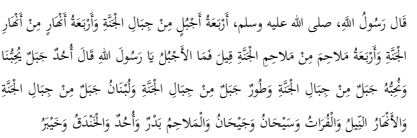
Le Messager d'Allah ﷺ a dit : « Quatre montagnes font partie des montagnes du Paradis (Jannah), quatre fleuves font partie des fleuves du Paradis (Jannah) et quatre grandes batailles acharnées feront partie des batailles du Paradis (Jannah) ». On lui demanda : « Quelles montagnes, ô Messager d'Allah ? » Il répondit : « Uhud, une montagne qui nous aime et que nous aimons, est une montagne parmi les montagnes du Paradis (Jannah) ; Tur est une montagne parmi les montagnes du Paradis (Jannah) et Lubnan est une montagne parmi les montagnes du Paradis (Jannah). Quant aux fleuves, ce sont le Nil, l'Euphrate, le Saihan (Oxus) et le Jaihan (Jaxartes), tandis que les grandes batailles acharnées sont Badr, Uhud, Khandaq et Khaibar ».
The Messenger of Allah (peace be upon him) said: “Four mountains are from the mountains of Jannah (paradise) and four rivers are from the rivers of paradise and four fierce great battles will be from the battles of paradise” It was asked: “Which mountains O Messenger of Allah?” He said: “Uhud, a mountain that loves us and we love it, is a mountain from the mountains of paradise, Tur is a mountain from the mountains of paradise and Lubnan is a mountain from among the mountains of paradise. And the rivers are the Nile, Euphrates, Saihan (Oxus) and Jaihan (Jaxartes), while the fierce great battles are Badr, Uhud, Khandaq and Khaibar”.
- Muhammad bin ‘Ali bin Mu’aim Al-Baladi nous a rapporté, d'après Muhammad bin Abdullah bin ‘Umar, d'après Ma’afa bin ‘Imran, d'après Kathir bin Abdullah bin ‘Amr, d'après son père, d'après son grand-père : que le Prophète ﷺ a dit :
- Muhammad bin ‘Ali bin Mu’aim Al-Baladi related to us from Muhammad bin Abdullah bin ‘Umar, from Ma’afa bin ‘Imran, from Kathir bin Abdullah bin ‘Amr, from his father, from his grandfather: That the Prophet (peace be upon him) said:

« Ô assemblée des Quraish, gardez-moi à l'esprit en ce qui concerne mes compagnons, leurs fils et les fils de leurs fils. »
“O gathering of the Quraish, keep me in mind in respect to my companions, their sons and the sons of their sons”.
- Muhammad bin Rabi’ bin Sulaiman Al-Jiziy nous a rapporté, d'après Abu Umayyah At-Tarsusiy, d'après Mu’awiyah bin ‘Amr, d'après Abu Ishaq Al-Fazariy, d'après Ibn Kathir bin Abdullah, d'après son père, d'après son grand-père, qui a dit :
- Muhammad bin Rabi’ bin Sulaiman Al-Jiziy related to us from Abu Umayyah At-Tarsusiy, from Mu’awiyah bin ‘Amr, from Abu Ishaq Al- Fazariy, from Ibn Kathir bin Abdullah, from his father, from his grandfather, who said:

Le Messager d'Allah ﷺ a dit : « Il n'y a ni pillage, ni butinage, ni vol dans le butin, et quiconque vole dans le butin se présentera au Jour de la Résurrection avec ce qu'il a volé ».
The Messenger of Allah (peace be upon him) said: “There is no plundering, no looting and no stealing from the spoils and whoever steals from the spoils will come on the Day of Judgement with that which he stole”.
- Muhammad bin Ahmad Bin Al-Hussein Al-Ahwaziy nous a rapporté, d'après ‘Amr bin ‘Ali, d'après Muhammad bin Khalid bin ‘Athmah, d'après Kathir bin Abdullah Al-Muzani, d'après son père, d'après son grand-père, qui a dit :
- Muhammad bin Ahmad Bin Al-Hussein Al-Ahwaziy related to us from ‘Amr bin ‘Ali, from Muhammad bin Khalid bin ‘Athmah, from Kathir bin Abdullah Al-Muzani, from his father, from his grandfather, who said:

Le Messager d'Allah ﷺ a dit : « L'Heure ne viendra pas avant qu'Allah ne conquière Constantinople et Rome, accompagnées de Tasbih et de Takbir ».
The Messenger of Allah (peace be upon him) said: “The final hour will not come until Allah conquers Constantinople and Rome accompanied by Tasbih and Takbir”.
- Ahmad bin Muhammad bin Abdul ‘Aziz bin Al-Ja’d nous a rapporté, d'après Muhammad bin Ishaq Al-Masibi, d'après Abdullah bin Muhammad bin Salm, d'après Abdur Rahman bin Ibrahim, d'après Abdullah bin Nafi’, d'après Kathir bin Abdullah, d'après son père, d'après son grand-père, d'après le Prophète ﷺ :
- Ahmad bin Muhammad bin Abdul ‘Aziz bin Al-Ja’d related to us from Muhammad bin Ishaq Al-Masibi, from Abdullah bin Muhammad bin Salm, from Abdur Rahman bin Ibrahim, from Abdullah bin Nafi’, from Kathir bin Abdullah, from his father, from his grandfather, from the Prophet (peace be upon him):

« Celui qui donne l'aumône obligatoire (Zakah) a réussi » Il a dit : Zakat ul-Fitr.
“The one who gives Zakah has attained success” He said: Zakat ul-Fitr.
- Ibn Salm nous a rapporté d'après Abdur Rahman, d'après Abdullah bin Nafi’, d'après Kathir bin Abdullah, d'après son père, d'après son grand-père, que le Prophète ﷺ a dit :
- Ibn Salm related to us from Abdur Rahman, from Abdullah bin Nafi’, from Kathir bin Abdullah, from his father , from his grandfather, that the Prophet (peace be upon him) said:

« Gardez-vous du faux pas ou de l'égarement de l' 'Aalim (savant) et attendez-vous à ce qu'il se reproduise ». Ahmad bin Hafs nous a rapporté, d'après Az-Zubair bin Bakkar, d'après Abdullah bin Nafi’, la même chose que ci-dessus. Ahmad bin 'Ali Al-Mada'ini nous a rapporté, d'après Ahmad bin Muhammad Abu Bakr Al-Hatibi, d'après Ishaq Al-Janbiy qui a dit : Kathir bin Abdullah Al-Muzani l'a mentionné d'après son père, d'après son grand-père, qui a dit : Le Messager d'Allah ﷺ a dit : La même chose que ci-dessus (c'est-à-dire « Gardez-vous de l'égarement de l' 'Aalim »).
“Take guard from the slip or lapse of the ‘Aalim (scholar) and so await its recurrence”. Ahmad bin Hafs related to us from Az-Zubair bin Bakkar, from Abdullah bin Nafi’ the same as above. Ahmad bin ‘Ali Al-Mada’ini related to us, from Ahmad bin Muhammad Abu Bakr Al-Hatibi, from Ishaq Al-Janbiy who said: Kathir bin Abdullah Al-Muzani mentioned it from his father, from his grandfather, who said: The Messenger of Allah (peace be upon him) said: The same as above (i.e. “Take guard from the lapse of the ‘Aalim”).
- Ahmad bin ‘Ali nous a rapporté de Muhammad bin Khuraim Al-Qazzaz, de Hisham bin Khalid, de Marwan bin Mu’awiyah, de Kathir bin Abdullah Al-Muzani, de son père, de son grand-père :
- Ahmad bin ‘Ali related to us from Muhammad bin Khuraim Al- Qazzaz, from Hisham bin Khalid, from Marwan bin Mu’awiyah, from Kathir bin Abdullah Al-Muzani, from his father, from his grandfather:

« Le Prophète ﷺ a dit à Bilal bin Al-Harith : "Ô Bilal, sache !" Il dit : "Je suis prêt à savoir, ô Messager d'Allah ﷺ !" Il dit (de nouveau) : "Ô Bilal, sache !" Il dit : "Je suis prêt à savoir, ô Messager d'Allah ﷺ !" Il dit : "Ô Bilal, sache que certes, quiconque fait revivre une sunna de ma sunna qui est morte après moi, alors il aura une récompense semblable à celle de celui qui l'applique, sans que cela ne diminue en rien leurs récompenses. Et quiconque introduit une innovation erronée dont Allah n'est pas satisfait, ni Son Messager ﷺ, alors il recevra des péchés semblables à ceux de celui qui l'applique, sans que cela ne diminue en rien les péchés des gens". »
“That the Prophet (peace be upon him) said to Bilal bin Al-Harith: “O Bilal, Know!”. He said: “I am ready to know O Messenger of Allah!” He said (again) “O Bilal, know!” He said: “I am ready to know O Messenger of Allah!” He said: “O Bilal, know that indeed whoever revives a Sunnah from my Sunnah which has died out after me, then for him is a reward similar to whoever acts upon it without diminishing anything from their rewards. And whoever introduces an erroneous innovation which Allah is not pleased with, nor His Messenger, then he shall receive sins similar to whoever acts upon it, without that diminishing anything from the sins of the people”.
- Avec la même chaîne de transmission (Isnad) de son grand-père, qui a dit :
- With the same Isnad from his grandfather, who said:

« J'ai mémorisé du Messager d'Allah ﷺ 16 fondements parmi les fondements de la religion (Deen) ». Il a dit : Le Messager d'Allah ﷺ a dit :
“I memorised from the Messenger of Allah (peace be upon him) 16 foundations from the foundations of the Deen”. He said: The Messenger of Allah (peace be upon him) said:

« Il n'y a pas de responsabilité (diya) pour les bêtes (c'est-à-dire en cas d'attaque), il n'y a pas de responsabilité pour les puits (c'est-à-dire pour les accidents qui s'y rapportent) et un cinquième est dû sur le trésor enfoui (Rikaz). »
“There is no liability (blood money) for beasts (i.e. from being attacked), there is no liability for wells (i.e. accidents related to them) and a fifth is due from the buried treasure (Rikaz)”.

Il a dit : « Il n'y a ni Jalab ni Janab (signifiant que les animaux ne doivent pas être déplacés de leur lieu de pâturage vers le collecteur de l'aumône obligatoire (Zakah)), il n'y a pas d'entrave et il n'y a pas de commerce d'un citadin. »
He said: “There is no Jalab and no Janab (meaning that animals should not be moved away from their place of grazing to the collector of Zakah), there is no obstruction and there is no trade of a townsperson
« ... pour un Bédouin. Il n'y a point de prise de possession illicite, ni de pillage, ni de butinage, ni de vol dans le butin ; et quiconque vole dans le butin viendra avec ce qu'il a volé le Jour du Jugement. »
for a Bedouin. And there is no unlawful taking of possession, no plundering, no looting and no stealing from the spoils and whoever steals from the spoils will come with that which he stole on the Day of Judgement”.

Il a dit : « Quiconque prend en charge un Mawla qui n'est pas de ses Mawali, alors la malédiction d'Allah et Sa colère seront sur lui, et rien ne sera accepté de lui ».
He said: “Whoever takes charge of a Mawla from other than his Mawali, then the curse of Allah and His anger will be upon him, and nothing will be accepted from him”.

Il a dit : « Quiconque commet un crime (c'est-à-dire une violation des droits d'autrui ou de l'alliance), alors la malédiction d'Allah et Sa colère seront sur lui, et rien ne sera accepté de sa part ».
He said: “Whoever commits a crime (i.e. breaching the rights of others or the covenant), then the curse of Allah and His anger will be upon him, and nothing will be accepted from him”.
- Avec la même chaîne de transmission (Isnad) de son grand-père, il a dit : Le Messager d'Allah ﷺ a dit :
- With the same Isnad from his grandfather, he said: The Messenger of Allah (peace be upon him) said:

« Les musulmans sont liés par leurs conditions, à l'exception de la condition qui rend le licite (Halal) illicite (Haram) ou une condition qui rend l'illicite (Haram) licite (Halal) ».
“The Muslims are upon their conditions apart from the condition which makes the Halal (lawful) Haram (unlawful) or a condition that makes the Haram (unlawful) Halal (lawful)”.
- Abdul Wahhab bin Abu ‘Usmah nous a rapporté, d'après Isma’il bin Yazid Al-Asbahani, d'après Ma’n bin ‘Eisa, d'après Kathir bin Abdullah Al-Muzani, d'après son père, d'après son grand-père qui a dit :
- Abdul Wahhab bin Abu ‘Usmah related to us from Isma’il bin Yazid Al-Asbahani, from Ma’n bin ‘Eisa, from Kathir bin Abdullah Al- Muzani, from his father, from his grandfather who said:

J'ai entendu le Messager d'Allah ﷺ dire : « Il s'est levé, a loué Allah et L'a glorifié. Puis il a dit : Ô gens, quiconque parmi ceux qui entreprennent le pèlerinage (Hajj) et le petit pèlerinage (Umrah) et ceux qui sont en voyage se trouve sur une terre déserte a plus de droit à l'eau et à l'ombre, ne privez donc pas les gens de la terre (c'est-à-dire de l'accès). »
I heard the Messenger of Allah (peace be upon him): “He stood, praised Allah and extolled Him. He then said: O people, whoever from those undertaking Hajj and ‘Umrah and those who are travelling are upon deserted land have more right to water and shade and so do not prevent the people from the land (i.e. access)”.
À la suite de cela, il est apparu, dans cette édition imprimée, un certain nombre de hadiths sans lien qui n'avaient aucun rapport avec Kathir bin Abdullah. Il semble que l'origine de l'erreur soit le manuscrit lui-même, et d'autres manuscrits peuvent être révisés et comparés à celui-ci s'ils peuvent être trouvés… (Après la mention de ces hadiths sans rapport, Ibn Adiy continue) :
Following this, there came, in this printed edition, a number of unconnected Ahadeeth which had no relationship with Kathir bin Abdullah at all. It appears that the origin of the error is the manuscript itself and other manuscripts can be revised and compared to this one if they can be found … (Following the mention of those unrelated Ahadeeth Ibn Adiy continues):
- Il (Ibn ‘Adiy) a dit : Ahmad bin Hafs As-Sa’diy nous a rapporté, d'après Ahmad bin Ibrahim Ad-Duraqiy, d'après Abdullah bin Nafi’, d'après Kathir bin Abdullah Al-Muzani, d'après son père, d'après son grand-père, qui a dit :
- He (Ibn ‘Adiy) said: Ahmad bin Hafs As-Sa’diy related to us from Ahmad bin Ibrahim Ad-Duraqiy, from Abdullah bin Nafi’, from Kathir bin Abdullah Al-Muzani, from his father, from his grandfather, who said:

Le Messager d'Allah ﷺ a dit : « Laissez ces Abyssins en paix tant qu'ils vous laissent en paix. »
The Messenger of Allah (peace be upon him) said: “Leave be those Abyssinians as long as they leave you be”.
- Muhammad bin Al-Hasan Al-Basriy a rapporté de Muhammad bin Bakkar Al-‘Aishi, de Muhammad bin Isma’il bin Abu Fadaik, de Kathir bin Abdullah Al-Muzani, de son père, de son grand-père, qui a dit :
- Muhammad bin Al-Hasan Al-Basriy related from Muhammad bin Bakkar Al-‘Aishi, from Muhammad bin Isma’il bin Abu Fadaik, from Kathir bin Abdullah Al-Muzani, from his father, from his grandfather, who said:

« Le Prophète ﷺ a entendu un homme dire qu'il était vert (luxuriant) et il a alors dit : Nous sommes à votre service. Nous avons pris et vous avez pris de ce qui est parmi vous. »
“The Prophet (peace be upon him) heard a man calling it green (luscious) and so he said: We are at your service. We have taken and you have from what is among you” .
- Muhammad bin Al-Hasan Al-Basriy, d'après Al-‘Abbas bin Abdul ‘Azhim, d'après Abdullah bin Ja’far bin Abu Kathir Al-Ansari, d'après Kathir bin Abdullah bin ‘Amr bin ‘Awf Al-Muzani, d'après son père, d'après son grand-père, d'après Bilal bin Al-Harith Al-Muzani :
- Muhammad bin Al-Hasan Al-Basriy related from Al-‘Abbas bin Abdul ‘Azhim, from Abdullah bin Ja’far bin Abu Kathir Al-Ansari, from Kathir bin Abdullah bin ‘Amr bin ‘Awf Al-Muzani, from his father, from his grandfather, from Bilal bin Al-Harith Al-Muzani:

« Que lorsque le Prophète ﷺ voulait se soulager, il s'éloignait à une certaine distance ».
“That when the Prophet (peace be upon him) wanted to relive himself, he would move away at a distance”.
- Abdullah bin Abdul Hamid Al-Wasitiy a rapporté d'An-Nadr bin Salamah, d'Abu ‘Uziyyah Muhammad bin Musa Al-Ansari, le juge (Qadi) d'Al-Madinah, de Kathir bin Abdullah, de son père, de son grand-père ‘Amr bin ‘Awf, qui a dit :
- Abdullah bin Abdul Hamid Al-Wasitiy related from An-Nadr bin Salamah, from Abu ‘Uziyyah Muhammad bin Musa Al-Ansari, the Qadi (Judge) of Al-Madinah, from Kathir bin Abdullah, from his father, from his grandfather ‘Amr bin ‘Awf, who said:

« J'ai vu le Messager d'Allah ﷺ debout sur le Maqam et il disait : Ô gens, ceci est la direction de la prière (Qiblah), c'est la direction de la prière (Qiblah) de la mosquée et la mosquée est la direction de la prière (Qiblah) de la Dunyaa (monde) ».
“I saw the Messenger of Allah (peace be upon him) standing upon the Maqam and he was saying: O people, this Qiblah, it is the Qiblah of the Masjid and the Masjid is the Qiblah of the Dunyaa (world)”.
- Muhammad bin Yusuf bin ‘Asim Al-Bukhari nous a rapporté, d'après Ahmad bin Isma’il Al-Qurashi, d'après Abdullah bin Nafi’, d'après Kathir bin Abdullah, d'après son père, d'après son grand-père :
- Muhammad bin Yusuf bin ‘Asim Al-Bukhari related to us from Ahmad bin Isma’il Al-Qurashi, from Abdullah bin Nafi’, from Kathir bin Abdullah, from his father, from his grandfather:

« Que le Messager d'Allah ﷺ était dans la mosquée. Il entendit des paroles derrière lui et celui qui les prononçait disait : "Ô Allah, aide-moi par ce qui me sauvera de ce dont Tu m'as fait craindre". Alors, le Messager d'Allah ﷺ dit en entendant cela : "N'inclurais-tu pas sa sœur avec elle ?" L'homme dit alors : "Ô Allah, accorde-moi l'aspiration des véridiques pour ce que Tu as rendu désirable pour eux". Le Messager d'Allah ﷺ dit alors à Anas bin Malik qui était avec lui : "Va vers lui, ô Anas, et dis-lui que le Messager d'Allah ﷺ te dit : 'Demande pardon pour moi'". Anas alla donc vers lui et lui transmettit cela. L'homme dit alors : "Ô Anas, tu es le messager du Messager d'Allah ﷺ pour moi". Il répondit : "Tout comme tu l'es". Il retourna pour vérifier. Le Messager d'Allah ﷺ dit alors : "Dis-lui oui". Alors, il (l'homme) lui dit : "Va et dis-lui qu'Allah t'a favorisé par rapport aux Prophètes comme Il a favorisé le mois de ramadan par rapport aux autres mois, et qu'Il a favorisé ta communauté (Ummah) par rapport aux nations comme Il a favorisé le jour du Jumu’ah par rapport à tous les autres jours". Ils partirent à sa recherche et voici que c'était Khadir (paix sur lui). »
“That the Messenger of Allah (peace be upon him) was in the Masjid. He heard speech behind him and the one saying it was saying: “O Allah assist me with which will save me from that which you have made me fearful of”. So, the Messenger of Allah (peace be upon him) said when he heard that: “Will you not include its sister alongside it?” The man then said: “O Allah bestow upon me the longing of the truthful to that which you have made desirable for them”. The Messenger of Allah (peace be upon him) then said to Anas bin Malik who was in his company: “Go to him O Anas and say to him that the Messenger of Allah (peace be upon him) says to you: “Seek forgiveness for me”. So, Anas went to him and conveyed that to him. The man then said: “O Anas, you are the messenger of the Messenger of Allah (peace be upon him), to me. He replied: “Just as you are”. He returned to verify it. The Messenger of Allah (peace be upon him) then said: “Say to him yes”. So, he (the man) said to him: “Go and say to him that Allah has favoured you over the Prophets like He has favoured the month of Ramadan over other months and that He has favoured your Ummah (nation) over the nations like He has favoured the day of Jumu’ah over all of the other days”. They went looking and behold it was Khadir, peace be upon him”.
- Ahmad bin Ja’far nous a rapporté, d'après Ya’qub bin Ibrahim Ad-Duraqi, d'après Ibrahim bin Abdullah Ar-Rafa’iy, d'après Kathir bin Abdullah, d'après son père, d'après son grand-père :
- Ahmad bin Ja’far related to us from Ya’qub bin Ibrahim Ad-Duraqi, from Ibrahim bin Abdullah Ar-Rafa’iy, from Kathir bin Abdullah, from his father, from his grandfather:

« Que le Messager d'Allah ﷺ a accompli la prière funéraire sur le Najashi (Négus d'Abyssinie) et a fait cinq Takbirs ».
“That the Messenger of Allah (peace be upon him) prayed over the Najashi (Negus of Abyssinia) and did five Takbirs”.
- ‘Imran bin Musa nous a rapporté, d'après Ibrahim bin Al-Mundhir, d'après Abu Al-Ja’d Abdur Rahman bin Abdullah As-Salmiy, d'après Kathir bin Abdullah Al-Muzani, d'après son père, d'après son grand-père, qui a dit :
- ‘Imran bin Musa related to us from Ibrahim bin Al-Mundhir, from Abu Al-Ja’d Abdur Rahman bin Abdullah As-Salmiy, from Kathir bin Abdullah Al-Muzani, from his father, from his grandfather, who said:

Le Messager d'Allah ﷺ a dit : « le cheval est offert le jour de son abreuvement ».
“The Messenger of Allah (peace be upon him) said: “the horse is offered the day of its watering”.
Il reste encore un petit nombre de hadiths rapportés par Kathir bin Abdullah de son père, de son grand-père, et la plupart de ses hadiths que j'ai mentionnés ainsi que la majeure partie de ce qu'il a rapporté ne possèdent pas de corroboration (ou de soutien) (c'est-à-dire qu'il est seul à les rapporter). - Bahlul bin Ishaq nous a rapporté, d'après Isma’il bin Abu Uwais, d'après Kathir bin Abdullah Al-Muzani, d'après Rubaih bin Abdur Rahman bin Abu Sa’id Al-Kudri, d'après son père, d'après son grand-père, qui a dit :
There are still a small number of Ahadeeth related by Kathir bin Abdullah from his father, from his grandfather remaining and most of his Ahadeeth which I mentioned and most of what he related, does not have that which conforms (or supports) them (i.e. he is alone in narrating them). - Bahlul bin Ishaq related to us from Isma’il bin Abu Uwais, from Kathir bin Abdullah Al-Muzani, from Rubaih bin Abdur Rahman bin Abu Sa’id Al-Kudri, from his father, from his grandfather, who said:

« J'ai vu des hommes parmi les Arabes (c'est-à-dire des Bédouins) s'approcher du Messager d'Allah ﷺ. Ils dirent : "Ô Messager d'Allah, nous sommes des gens possédant du bétail et nous en prélevons notre aumône (Sadaqah) (c'est-à-dire la Zakah), est-ce que cela couvre également pour nous l'aumône obligatoire (Zakah) du ramadan ?" Le Messager d'Allah ﷺ dit : "Non, elle est prélevée sur l'enfant et l'adulte, sur l'homme libre et sur l'esclave. C'est une purification pour vous". Abu Sa’id Al-Khudri a dit : "J'ai vu durant l'année que les troupeaux étaient abondants et que les récoltes blanches avaient diminué plus que les noires. J'ai ensuite vu durant l'année suivante que les récoltes étaient abondantes et que les troupeaux noirs avaient diminué plus que les blancs". Je ne connais personne rapportant ce hadith de Rubaih en dehors de Kathir bin Abdullah] [Fin de la citation d'Ibn ‘Adiy].
“I saw men from the Arabs (i.e. Bedouins) approaching the Messenger of Allah (peace be upon him). They said: “O Messenger of Allah, we are people possessing livestock and we take out from them our Sadaqah (i.e. Zakat) and so does that also cover for us the Zakat of Ramadan?” The Messenger of Allah (peace be upon him) said: “No, it is taken from the child and the adult, from the free and the slave. It is a purification for you”. Abu Sa’id Al-Khudri said: I saw in the year that the herds were plentiful and that the white crops diminished more than the black. I then saw in the year following that the crops were plentiful and that the black herds were diminished more than the white”. I do not know anyone relating this Hadith from Rubaih apart from Kathir bin Abdullah] [End of quote of Ibn ‘Adiy].
Je dis : Concernant la déclaration d'Ibn ‘Adiy : « Il reste encore un petit nombre de hadiths rapportés par Kathir bin Abdullah de son père, de son grand-père, et la plupart de ses hadiths que j'ai mentionnés ainsi que la majeure partie de ce qu'il a rapporté, ne possèdent pas de corroboration (c'est-à-dire qu'il est seul à les rapporter) », cela ne signifie pas une déclaration de non-fiabilité ou une classification de faiblesse. Car le simple fait d'être seul à rapporter des hadiths, « la majeure partie de ce qu'il a rapporté ne possède pas de corroboration », surtout en ce qui concerne celui qui est issu des petits-fils peu célèbres des compagnons (Sahabah) (comme le cas de Bahz bin Hakim par exemple), n'impose pas la faiblesse ou la non-fiabilité. C'est comme si Ibn ‘Adiy préférait rester prudent et choisissait d'éviter de rendre un verdict sur l'homme. En effet, lorsqu'il veut exprimer la non-fiabilité ou le défaut d'un homme, il déclare généralement : « Et la faiblesse est évidente dans son hadith » ou des paroles similaires. Alors que s'il veut déclarer la fiabilité et la justesse d'un narrateur, il dit : « Je n'ai rien trouvé de blâmable (Munkar) à son sujet » ou « Je n'ai rien trouvé de blâmable (Munkar) de sa part si un Thiqah (narrateur fiable et digne de confiance) a rapporté de lui ». Il est apparent que rien ne lui est parvenu d'Al-Bukhari en dehors de ce que son Sheikh Isma’il bin Abu Uwais lui a rapporté : « J'ai entendu (ou reçu de) Kathir bin Abdullah bin ‘Amr bin ‘Awf bin Yazid bin Milhah Al-Muzani en l'an 158, puis l'an 161 ou 162 ».


« Que le Messager d'Allah ﷺ était dans la mosquée. Il entendit des paroles derrière lui et celui qui les prononçait disait : "Ô Allah, aide-moi par ce qui me sauvera de ce dont Tu m'as fait craindre". Alors, le Messager d'Allah ﷺ dit en entendant cela : "N'inclurais-tu pas sa sœur avec elle ?" L'homme dit alors : "Ô Allah, accorde-moi l'ardent désir des véridiques pour ce que Tu as rendu désirable pour eux". Le Messager d'Allah ﷺ dit alors à Anas bin Malik qui était en sa compagnie : "Va vers lui, ô Anas, et dis-lui que le Messager d'Allah ﷺ te dit : 'Demande pardon pour moi'". Anas alla donc vers lui et lui transmit cela. L'homme dit alors : "Ô Anas, tu es le messager du Messager d'Allah ﷺ pour moi". Il répondit : "Tout comme tu l'es". Il retourna pour vérifier. Le Messager d'Allah ﷺ dit alors : "Dis-lui oui". Alors, il (l'homme) lui dit : "Va et dis-lui qu'Allah t'a favorisé par rapport aux Prophètes comme Il a favorisé le mois de ramadan par rapport aux autres mois, et qu'Il a favorisé ta communauté (Ummah) par rapport aux nations comme Il a favorisé le jour du Jumu’ah par rapport à tous les autres jours". Ils partirent à sa recherche et voici que c'était Khadir (paix sur lui). »
“That the Messenger of Allah (peace be upon him) was in the Masjid. He heard speech behind him and the one saying it was saying: “O Allah assist me with which will save me from that which you have made me fearful of”. So, the Messenger of Allah (peace be upon him) said when he heard that: “Will you not include its sister alongside it?” The man then said: “O Allah bestow upon me the longing of the truthful to that which you have made desirable for them”. The Messenger of Allah (peace be upon him) then said to Anas bin Malik who was in his company: “Go to him O Anas and say to him that the Messenger of Allah (peace be upon him) says to you: “Seek forgiveness for me”. So, Anas went to him and conveyed that to him. The man then said: “O Anas, you are the messenger of the Messenger of Allah (peace be upon him), to me. He replied: “Just as you are”. He returned to verify it. The Messenger of Allah (peace be upon him) then said: “Say to him yes”. So, he (the man) said to him: “Go and say to him that Allah has favoured you over the Prophets like He has favoured the month of Ramadan over other months and that He has favoured your Ummah (nation) over the nations like He has favoured the day of Jumu’ah over all of the other days”. They went looking and behold it was Khadir, peace be upon him”.
Nous avons cherché cette narration dans tous les endroits imaginables, mais nous n'avons pas été en mesure de la trouver, si ce n'est par cette voie de l'imam Ibn ‘Adiy. La narration lui est également attribuée dans le livre « Unais As-Saari Fee Takhrij Ahadeeth Fat’h ul-Baari » (9/6578/4610) :
We searched for this narration in every conceivable place but we were unable to find it except from this path of Imam Ibn ‘Adiy. The narration is also attributed to him in the book “Unais As-Saari Fee Takhrij Ahadeeth Fat’h ul-Baari” (9/6578/4610):

‘Amr bin ‘Awf a rapporté : « Que le Prophète ﷺ a entendu des paroles alors qu'il se trouvait dans la mosquée et a ensuite dit : "Ô Anas, va vers celui qui a dit cela et demande-lui de demander pardon pour moi". Anas alla vers l'homme et celui-ci lui dit : "Dis-lui (c'est-à-dire au Prophète ﷺ) que certes Allah t'a favorisé par rapport aux Prophètes par ce dont Il a favorisé le ramadan par rapport aux autres mois". Il dit : Ils allèrent ensuite voir et il s'avéra que c'était Khadir ». Al-Hafizh (Ibn Hajar) a dit : « C'est un hadith faible qu'Ibn ‘Adiy a extrait via la voie de Kathir bin ‘Amr bin ‘Awf, de son père, de son grand-père, et c'est une chaîne de transmission (Isnad) faible ». Ibn ‘Asakir a rapporté quelque chose de similaire à partir du hadith d'Anas, avec une chaîne de transmission (Isnad) plus faible que celle-ci » (7/245 – Le livre des ahadith des Prophètes – Chapitre : Le hadith d'Al-Khadir avec Musa (paix sur lui)). Il est très faible. Il a rapporté à partir du hadith de ‘Amr bin ‘Awf et du hadith d'Anas. Quant au hadith de ‘Amr bin ‘Awf, alors Ibn ‘Adiy l'a extrait (6/2083) via la voie de Abdullah bin Nafi’ As-Sa’igh de Kathir bin Abdullah, de son père, de son grand-père : « Que le Messager d'Allah ﷺ était dans la mosquée et a ensuite entendu des paroles... etc... ».
[‘Amr bin ‘Awf related: “That the Prophet (peace be upon him) heard speech whilst he was in the Masjid and then said: “O Anas, go to the one who said that and ask him to seek forgiveness for me”. Anas went to the man and he (the man) said to him: “Say (to him i.e. the Prophet) that verily Allah has favoured you over the Prophets by that which he has favoured Ramadan over the remaining months”. He said: They then went to see and behold it was Khadir”. Al-Hafizh (Ibn Hajar) said: “It is a weak Hadith which Ibn ‘Adiy extracted via the path of Kathir bin ‘Amr bin ‘Awf, from his father, from his grandfather, and it is a weak Isnad (chain of transmission)”. Ibn ‘Asakir related similar to it from the Hadith of Anas, with a chain of transmission which is weaker than it” (7/245 – The book of the Ahadeeth of the Prophets – Chapter: The Hadith of Al-Khadir with Musa, peace be upon him). It is very weak. He related from the Hadith of ‘Amr bin ‘Awf and the Hadith of Anas. As for the Hsdith of ‘Amr bin ‘Awf, then Ibn ‘Adiy extracted it (6/2083) via the path of Abdullah bin Nafi’ As-Sa’igh from Kathir bin Abdullah, from his father, from his grandfather: “That the Messenger of Allah (peace be upon him) was in the Masjid and then he heard speech … etc …].
Comme on peut le voir, Al-Hafizh (Ibn Hajar) a attribué la narration à Kathir bin Abdullah, tandis qu'Abu Hudhaifah Nabil bin Mansur bin Ya’qub bin Sultan Al-Bisarah Al-Kuwitiy, l'auteur de « Unais As- Saari », l'a attribuée à Abdullah bin Nafi’ As-Sa’igh de la part de Kathir bin Abdullah. Cependant, tous deux sont coupables d'un manquement obscène à cet égard.
As can be seen, Al-Hafizh (Ibn Hajar) attributed the narration to Kathir bin Abdullah whilst Abu Hudhaifah Nabil bin Mansur bin Ya’qub bin Sultan Al-Bisarah Al-Kuwitiy, the author of “Unais As- Saari”, attributed it to Abdullah bin Nafi’ As-Sa’igh from Kathir bin Abdullah. However, both of them are guilty of an obscene shortcoming in respect to this.

Le Messager d'Allah ﷺ a dit : « Certes, la religion (Deen) retournera au Hijaz comme un serpent retourne à son trou, et la religion (Deen) cherchera refuge au Hijaz comme la chèvre de montagne cherche refuge au sommet de la montagne. La religion (Deen) a commencé comme une chose étrange et reviendra comme une chose étrange. Bénis soient les étrangers ; ceux qui rectifieront ce que les gens après moi auront corrompu de ma sunna ».
That the Messenger of Allah (peace be upon him) said: “Verily, the Deen will retreat back to the Hijaz as a snake retreats back to its hole, and the Deen will seek refuge in the Hijaz as the mountain goat seeks refuge in the mountain top. The Deen began as something strange and will return as something strange. Blessed are the strangers; those who will rectify what the people after me have corrupted from my Sunnah”.
Certains ont parlé de Kathir, et s'ils s'étaient tus à son sujet, cela aurait été plus bénéfique. En vérité, seuls les ignorants ont parlé de lui et de ses motivations (ou de ses relations). J'ai entendu Ibn Uwais dire : Malik m'a interrogé sur ses hadith et Yahya bin Sa’id Al-Ansari a rapporté de lui. Je n'ai aucun doute avoir entendu Ibrahim bin Al-Mundhir (et si je ne l'ai pas entendu de lui, alors un Thiqah me l'a rapporté) dire : « Kathir prétendait que le Prophète ﷺ avait accordé des terres à son grand-père et il ne cessait de contester avec ceux de cette région. Il se querellait beaucoup. Il s'est rendu auprès d'Ibn ‘Imran pour se quereller et ainsi ‘Imran lui dit : "Ô Kathir, en vérité tu es un homme oisif qui se querelle beaucoup au sujet de ce que tu ne connais pas, tu prétends ce qui ne t'appartient pas et tu n'as aucune preuve pour ce que tu demandes. Ne m'approche donc pas et je ne te laisserai me voir que si tu considères que j'ai libéré mon temps pour les gens de l'erreur. Si tu vois cela, alors viens". Un jour, Ibn ‘Imran était avec nous et soudain Kathir bin Abdullah s'est approché de lui. Il (Ibn ‘Imran) dit : "Ne vous ai-je pas dit de ne pas venir vers moi à moins que vous ne me voyiez avoir libéré mon temps pour les gens de l'erreur ?" Kathir répondit alors : "Vous avez dit la vérité, qu'Allah améliore l'affaire du juge (Qadi). En vérité, je ne suis venu vers vous que lorsque les gens de l'erreur sont venus vers vous. Telle et telle personne est venue vers vous. Ils sont tous deux des gens de l'erreur, alors je suis venu avec eux deux". Cela faisait suite à l'ordre d'Ibn ‘Imran à son égard. » Abu Yusuf a dit : « Il a ordonné de rester ferme sur la colonne jusqu'à ce qu'il se soit levé des procédures judiciaires. » Abu Yusuf a dit : « Ils faisaient partie de ceux qui étaient dévoués à Ibn ‘Imran. » Ceci a également été enregistré dans la transcription de « Ash-Shamela Lil-Ma’rifah Wa At-Tarikh » (p. 62 – selon la numérotation de la bibliothèque électronique Shamela).
Some have spoken about Kathir who had they been silent about him it would have been more beneficial. Indeed, only the ignorant have spoken about him and his motives (or relations). I heard Ibn Uwais saying: Malik asked me about his Hadith and Yahya bin Sa’id Al-Ansari related from him. I have no doubt that I heard Ibrahim bin Al- Mundhir (And if I didn’t hear it from him, then a Thiqah related it to me) that he said: “Kathir used to claim that the Prophet (peace be upon him) had granted his grandfather land and he used to dispute with those in that area. He used to quarrel a lot. He went to Ibn ‘Imran to quarrel and so ‘Imran said to him: “O Kathir, indeed you are an idle man who quarrels a lot in respect to that which you don’t know, you claim that which does not belong to you and you have no evidence from what you demand. So, don’t approach me and I will not let me see you unless you see that I have freed my time for the people of falsehood. If you see that, then come”. One day Ibn ‘Imran was with us and then behold Kathir bin Abdullah had approached him. He (Ibn ‘Imran) said: “Did I not tell you to not come to me unless you see me having freed my time for the people of falsehood?” Kathir then replied: ““You have said the truth, may Allah make good the affair of the Qadi. Indeed, I only came to you when the people of falsehood came to you. So and so and so and so person came to you. They are both people of falsehood and so I came along with them both”. It was from the command of Ibn ‘Imran to him. Abu Yusuf said: “He commanded to remain fast to the column until he had stood from judicial proceedings”. Abu Yusuf said: “They were from those devoted to Ibn ‘Imran]. This has also been recorded in the transcript of “Ash-Shamela Lil- Ma’rifah Wa At-Tarikh” (p. 62 – by the numbering of the Shamela E- library).