1.4 “穆阿哈拉”(兄弟盟约)是何时缔结的,麦地那的《宪章》(Sahifah)又是何时写成的?
1.4 When was the “Mu’akhaah” (brotherhood pact) concluded and when was the Sahifah (of Al-Madinah) written?
既然已经提供了足够的文本,由此我们可以推断出以下结论:
The texts that have already been presented should be sufficient and from them we deduce the following:
1) 正确的观点是,穆哈吉如因(Muhajirin)与安萨尔(Ansar)之间的这种兄弟结盟,不可能发生在阿斯阿德·本·祖拉拉(愿真主喜悦他)去世之前,而是发生在建造清真寺期间,即先知(愿主福安之)抵达后约七个月。如果这件事发生在他在世时,而他却未被提及,这是难以想象的,因为他是安萨尔的首领,也是“纳基布”之一(即在第二次“阿夸巴”宣誓时被推选出来的安萨尔领袖)。因此,阿布·欧麦尔·伊本·阿卜杜·巴尔(Abu ‘Umar ibn Abd AlBarr)的说法……
1) The correct view is that this brotherhood between the Muhajirin and the Ansar could not possibly have taken place prior to the death of As’ad bin Zurarah (May Allah be pleased with him), during the building of the Masjid, about seven months following the arrival of the Prophet (peace be upon him). It is not conceivable that it took place in his lifetime without him having been mentioned in it, as he was chief of the Ansar and one of the Naqeebs (selected leaders of the Ansar at the second pledge of ‘Aqabah). Therefore, the statement of Abu ‘Umar ibn Abd AlBarr:
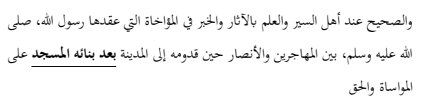
“学者们在圣传(Seera)方面所持的正确观点,以及相关记载表明,先知ﷺ来到麦地那后,在穆哈吉伦(迁徙者)与安萨尔(辅助者)之间缔结的“穆阿哈” (兄弟关系),是在他ﷺ建造清真寺之后进行的,其基础是相互扶持与援助,以及真理(Haqq)……”
“The correct view as held by the scholars of Seera and reports in respect to the “Mu’akhaah” (brotherhood) which the Messenger of Allah (peace be upon him) concluded between the Muhajirin (emigrants) and the Ansar (helpers), when he came to Al-Madinah, was that it took place after his building of the Masjid and it was upon the basis of the provision of assistance/support and the Haqq (truth) …” .
这是非常可信的,尤其是清真寺建成及其开放庆典的完成,为采取这一步骤提供了很好的时机。此外,这件事一定发生在白德尔战役之前,因为其中提到了欧拜达·本·哈里斯(本·阿尔-穆塔里布·本·阿卜杜·马纳夫·本·古赛伊·阿尔-古赖氏·阿尔-穆塔里布)以及他的兄弟欧麦尔·本·胡玛姆(本·贾穆赫·本·载伊德·本·哈拉姆·本·卡卜)。他们两人都在白德尔战役中殉教,愿安拉喜悦他们。他们在生时是兄弟,在死时也是兄弟,我们希望从安拉那里得到,他们在审判日也能如此。 2)正确的观点是,穆哈吉尔与安萨尔之间的这种兄弟关系,本来并未形成书面文件,因为其性质与此不相容。原因在于,所有的传述,没有一例例外,都根本没有提到书面文件。考察传记、历史和圣训的典籍可以发现,在麦地那宪章(Sahifah)之前,没有提到任何宪章、书面文件或法典。唯一的例外包括:
is very conceivable, and particularly as the completion of the building of the Masjid and the celebration for its opening, represented a good occasion for such a step to be undertaken. I addition, it must have been undertaken prior to the battle of Badr because Ubaida bin Al- Harith (bin Al-Muttalib bin Abd Manaf bin Qusayy Al-Qurashi Al-Muttalibi) is mentioned in it along with his brother ‘Umair bin Al- Humam (bin Al-Jamuh bin Zaid bin Haram bin Ka’b) and they were both martyred at the battle of Badr, may Allah be pleased with them. They were brothers in life and at death, and we hope from Allah that they be like that also, on the Day of Judgement. 2) The correct view is that this brotherhood between the Muhajirin and the Ansar was not written in origin as its nature was incompatible with that. That is because all of the narrations, without exception, do not mention a written document at all. An examination of the books of Seera, history and Hadith reveal the absence of the mention of any charter, written document or code prior to the Sahifah of Al-Madinah. The exception to that included:
a) 古兰经的“经页”(Sahaa'if):其中最为人所知的,有与欧麦尔皈依伊斯兰相关提到的那份经页(Sahifah,即书面文本),其中包含《塔哈》章;此外,还有欧麦尔亲笔所写、并寄给希沙姆·本·阿斯的那份经页,其中包含的内容是:
a) The pages (Sahaa’if) of the Qur’an: From among the most well- known of these was the Sahifah (written document) mentioned in relation to Umar’s embracing of Islam which included Surah TaHa within it. Also, the Sahifah which ‘Umar wrote by hand and was sent to Hisham bin Al-‘Aas. It contained within it:
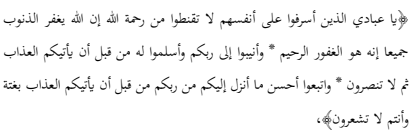
“说:‘我的仆人们啊!你们对自己过分(犯罪)的,不要对真主的慈悯绝望,真主必定赦宥一切罪过,他确是至赦的,确是至慈的。’你们应当归向你们的主,应当皈依他,在刑罚临头之前,然后你们不会得到援助。你们应当遵循你们的主所降示你们的最优美的(经典),在刑罚忽然临头,而你们不觉得之前。”(古兰经 39:53-55)
“Say, “O My servants who have transgressed against themselves [by sinning], do not despair of the mercy of Allah. Indeed, Allah forgives all sins. Indeed, it is He who is the Forgiving, the Merciful”. And return [in repentance] to your Lord and submit to Him before the punishment comes upon you; then you will not be helped. And follow the best of what was revealed to you from your Lord before the punishment comes upon you suddenly while you do not perceive” [TMQ 39:53-55].
b) 《鲁格曼的小册子》:Al-Majallah(Al-Majallah)与As-Sijli(As-Sijli)一样,都是指一种写成的文书(Sahifah),其页面是可以翻动的。这与Al-Baihaqi在《Dala’il An-Nubuwwah》(2/419)中所提到的情况相似。(在列出完整的传述链之后)'Asim bin 'Umar bin Qatadah Al-Ansaariy从他族中的长辈(Shuyukh)那里传述,他们说:
b) The Majallah of Luqman: Al-Majallah and likewise As-Sijli are a Sahifah (written document) that is turned or (its pages) turned over. That is like what came mentioned in “Dala’il An-Nubuwwah” of Al- Baihaqi (2/419). (After mentioning the full line of transmission) ‘Asim bin ‘Umar bin Qatadah Al-Ansaariy related from the Shuyukh (elders) of his people, that they said:
“来自白努·阿慕尔·本·奥夫部落的兄弟苏威德·本·萨米特,前来麦加朝觐或作小朝(欧姆拉)。他的族人称他为他们中的完美典范,因为他的年纪、肤色和头发。”他(传述者)说道:
“Suwaid bin As-Samit, the brother of Bani ‘Amr bin ‘Awf, came to Makkah as a pilgrim for Hajj of ‘Umrah. Suwaid was described by his people as being the model of perfection among them, due to his age, skin and hair. He (the narrator) said:
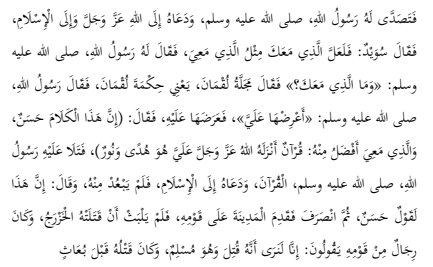
然后,安拉的使者(愿主赐他平安)走近他,邀请他信奉安拉——伟大而尊贵的安拉,并皈依伊斯兰。苏瓦伊德说:“也许你所拥有的,与我所拥有的相似。”于是,安拉的使者(愿主赐他平安)问道:“你拥有什么?”他回答说,他拥有鲁格曼的Majallah,即鲁格曼的Hikmah(智慧)。安拉的使者(愿主赐他平安)便说:“把它拿给我看。”他便拿给他看。他(愿主赐他平安)说:“这段话很好,但我所拥有的比它更好。那是安拉伟大而尊贵所启示的《古兰经》,它是引导与光明。”安拉的使者(愿主赐他平安)便向他诵读《古兰经》,并邀请他皈依伊斯兰。他没有远离,而是说:“这确实是一段好话。”随后他离开了,后来回到麦地那见到他的族人。不久之后,他便被赫兹拉季部落杀害了。他的族人中有人说:“我们认为他是在作为穆斯林时被杀的。”而他被杀发生在布阿斯战役之前。[引文结束] c)古莱氏人悬挂在天房内的那份(压迫而被诅咒的)抵制文书;它的故事,白蚁蛀食它的故事,以及关于它被废除的著名的穆塔瓦提尔(多途径传述)故事。 d)安拉的使者(愿主赐他平安)交给各次远征军指挥官的书页(Suhuf),其中载有指示,并且它们被封存或拼接在一起。这方面的例子见于瓦基迪的《Kitab ul-Maghazi》(1/13):
Then, the Messenger of Allah (peace be upon him) approached him and invited him to Allah ‘Azza Wa Jalla and to Islam. Suwaid said: “It may be that what you have is like that which I have”. So, the Messenger of Allah (peace be upon him) asked: “And what do you have?” He responded by saying that he had the Majallah of Luqman, meaning the Hikmah (wisdom) of Luqman. The Messenger of Allah (peace be upon him) then said: “Show it to me” and so he did. He (peace be upon him) said: “This speech is good but what I have is better than it. It is a Qur’an that Allah ‘Azza Wa Jalla has revealed and it is guidance and light”. The Messenger of Allah (peace be upon him) then recited the Qur’an to him and invited him to Islam. He didn’t distance himself from it and said: “Verily, this is a good speech”. He then left and later arrived to Al-Madinah to his people. It was not long thereafter that he was killed by the Khazraj. There were men from his people who would say: “We view that he was killed whilst he was a Muslim” and his killing occurred before the war of Bu’ath” [End of Quote]. c) The Sahifah (written document) of the (oppressive and accursed) Boycott which the Quraish hung inside the Ka’ba along; its story, the story of the termites eating it and then its well-known Mutawatir story concerning its nullification. d) The pages (Suhuf) which the Messenger of Allah (peace be upon him) gave to the commanders of the military expeditions, containing instructions, and they were sealed or patched together. And example of that is what came stated in Al-Waqidi’s “Kitab ul-Maghazi” (1/13):
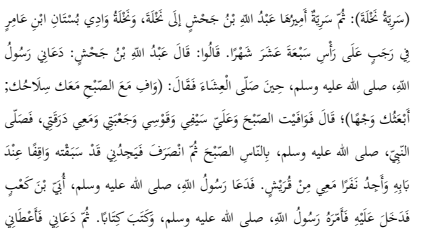
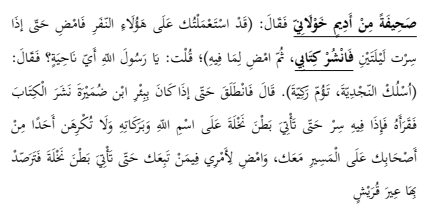
“由阿卜杜拉·本·贾赫什统领的纳赫拉远征(纳赫拉是伊本·阿米尔果园中的一处山谷)发生在伊历第二年的赖哲卜月,即伊斯兰历的第十七个月。”
“The expedition to Nakhla commanded by Abdullah bin Jahsh (Nakhla is a valley in the Bustan (Orchard) of Ibn ‘Amir) took place in the month of Rajab, the seventeenth month AH.
他们说:阿卜杜拉·本·贾哈什说:安拉的使者(愿主福安之)在他礼了宵礼时召见我,并说:"你明早带着你的武器来见我,我要派你去执行一项任务"。他说:于是我在黎明时带着我的剑、弓、箭袋和盾牌前去。先知(愿主福安之)与众人一同礼了晨礼(即斐杰尔礼),然后出来找到了我。他发现我已先于他站在他的门口,而我身边还有一群古莱氏人(即迁士)。安拉的使者(愿主福安之)召来乌贝依·本·凯尔卜,命他写一份文书。随后他召唤我,把一张来自哈瓦兰的皮纸交给我,说:"我任命你统率这群人。你们前行,直到走了两夜的路程,然后打开我的信,照信中所说的去做"。我说:"安拉的使者啊,应往哪个方向?"他回答:"朝纳季迪耶方向走,直到你到达一口小井"。传述者说:阿卜杜拉·本·贾哈什加快脚步,直到抵达伊本·杜迈拉的井边。然后他打开信阅读,信中写道:"你们奉安拉之名、蒙祂的祝福前行,直到抵达纳赫拉山谷。但不要强迫你的任何同伴与你同行。依照我的命令行事,与跟随你的人一起前进,直到抵达纳赫拉山谷,并在那里埋伏,等候古莱氏的商队"。(引文结束)
They said: Abdullah bin Jahsh said: The Messenger of Allah (peace be upon him) called for me when he prayed Ishaa’, and said: “Come to me at dawn with your weapons, as I will send you on a mission”. He said: So, I approached at dawn with my sword, my bow, my quiver and my shield. The Prophet prayed Subh (i.e. Fajr) with the people, and then he left and found me. He found me having preceded him already standing at his door whilst I found a group of the Quraysh (i.e. Muhajirun) with me there. The Messenger of Allah (peace be upon him) called for Ubayy bin Ka’b and commanded him to write a document. Then he called me and gave me the sheet of leather from Khawlan, saying: “I have appointed you over this group. Proceed until you have travelled for two nights. Then open my letter and do as it says”. I said: “O Messenger of God, in which direction?” He replied, “Go towards Najdiyya until you reach a small well”. The narrator said: Abdullah bin Jahsh hastened, until he reached the well of Ibn Dumayra. He then opened the letter and read it. It said: “Go, in the name of Allah and with His blessings, until you come to the valley of Nakhla, but do not force any one of your companions to go with you. Proceed according to my commands with whoever follows you, until you reach the valley of Nakhla and lie in wait for the caravan of Quraysh from there” [End of Quote].
3)正确的观点是,这种"Mu'ahkaah"(兄弟盟约)纯粹是以个人为单位的,即这个人以其个人身份与那个人以其个人身份结成对子。其中没有提及部落、血金(亲属关系)、战争或和平。因此,它与麦地那宪章(Sahifah of al-Madinah)在根本上是不同的。
3) The correct view is that this “Mu’ahkaah” (brotherhood pact) was purely on an individual basis i.e. This man in his personal individual description was paired with that man, in his personal individual description. There was no mention in it of tribes, blood money (relationship), war or peace. It was therefore fundamentally different to the Sahifah of al-Madinah.
4) 正确的观点是,在迁徙(希吉拉)之前,穆哈吉尔们之间确有一项“穆阿赫拉”(兄弟之约),其中包括先知ﷺ与阿里·本·阿比·塔利卜(愿安拉喜悦他)结为兄弟。最占优势的观点是,这一“穆阿赫拉”被在麦地那所订立的“穆阿赫拉”所取代或废止,但先知ﷺ与阿里·本·阿比·塔利卜(愿安拉喜悦他)之间所建立的兄弟关系,以及哈姆扎·本·阿卜杜勒·穆塔利卜与宰德·本·哈里赛(愿安拉喜悦他们)之间的兄弟关系,不在此列。因此,伊本·泰米叶所说的那些针对什叶派的话,并无依据,那是出于可憎可鄙的教派偏见与派系之争而发的。
总结与结论
Summary Conclusion
凡是遇到有关“صحيفة”(文书)或穆哈吉尔与安萨尔之间的文书的叙述,或涉及血金权利、战争或和平的叙述,我们必然知道,它与这一“兄弟结盟”(Mu’akhaah)毫无关系。它要么与麦地那的《麦地那宪章》有关,要么是在其之后才出现或写成的。艾哈迈德·阿布·宰德在《先知传记》(As-Seera An-Nabawiyah)第71页中,在“与犹太人订立条约(Mu’ahadah)的写作日期”这一标题下所载的内容,同样没有效力:“一位当代研究者认为,占优势的看法是,该文书本来是两份文件,后来历史学家将它们合并为一份。其中一份涉及安拉的使者ﷺ与犹太人的条约,写于伟大的白德尔战役之前;而另一份则阐明了穆斯林中的穆哈吉尔与安萨尔的义务、权利与责任。”他又说:“在我看来,与犹太人的和平协议(Muwada’ah)文书写于伟大的白德尔战役之前较为可信;至于第二份文书,则写于该战役之后。”古典文献中已有表达支持这一看法的内容。阿布·欧拜德·卡西姆·本·萨拉姆说:“这份文书(Wathiqa)是在两次情况下写成的:先知ﷺ抵达麦地那时,伊斯兰尚未占据优势、尚未壮大,也早于他奉命向有经典的人(Ahl ul-Kitab)征收人头税(Jizyah)之前。”拜拉祖里说:“安拉的使者ﷺ抵达麦地那时,与犹太人订立了和约(Muwada’ah),并在他自己与他们之间写下一份文书。他规定他们不得支持或助长他的敌人,要在他遭受攻击时支持他,并且他不会为了保护受庇护者(Ahl udh-Dhimmah)而参战。” 他并没有因此向任何人发动战争,他们也没有诽谤他,他也没有派遣军队,直到安拉·阿兹札·瓦·哲利(Allah ‘Azza Wa Jalla)降示:“那些遭受攻击的人,已被准许(应战),因为他们受到了不义的迫害。安拉确能使他们获胜。他们是无理被逐出家园的人。”(TMQ 22:39-40)。
Wherever we find a narration about a Sahifah or a written document between the Muhajirin and the Ansar, or concerning blood money rights, war or peace, we know, by necessity, that it bears no relation to this “Mu’akhaah” (formation of brotherhood). It would either be related to the Sahifah of Al-Madinah or something that came or was written (much) later than it. There is also no validity in what came related in “As-Seera An- Nabawiyah” by Ahmad Abu Zaid (p. 71) under the heading “The date of the writing of the treaty (Mu’ahadah) with the Jews”: “One of the contemporary researchers found preponderant that the document was actually two documents in origin and then the historians combined them into one. One of them dealt with the treaty of the Messenger of Allah (peace be upon him) with the Jews and was written prior to the great battle of Badr. That is whilst the second clarified the commitments (duties) of the Muslims from the Muhajirin and the Ansar, their rights and obligations. He said: “It is preponderant in my view that the peace agreement (Muwada’ah) document with the Jews was written before the great battle of Badr. As for the second document, then it was written after it”. The classical sources have expressed that which supports this preponderance. Abu ‘Ubaid Al-Qasim bin Salam said: “The Wathiqa (document) was written on two occurrences, when the Prophet (peace be upon him) arrived in Al-Madinah, prior to the dominance of Islam and its becoming strong and before he was commanded to take the Jizyah from Ahl ul-Kitab (the people of the book)”. Al-Baladhari said: “When the Messenger of Allah (peace be upon him) arrived in Al-Madinah he made a treaty (Muwada’ah) with the Jews and wrote between himself and them a document. He stipulated upon them that they should not support or side with his enemies, to support him against those who attack him and that he would not fight in defence of the Ahl udh-Dhimmah. He did not then wage war against anyone, they did not defame him and he did not dispatch a military expedition, until Allah ‘Azza Wa Jalla revealed: “Permission [to fight] has been given to those who are being fought, because they were wronged. And indeed, Allah is capable of providing them victory. [They are] those who have been evicted from their homes without right” (TMQ 22:39- 40)”.

"允许(与敌人)作战的人,已获得准许,因为他们受到了不义的待遇。安拉确实有能力使他们获胜。"
“Permission [to fight] has been given to those who are being fought, because they were wronged. And indeed, Allah is capable of providing them victory.
“他们是那些无端被驱逐出家园的人。” [TMQ 22:39-40]
[They are] those who have been evicted from their homes without right” [TMQ 22:39-40]
这是因为“Muwada’ah”(和平与停战)是自然而原始的状态,无需为之召集会议来确立。之后,若战争爆发,“Muwada’ah”便会终止,直到战争以停战、条约或和平协议的方式结束,它才会重新恢复。
That is because the “Muwada’ah” (peace and truce) is the natural and original situation and is not in need of being convened in order to establish it. Then, if war was to take place, the “Muwada’ah” would cease and it would not return until the war ends by way of a truce, treaty or peace agreement.
因此,“穆瓦达阿”(Muwada’ah)所代表的是一种可能存在、也可能不存在的状态。所以,安拉的使者(愿主赐他平安)所说的“只要阿比西尼亚人不惹你们,你们就不要惹他们”,必然意味着:只要阿比西尼亚人遵守,就应肯定并延续“穆瓦达阿”(和平与停战)的现状。同样,对于塞拉学者所用的说法以及有关先知(愿主赐他平安)的传述,例如:“他抵达麦地那时,与居住在那里的所有犹太人议和”,不能理解为他订立了正式的“穆瓦达阿”或缔结了盟约(正式条约)。毋宁说,这意味着他肯定并延续了双方之间原已存在的停战与和平现状。
Consequently, the “Muwada’ah” represents a status that could be present or absent. Therefore, the statement of the Messenger of Allah (peace be upon him): “Leave the Abyssinians be as long as they leave you be” means by necessity: Affirm and continue upon the status quo of the Muwada’ah (peace and truce) as long as Abyssinia does so. As such, in respect to the statement used by the scholars of Seera and reports concerning the Prophet (peace be upon him) like: “When he arrived in Al-Madinah he made peace with all of the Jews who were residing there”, it is not permissible to be understood to mean that he established an official “Muwada’ah” or contracted a covenant (official treaty). Rather, it means that he affirmed and continued upon the original status quo of the truce and peace existing between them.
如果我们留意所传述的那段话——先知(愿主福安之)说:“如果他(指卡卜·本·艾什拉夫)坚持了与他持同样观点之人所坚持的(立场),他就不会被杀。然而,他以诗歌辱骂我们、嘲讽我们,你们中没有人会那样做,除非他有一把剑。”——我们就会看到,它完全印证了我们的这一观点。因为其中并没有提到卡卜·本·阿什拉夫违反了任何盟约或条约。相反,他没有延续并遵守那些人所遵守的和约(Muwada'ah)。伊玛目伊本·盖伊姆(愿安拉慈悯他)对此有所了解。他在其著作《Ahkam Ahu dh-Dhimmah》(3/1404)中写道:
If we were to pay attention to what was related from him (peace be upon him): “If had kept to what other than him, who shared his view, kept to, he would not have been assassinated. However, he abused us and ridiculed us through poetry, and none of you would have done that unless he had a sword” we would see that it confirms this view of ours perfectly. That is because there is nothing mentioned in it concerning a covenant or treaty that had been breached by Ka’b bin Al-Ashraf. Rather, he didn’t continue upon and affirm to the peace (Muwada’ah” that others had kept to. Imam Ibn ul-Qayyim (may Allah’s mercy be upon him) was aware of some of this. He stated in his book “Ahkam Ahu dh-Dhimmah” (3/1404):
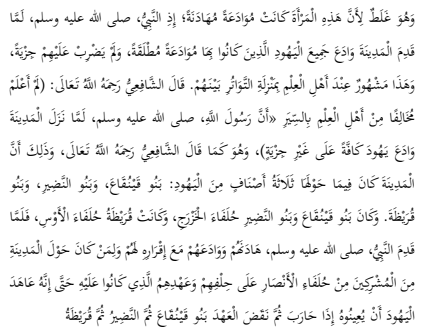
“这种看法是错误的,因为这名妇女处于和平状态,并且处于休战(Muhadanah)协议之下。原因在于,当先知ﷺ来到麦地那时,他与居住在那里的所有犹太人缔结了和约,且不加任何限制,也没有向他们征收人头税(Jizyah)。这一点为有学识的人所熟知,在他们之中已达到“Tawatur”(确定无疑的连续传述)的程度。Ash-Shafi’iy(愿安拉怜悯他)说:“我未曾听说,在研究先知传记(Seera)的学者中,有任何人对以下这一点存在分歧:当安拉的使者ﷺ定居麦地那后,他与所有犹太人缔结了和约,并未向他们征收人头税。”情况正如Ash-Shafi’iy(愿安拉怜悯他)所陈述的那样。原因在于,麦地那周围有三支犹太部落:Banu Qainuqaa'、Banu An-Nadir和Banu Quraizha。Banu Qainuqaa'和Banu An-Nadir是Khazraj部落的盟友,而Banu Quraizha则是Aws部落的盟友。随后,安拉的使者ﷺ来到麦地那,他与他们以及麦地那周围的多神教徒(他们是辅士的盟友)缔结了休战与和约,并依据他们先前所遵守的同盟与契约关系,予以认可。他甚至从犹太人那里取得了一份盟约,即若他遭到攻击,他们将支持他。然而,Banu Qainuqaa'先违约,随后是An-Nadir,接着是Quraizha。”
“And it is a mistake because this woman was at peace and under a truce (Muhadanah). That is because when the Prophet (peace be upon him) came to Al-Madinah he made peace with all of the Jews residing there an unrestricted manner and he did not impose Jizyah upon them. This is well-known by the people of knowledge to the level of Tawatur (decisive concurrent transmission) among them. Ash- Shafi’iy (may Allah’s mercy be upon him) said: “I do not of any from the people of knowledge of Seera who disagree upon the point “That when the Messenger of Allah (peace be upon him) settled in Al- Madinah, he made peace with all of the Jews without the imposition of the Jizyah”. It is as Ash-Shafi’iy (May Allah’s mercy be upon him) stated. That is because Al-Madinah had three groups of Jews surrounding it: Banu Qainuqaa’, Banu An-Nadir and Banu Quraizha. Banu Qainuqaa’ and Banu An-Nadir were allies of the Khazraj, while Banu Quraizha were allies of the Aws. Then when the Messenger of Allah (peace be upon him) came to Al-Madinah, he made a truce and peace with them with his approval of them, alongside those who were around Al-Madinah from the polytheists who were allies of the Ansar, upon the basis of their alliance and covenant that they had previously been upon. He even took a covenant from the Jews that they would support him if he was fought against. Then, Banu Qainuqaa’ broke the covenant, followed by An-Nadir and then Quraizha” [End of Quote].
即使这里所用的一些措辞未必是最精确的,比如他形容那位犹太妇女处于“休战”(Muhadanah)状态,而实际上当时并没有任何战斗,因此谈不上随后生效的休战。也许这只是一种表述上的失误。
That is even if some of the expressions used here were possibly not the most accurate, like his statement describing the Jewish woman as being under a “truce” (Muhadanah), as there had not even been any fighting, for a truce to have come into effect followed it. It may be that this was merely a slip of expression.
至于乌斯塔兹艾哈迈德·本·宰德所提及的历史学家的言论或观点,其中大多数要么是无效的,要么是不确定的。
As for what Ustadh Ahmad bin Zaid mentioned in terms of statements or views of the historians, then most of them are either invalid or inconclusive:
1) 艾布·欧拜德·卡西姆·本·赛拉姆的说法:
1) The statement of Abu ‘Ubaid Al-Qasim bin Salam:

“《瓦西嘎》(文书)写于两个时期(Hadathani),即先知(愿主福安之)抵达麦地那之后,在伊斯兰教占据优势并变得强大之前,也在他奉命向经典之民(Ahl ul-Kitab)征收吉兹亚之前”。 Wait — the rules require ﷺ after every mention of the Prophet, instead of an honorific written in words. So the correct output is: “《瓦西嘎》(文书)写于两个时期(Hadathani),即先知ﷺ抵达麦地那之后,在伊斯兰教占据优势并变得强大之前,也在他奉命向经典之民(Ahl ul-Kitab)征收吉兹亚之前”。
“The Wathiqa (document) was written on two occurrences (Hadathani), when the Prophet (peace be upon him) arrived in Al- Madinah, prior to the dominance of Islam and its becoming strong and before he was commanded to take the Jizyah from Ahl ul-Kitab (the people of the book)” .
“Hadathani”一词并未为我们确定一个可以加以考虑的明确时间范围,因此含糊不清。伊斯兰真正广泛传播并变得强大,是在联军(即Ahzab,也就是壕沟之役)战败之后。那是因为先知ﷺ开始主动向敌人发起进攻,而敌人不再主动进攻他。此外,我们也不知道他是在何时受命向人们征收吉兹亚的。而他所说的“从有经人(Ahl ul-Kitab)那里征收吉兹亚”,是一个广为流传的错误说法的重复,因为事实是,吉兹亚甚至也向多神教徒征收,包括拜火教徒(Majus),这在《穆斯林圣训实录》(Sahih Muslim)等辑录中所记载的艾尔-努尔曼·本·穆盖林的圣训中已有说明。 2)至于Al-Baladhari的说法,
is vague because the word “Hadathani” does not establish for us a determined time frame that can be taken into consideration. Islam only manifested in a prevalent manner and truly became powerful following the defeat of the confederates (Ahzab i.e. battle of the trench). That is because the Prophet (peace be upon him) began to go on the offensive against the people and they were no longer on the offensive against him. In addition, we do not know when he was commanded to take the Jizyah from the people. That is whilst his statement “take the Jizyah from Ahl ul-Kitab (the people of the book)” is a repetition of a well-known error, as the truth is that the Jizyah was taken even from the polytheists, including the Majus, as has come stated in the Hadith of An-Nu’man bin Muqarrin, recorded in Sahih Muslim and other collections. 2) As for the statement of Al-Baladhari
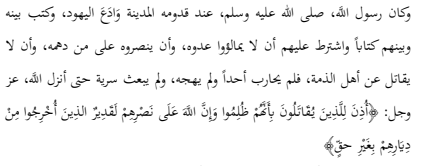
当安拉的使者ﷺ抵达麦地那时,他与犹太人订立了盟约(Muwada'ah),并在自己与他们之间书写了一份文书。他对他们作出规定:他们不得支持或偏袒他的敌人,要在有人攻击他时协助他;而他不会为了保卫“受保护者”(Ahl udh-Dhimmah)而作战。此后,他没有对任何人发动战争,他们也没有诽谤他,他也没有派出军事远征,直到安拉——至尊至大的主——降示:“准许那些遭受攻击的人还击,因为他们受到了不义的对待。安拉确能使他们获胜。他们是无理地被逐出家园的人。”(TMQ 22:39-40)
“When the Messenger of Allah (peace be upon him) arrived in Al- Madinah he made a treaty (Muwada’ah) with the Jews and wrote between himself and them a document. He stipulated upon them that they should not support or side with his enemies, to support him against those who attack him and that he would not fight in defence of the Ahl udh-Dhimmah. He did not then wage war against anyone, they did not defame him and he did not dispatch a military expedition, until Allah ‘Azza Wa Jalla revealed: “Permission [to fight] has been given to those who are being fought, because they were wronged. And indeed, Allah is capable of providing them victory. [They are] those who have been evicted from their homes without right” (TMQ 22:39-40)”.
这段讲话前后矛盾:先知(ﷺ)在降示那段经文之前,本未被允许参与战斗,当时也没有与任何人处于交战状态。麦地那也没有遭受攻击的预期。因此,他讲话中的那句话:“他为他们立下约定,他们不得支持或助长他的敌人,并要支持他抵御那些攻击他的人”,这句话概括了《宪章》(Sahifah)中的部分内容,但在当时的时代背景下是难以想象的,也没有现实依据。更加荒谬的是这句话:“他不会为了迪玛(Ahl udh-Dhimmah)而战”,假设印刷上没有错误的话。首先,当时本就不存在“迪玛人”(Ahl udh-Dhimmah)。其次,他们既然有义务支持他抵御攻击他的人,怎么可能他却没有义务支持他们抵御攻击他们的人呢?!3)艾尔-巴拉祖里(Al-Baladhariy)关于白努·盖努盖尔(Banu Qainuqaa’)的论述:
This speech is contradictory because he (peace be upon him) had not been permitted in origin to engage in fighting prior to the revelation of the Aayah and was not in a state of war with anyone. There was also no expectation for Al-Madinah to be attacked. Therefore, the sentence from his speech: “He stipulated upon them that they should not support or side with his enemies, to support him against those who attack him”, which summarized some of what came stated in the “Sahifah”, is inconceivable and has no reality to it during that time period. Even more atrocious is the statement: “And that he would not fight in defence of the Ahl udh-Dhimmah”, assuming there was no error in the printing. Firstly, there were no “Ahl udh-Dhimmah” there in origin. Secondly, how could it be that they are obliged to support him against those who attack him, whilst he is not obliged to support them against those who attack them?! 3) The statement of Al-Baladhariy concerning Banu Qainuqaa’:
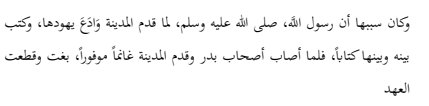
“之所以如此,是因为真主的使者(愿主福安之)抵达麦地那后,与当地的犹太人订立了和约,并在他与他们之间写下了一份文书。后来,穆斯林在白德尔战役中获胜,带着丰厚的战利品回到麦地那,犹太人便背叛并撕毁了盟约。”这种说法同样没有意义。因为“穆瓦达阿”(和平状态)本是根本,不需要正式地相互签约或书面订立。而卡卜·本·艾什拉夫是第一个违背、发动战争并割断“穆瓦达阿”(和平或停战状态)的人,这一点如前所述,已经通过大量可靠的一致传述得到确立。随后他写下了“赛赫法”,而其目的并非确立“穆瓦达阿”,而是建立一个“邦联联盟(伊提哈德·邦联)”。此后,奈欧尔·盖努嘎阿部族退出了这个“联盟”并发动战争,接着是奈迪尔部族,而古赖萨部族则背叛了它。 4)关于泰伯里的说法:
“The reason for it was that the Messenger of Allah (peace be upon him), when he arrived in Al-Madinah, made a peace agreement with its Jews and wrote a document between himself and them. Then, when the Muslims were victorious at Badr and came back to Al- Madinah with abundant booty, the Jews rebelled and broke the covenant”, then this also has no meaning to it. That is because the “Muwada’ah” (state of peace) is the origin and does not need to be officially mutually contracted or write. That is while Ka’b bin Al-Ashraf was the first to transgress, war and cut the “Muwada’ah” (state of peace or truce) which, as previously mentioned, has been established via Mutawatir (decisive concurrent) transmissions and he then wrote the “Sahifah” which was not the purpose of establishing a “Muwada’ah” but rather to establish a “Confederal Union (Ittihad Confedarali)”. Thereafter, Bani Qainuqaa’ exited from the “union” and waged war, followed by Banu An-Nadir and then Quraizhah betrayed it. 4) Concerning the statement of At-Tabari:
"此后,使者(愿主福安之)在从白德尔回来后仍留在麦地那。他抵达麦地那后,与当地的犹太人订立了和约,条件是他们不得协助任何人对抗他,而若他在麦地那遭到敌人攻击,他们应当支持他。随后,当安拉的使者(愿主福安之)杀死了古莱氏多神教徒中被他诛杀的那些人时,他们对他表现出嫉妒与悖逆,并显露出违背盟约的行为。" Note: the original's "(peace be upon him)" is rendered as ﷺ in the required form, so the Chinese should read: "此后,安拉的使者ﷺ在从白德尔回来后仍留在麦地那。他抵达麦地那后,与当地的犹太人订立了和约,条件是他们不得协助任何人对抗他ﷺ,而若他ﷺ在麦地那遭到敌人攻击,他们应当支持他ﷺ。随后,当安拉的使者ﷺ杀死了古莱氏多神教徒中被他ﷺ诛杀的那些人时,他们对他ﷺ表现出嫉妒与悖逆,并显露出违背盟约的行为。"
“Then the Messenger of Allah (peace be upon him) remained in Al- Madinah after his return from Badr. When he had arrived in Al- Madinah he had made a peace agreement with its Jews upon the stipulation that they do not assist anyone against him and that if he was attacked in Al-Madinah by an enemy, they would support him. Then when the Messenger of Allah (peace be upon him) killed those whom he had killed from the Mushrikin (polytheists) of Quraish, they demonstrated envy and rebelliousness towards him and demonstrated the breaching of the covenant”,
因此,这与前面阿尔-巴拉左里的说法相符,对它的反驳也一样,不过(此处的反驳)要好得多。这是因为,他并没有断言此前的旧“Muwada’ah”(和平协议/停战协定)是一份书面文件,而阿尔-巴拉左里在这一点上出了差错;他的文本中也没有相当于那句骇人听闻的话“他不会为保护Ahl udh-Dhimmah(受保护者)而战”的内容。尽管如此,阿特-塔巴里所说的“违背盟约(Naqdh Al‘Ahd)”,与事实并不相符。这是因为,在起源上并不存在先前的“Ahd”(盟约),而只是一种处于其原始状态的“Muwada’ah”。除非我们把对它的接受和遵守视为隐含的“Ahd”(盟约/条约)?正如艾哈迈德·阿布·宰德的说法所言:
then it is in line with the speech of Al-Baladhariy above and the refutation to it is the same, although it is much better. That is because he did not assert that the old “Muwada’ah” (agreement of peace/truce), prior to Badr, was a written document, as Al-Baladhariy slipped up in, just as his text does not include something equal to the atrocious sentence “And that he would not fight in defence of the Ahl udh-Dhimmah”. Despite that, the statement of At-Tabari “breaching of the covenant (Naqdh Al‘Ahd)” is not something that fits with reality. That is because there was no prior “Ahd” (covenant) in origin but rather a “Muwada’ah” upon its original state. That is unless we were to consider its acceptance and adherence to it as being an “Ahd” (Covenant/treaty) implicitly?! As the statement of Ahmad Abu Zaid:

“在这些相互印证、足以定论的(Mutawatir,即连续传承、指向确定性的)证据中,已有足够的依据说明,与犹太人所订立的和约文件写于希吉来历的第一年。此外,对其条款与文本的分析表明,它们并未显示先知ﷺ与犹太人之间存在任何紧张关系。因此,基于以上种种,伊斯兰百科全书的说法便站不住脚,其中的疑问也就被驳倒了。” Wait, I need to correct that: the original text as given in the user's message contains "(peace be upon him)" after "the Prophet", which per the rules should be replaced by ﷺ only, not written out. My translation above follows that rule. Here is the corrected translation: “在这些相互印证、足以定论的(Mutawatir,即连续传承、指向确定性的)证据中,已有足够的依据说明,与犹太人所订立的和约文件写于希吉来历的第一年。此外,对其条款与文本的分析表明,它们并未显示先知ﷺ与犹太人之间存在任何紧张关系。因此,基于以上种种,伊斯兰百科全书的说法便站不住脚,其中的疑问也就被驳倒了。”
“In these Mutawatir (concurrent transmissions indicating decisiveness) testimonies, there is enough to establish preponderance to conclude that the peace agreement document with the Jews was written in the first year of the Hijrah. In addition, an analysis of its articles and texts indicate that they are not indicative of any tension between the Prophet (peace be upon him) and the Jews. As such, due to all of this, the claims of the Islamic encyclopaedia fall down and their doubts are refuted”, then there are significant, indeed fatal errors in it.
1) 历史学家的陈述或观点,除非出自同时代的(亲历的)见证人,否则不被称为作证(shahada)。否则,这样的观点仅仅是基于正确或错误的信息或前提的一种意见。大量相符或相似的意见,并不被称为“塔瓦图尔”(即通过多方同时传述而确定无疑),它们也不具有确定性的“塔瓦图尔”肯定性证言的价值。
1) The statements or views of the historians are not called testimonies (shahada) unless it is from a contemporary (first-hand) witness. Otherwise, such a view is merely an opinion based upon correct or incorrect information or premises. A large number of conforming or similar opinions is not called Tawatur (i.e. established definitely by concurrent transmission) and they do not hold the value of Tawatur (decisive) testimonies of affirmation.
2) 有些宪法是在内战之后制定的,但其文本却并未反映出各方之间存在任何紧张关系。这是因为宪法的目的在于规定国家的体制(例如是单一制还是联邦制等)。因此,导致制定宪法之前的紧张或冲突的日期,既不会写入宪法,也不会在其中提及。由此可见,就“它们(即这些文本)并未表明先知(愿主赐福并使其平安)与犹太人之间存在任何紧张关系”这一说法而言,其反面同样可能成立。原因在于,邦联宪法或国际条约本身的订立,并不能证明其之前存在紧张、冲突或战争。可能存在过,也可能并不存在。只有依靠独立于所考察文件之外的其他历史迹象,或依靠文件本身的文字(这些文字表明冲突已经结束、战事已经停止,或补偿及血金等问题已经解决),才能得知这一点。阿赫迈德·阿布·宰德教授希望驳斥他在此前不久于《先知传记》(Ahmad Abu Zaid 著,第70页)中对“伊斯兰百科全书”所提出的观点,内容如下:
2) Some constitutions could be written following a civil war and yet its texts do not reflect the existence of any tension between the parties involved. That is because the purpose of the constitution is to lay down the regulation of the state (i.e. Unitary or union form etc…). As such, the date of the tension or conflict that occurred leading up to it, is neither written or mentioned within it. Consequently, in respect to the statement “They (i.e. the texts) are not indicative of any tension between the Prophet (peace be upon him) and the Jews”, then the opposite is also correct. That is because the writing of a confederal constitution or international treaty in itself, is not an evidence for the existence of a tension, conflict or war proceeding it. There could have been just as there may well not have been. This would only be known via other historical indications which are looked at independently from the document that is under examination, or from the texts of the document itself which indicate to the ending of a conflict or cessation of fighting or the solving of problems of compensations and blood monies etc… Ustadh Ahmad Abu Zaid wishes to refute the claims of the “Islamic Encyclopaedia” which he had formulated shortly before that in “As- Seera An-Nabawiyah” by Ahmad Abu Zaid (p: 70) as follows:
在百科全书阐述了该盟约(Mu’ahadah)的缔结在先知明智的政策制定方面所包含的内容,并指出伊本·伊斯哈格保存了该盟约的原文之后,它接着写道:就该文本的成文时间而言,它似乎并不能追溯到希吉拉历的第一年,因为它反映了先知ﷺ与犹太人之间紧张的关系。
“After the encyclopaedia mentioned what the contracting of that treaty (Mu’ahadah) contained in terms of wise prophetic policy making and after it indicated to Ibn Ishaq having preserved the text of that treaty, it stated: It appears that this text does not go back, in respect to the date of its writing, to the first year of the Hijrah, because it reflects the tense relations between the Prophet (peace be upon him) and the Jews”.
事实是,根据我们先前所呈现的历史传述文献的证据,《麦地那宪章》(Sahifah)是在希吉来历第三年初撰写的。因此,那部百科全书在这一问题上是正确的。至于那部百科全书的作者——东方学家们——所作的推断,即该文本(即Sahifah)
The truth is that the Sahifah of Al-Madinah was written at the beginning of the third year of Hijrah based upon the evidence of the historical transmitted texts that we have presented earlier. As such, the encyclopaedia was correct regarding this matter. As for the deduction of the orientalists, who are the authors of the encyclopaedia, that the text (i.e. Sahifah)

反映了先知(愿主福安之)与犹太人之间紧张的关系ﷺ
“reflected tense relations between the Prophet (peace be upon him) and the Jews”, .
那样说并不有说服力,而且不合时宜。人们在这里任由自己的想象驰骋。然而,历史只是已经过去的事件和事实,其记载必须取自亲历者以及当时人的记录,而不是出自想象,甚至也不是出自逻辑推断。是的,围绕《宪章》(Sahifah)写作的背景确实表明,它的写成是因为与部分犹太人(特别是卡卜·本·阿舍拉夫)的关系出现了紧张。但是,它的文本中并没有任何迹象表明此前存在紧张或冲突,哪怕是丝毫的暗示也没有!
then this is not convincing and out of place. People have given free reign to their imaginations here. That is whilst history is merely events and realities that have passed by and its reports must be taken from first-hand witnesses and records of those living at the time, not from imaginations or even logical deductions. Yes, it is true that the circumstances surrounding the writing of the Sahifah reveal that it was written due to the occurrence of a tension in the relations with some of the Jews (Ka’b in Al-Ashraf specifically). However, its text does not include anything indicating to any prior tension or conflict and not even remotely!