5.5 对卡西尔·本·阿卜杜拉·本·阿穆尔·本·奥夫·穆扎尼的公正评价
5.5 Fairness to Kathir bin Abdullah bin ‘Amr bin ‘Awf Al- Muzani
- 以下内容载于伊本·哈哲尔的《Taqrib At-Tahdhib》(1/460/5617):[Kathir bin Abdullah bin ‘Amr bin ‘Awf Al-Muzani Al- Madani 是 Da'if(弱)。那些把说谎归于他的人是过分的。(他属于)第七层(即传述系统中的世代)。]
- The following came stated in in “Taqrib At-Tahdhib” [Ibn Hajar] (1/460/5617): [Kathir bin Abdullah bin ‘Amr bin ‘Awf Al-Muzani Al- Madani is Da’if (weak). Those who attributed lying to him were excessive. (He was from) the seventh (i.e. generation or line of transmission)].
- 然而,阿勒巴尼在《Irwaa’ Al-Ghalil》(5/155)中说道:[ Al-Hafizh(即伊本·哈哲尔)在《Al-Fat’h》(4/371)中说:[卡西尔·本·阿卜杜拉在多数学者看来是Da’if(弱),然而布哈里以及追随他的人,如提尔米兹和伊本·胡宰麦,则肯定了他的地位。]]
- However, in “Irwaa’ Al-Ghalil”, by Al-Albani (5/155), the following was stated: [Al-Hafizh (i.e. ibn Hajar) said [in Al-Fat’h – (4/371)]: [And Kathir bin Abdullah is Da’if in the view of the majority however Al- Bukahri and those who followed him like At-Tirmidhi and Ibn Khuzaimah strengthen his affair (or status)].
- 下面这段记载见于布哈里的《历史大全》(Al-Bukhari, At-Tarikh Al-Kabir)(7/217/945):[Kathir bin Abdullah bin ‘Amr bin ‘Awf Al-Muzani Al-Madani 聆听(或从)其父处听闻圣训,Marwan bin Mu’awiyah、Isma’il bin Abu Uwais 和 Yahya Al-Ansari 从他处传述。]这段内容也见于布哈里《历史大全》的另一版本(7/96/945)。布哈里没有将他列为 Da’if(弱者),也没有对他做出任何评论,哪怕一个字都没有! - 下面这段记载见于伊本·阿布·哈提姆的《批评与认可》(Ibn Abu Hatim, Al-Jarh Wa At-Ta’dil)(7/154/858):[Kathir bin Abdullah bin ‘Amr bin ‘Awf Al-Muzani 从其父以及 Muhammad bin Ka’b 和 Rubaih bin Abdur Rahman 处传述,而 Abdul ‘Aziz bin Muhammad、Marwan bin Mu’awiyah、Ma’n bin ‘Eisa、Abdullah bin Wahb、Abdullah bin Nafi’ As-Sa’igh、Muhammad bin Khalid bin ‘Athma、Abu ‘Amir Al-‘Aqadiy、Khalid bin Makhlad、Ibn Qa’nab 和 Ibn Abu Uwais 从他处传述。我听我父亲这样说。Abdur Rahman 转述我们,他从 Muhammad bin Hamawaih bin Al-Hasan 处听到,后者说:我听 Abu Talib 说:我就 Kathir bin Abdullah bin ‘Amr bin ‘Awf 的情况询问艾哈迈德(即艾哈迈德·本·韩百勒),他说:“Munkar(即因传述上的缺陷而应被摒弃)的圣训,毫无价值。”Abdur Rahman 转述我们:他说:有人在 Al-‘Abbas bin Muhammad Ad-Dawri 面前宣读,据 Yahya bin Ma’een 说:“Kathir bin Abdullah Al-Muzani 在圣训方面是 Da’if(弱者)。”Abdur Rahman 转述我们。他说:我问艾布·祖尔ʿ阿,关于 Kathir bin Abdullah bin ‘Amr bin ‘Awf 的情况。他说:“圣训方面软弱,不可靠。”我又问他:在 Bahz bin Hakim、Abdul Muhaimin 和 Kathir bin Abdullah 之中,你最喜爱哪一位?他说:“相比他,我更喜爱 Bahz 和 Abdul Muhaiman。”Abdur Rahman 转述我们:他说:我父亲被问及 Kathir bin Abdullah bin ‘Amr bin ‘Awf,他说:“他不可靠(Matin)。”]
- The following came recorded in “At-Tarikh Al-Kabir” [Al-Bukhari] (7/217/945): [Kathir bin Abdullah bin ‘Amr bin ‘Awf Al-Muzani Al- Madani listened to (or received from) his father, while Marwan bin Mu’awiyah, Isma’il bin Abu Uwais and Yahya Al-Ansari related from him]. It is recorded in another edition of “At-Tarikh Al-Kabir” by Al- Bukhari (7/96/945). Al-Bukhari did not classify him as Da’if (weak) and he did not speak about him, not even a single letter! - The following came stated in “Al-Jarh Wa At-Ta’dil” [Ibn Abu Hatim] (7/154/858): [Kathir bin Abdullah bin ‘Amr bin ‘Awf Al-Muzani related from his father in addition to Muhammad bin Ka’b and Rubaih bin Abdur Rahman, while Abdul ‘Aziz bin Muhammad, Marwan bin Mu’awiyah, Ma’n bin ‘Eisa, Abdullah bin Wahb, Abdullah bin Nafi’ As-Sa’igh, Muhammad bin Khalid bin ‘Athma, Abu ‘Amir Al-‘Aqadiy. Khalid bin Makhlad, Ibn Qa’nab and Ibn Abu Uwais related from him. I heard my father saying that. Abdur Rahman related to us from Muhammad bin Hamawaih bin Al-Hasan who said: I heard Abu Talib who said: I asked Ahmad (meaning Ahmad bin Hanbal) concerning Kathir bin Abdullah bin ‘Amr bin ‘Awf and he said: “Munkar (i.e. rejectable due to defectiveness in respect to) Al-Hadith, of no worth”. Abdur Rahman related to us: He said: It was read to Al-‘Abbas bin Muhammad Ad- Dawri from Yahya bin Ma’een That he said: “Kathir bin Abdullah Al- Muzani is Da’if (weak) in Hadith”. Abdur Rahman related to us. He said: I asked Abu Zur’ah about Kathir bin Abdullah bin ‘Amr bin ‘Awf. He said: “Feeble/weak in Hadith and not strong”. I said to him: Out of Bahz bin Hakim, Abdul Muhaimin and Kathir bin Abdullah, which of them is the most beloved to you? He said: “Bahz and Abdul Muhaiman are more beloved to me than him”. Abdur Rahman related to us: He said: My father was asked about Kathir bin Abdullah bin ‘Amr bin ‘Awf and he said: “He is not solid/strong (Matin)”.
我说:“他不是 solid/strong(Matin)”这一表述,与“他不是 Qawiy(strong)”这一表述并不相同,也不等同于“Da'if”(weak)。这是因为“Matin”所描述的叙述者,在力量与可靠性方面已达到最高的境界。——《Tarikh ul-Islam》(10/224/330)中记载了相互矛盾的表述:[Kathir bin Abdullah bin 'Amr bin 'Awf bin Zaid bin Talha Al-Yashkuri Al-Muzani Al-Madani……他从其父及其祖父处传述(经由抄本),此外还从Nafi'和Muhammad bin Ka'b Al-Qurazhi处传述。从他那里传述的有:Ibn Wahb、Abdullah bin Nafi'、Al-Qa'nabi、Isma'il bin Abi Uwais和Khalq。]
I say: This statement “He is not solid/strong (Matin)” is not like the statement “He is not Qawiy (strong))” and it is not synonymous with the statement “Da’if” (weak). That is because the “Matin” narrator is the one who has reached the pinnacle in respect to strength and reliability. - Contradictory statements came stated in “Tarikh ul-Islam” (10/224/330): [Kathir bin Abdullah bin ‘Amr bin ‘Awf bin Zaid bin Talha Al-Yashkuri Al-Muzani Al-Madani … He related from his father and from his grandfather (by transcript), in addition to Nafi’ and Muhammad bin Ka’b Al-Qurazhi. And the following related from him: Ibn Wahb, Abdullah bin Nafi’, Al-Qa’nabi, Isma’il bin Abi Uwais and Khalq.
他们一致认同他对(这段圣训)弱点的判定,而艾哈迈德·本·罕百勒则拒绝了他的圣训。
They agreed upon his classification of weakness and Ahmad bin Hanbal rejected his Hadith.
阿什-沙菲仪说:他是虚妄(谎言)的支柱之一。艾布·达伍德也说过类似的话。
Ash-Shafi’iy said: He is a pillar from among the pillars of Al-Kadhib (deceit/untruth). Abu Dawud said similar to that.
‘Abbas 转述自 Ibn Ma’een(即 Kathir):“Da’if(弱)”。Ad-Darimiy 转述自 Ibn Ma’een:他没有任何价值。
‘Abbas related from Ibn Ma’een (that he i.e. Kathir is): “Da’if (weak)”. Ad-Darimiy related from Ibn Ma’een: He has no worth.
An-Nasa’i说:"他被弃用,或被忽略(即不引用其传述)。"Ad-Daraqutniy也这样说。
An-Nasa’i said: “He is left or disregarded (i.e. not related from)” and Ad-Daraqutniy said the same.
至于At-Tirmidhi,他随即口述道:“我对穆罕默德ﷺ说:有一段关于Kathir bin Abdullah的圣训,传自其父,再传自其祖父,与周五聚礼时间有关。他说:这是一段Hasan(佳)圣训,然而艾哈迈德·本·罕百勒将Kathir列为Da'if(弱)。”
As for At-Tirmidhi, then he began to dictate and said: “I said to Muhammad: There is the Hadith of Kathir bin Abdullah, from his father, from his grandfather, related to the (subject area) of the time of the Jumu’ah prayer. He said: It is a Hasan Hadith, however Ahmad bin Hanbal classifies Kathir as being Da’if (weak)”.
伊本·希班说:"卡西尔从他的父亲、从他的祖父转述了一份伪造的文本。除非是从惊异的角度,否则不允许提及他。"我说:他卒于公元163年。[引文结束]
Ibn Hibban said: “Kathir relates from his father, from his grandfather a fabricated transcript. It is not permissible to mention him except from the angle of astonishment”. I said: He died in the year 163 AH] [End of quote].
我说:对于“他们一致认定他的弱点分类”这一说法,若存在公正与中正的领袖伊玛目布哈里对其可信性的肯定,再加上来自偏激固执之人阿布·哈提姆的无足轻重之言,那么这一说法便毫无意义(或价值)。事实是,达拉古特尼在其《弱者与被弃者》(《Ad-Du'afa' Wa Al-Matrukin》)一书中,只是将他作为一群传述人中的一员列在名单里,并未加以评论。归于阿布·达伍德的话也与事实相矛盾,因为他曾刊载了卡西尔·本·阿卜杜拉的一些圣训,且对此并无异议,他还曾与麦加的人们就这些圣训进行书信往来。依我看,最可能的解释是:他转述了沙斐仪伊玛目的话并在一开始予以遵循,这一点可见于《Tahdhib Al-Kamal》(24/136/4948)与《Tahdhib At-Tahdhib》(8/377/753),其原文即将呈现。之后,这一指控的不实之处对他而言变得明显,于是他在自己的《逊南》中记录了他的传述。哈菲兹·本·哈哲尔本人的态度似乎也摇摆不定,因为他在《Al-Fat'h》中的话与他在《At-Taqrib》摘要中所陈述的并不一致。因此此事仍有歧义,故有必要对此人的情况与身份进行精确的考察。
I say: There is no meaning (or significance) to the statement: “They agreed upon his classification of weakness” when there exists an attestation of credibility from the chief of fairness and moderation Imam Al-Bukhari, in addition to the insignificant speech of Abu Hatim, who is from the prone to extremity and stubbornness! The truth is that Ad-Daraqutni only mentioned him as part of a list, without commentary, amongst a group of narrators, in his book “The weak and disregarded” (Ad-Du’afa’ Wa Al-Matrukin”. The speech attributed to Abu Dawud contradicts the fact that he published some of the Hadith of Kathir bin Abdullah and no disagreement resulted over them, when he wrote with them to the people of Makkah. The most likely explanation in my view, is that he related the speech of Imam Ash-Shafi’iy and followed it in the beginning, as is evident in “Tahdhib Al-Kamal” (24/136/4948) and in “Tahdhib At-Tahdhib” (8/377/753); the texts of which will be presented soon. Then (after that), it the incorrectness of the accusation became evident to him and so he recorded his relations within his Sunan. Al-Hafizh bin Hajar himself appears to be of two minds as his speech in “Al-Fat’h” is not consistent with what he stated in his summary in “At-Taqrib”. The matter is therefore ambiguous and as such it is necessary to undertake a precise study of the circumstances or status of this man.
以下内容记载于阿格利(Al-'Uqailiy)的《弱者传》(Ad-Du'afaa' Al-Kabir)(4/4/1555)中:[卡西尔·本·阿卜杜拉·本·阿姆尔·本·阿乌夫·穆扎尼(Kathir bin Abdullah bin 'Amr bin 'Awf Al-Muzani)。艾哈迈德·本·祖凯尔·哈达拉米(Ahmad bin Zukair Al-Hadrami)告诉我们,他从艾哈迈德·本·赛义德·菲赫里(Ahmad bin Sa'id Al-Fihriy)处听闻,后者从易卜拉欣·本·蒙迪尔(Ibrahim bin Al-Mundhir)处听闻,易卜拉欣从穆塔拉夫·本·阿卜杜拉(Mutarrif bin Abdullah)处听闻,穆塔拉夫说:"我见过卡西尔·本·阿卜杜拉·本·阿姆尔·本·阿乌夫·穆扎尼。他非常好争辩,我们的同伴中没有人愿意接受他的说法。"于是,伊本·伊姆兰·卡迪(Ibn 'Imran Al-Qadi)对他说:"卡西尔啊,你是个愚蠢的人,你在我们所不知道的事情上争辩。你对你并不拥有的东西提出主张,对你所追求的事物也没有证据。所以,除非你看到我在与愚昧或闲散的人相处,否则不要来找我。如果你看到愚昧的人在我身边,那你再过来。"易卜拉欣说:穆塔拉夫对我说:有一天伊本·伊姆兰在我们中间,卡西尔·本·阿卜杜拉来到他面前,他便说:"我不是跟你说过吗,除非你看到我和愚昧(或闲散)的人在一起,否则不要来找我?"卡西尔随即对他说:"你说得对,愿安拉使卡迪的事务安好。实际上,我只是在愚昧的人来找你的时候才来的。某某和某某来找你,他们二人都是愚昧(或闲散)的人,所以我便与他们二人一同前来。" 阿卜杜拉·本·艾哈迈德(Abdullah bin Ahmad)告诉我们:他说:我听到我父亲说:"侯赛因·本·阿卜杜拉·本·杜迈拉(Hussein bin Abdullah bin Dumairah)与卡西尔·本·阿卜杜拉·本·阿姆尔·本·阿乌夫二人合在一起毫无价值,他们相似,都不值一提。"我父亲拒绝了卡西尔·本·阿卜杜拉·本·阿姆尔·本·阿乌夫的圣训,因此他没有向我们转述这些圣训。穆罕默德·本·尔萨(Muhammad bin 'Eisa)告诉我们,从阿拔斯(Abbas)处听闻,阿拔斯说:我听到叶海亚(Yahya)说:卡西尔·本·阿卜杜拉·本·阿姆尔·本·阿乌夫·穆扎尼,他的祖父曾与先知ﷺ有过伴随(Suhbah),但卡西尔在圣训方面是弱者(Da'if)。 艾哈迈德·本·马哈茂德向我们转述,他从奥斯曼·本·赛义德处听来:我问叶海亚·本·穆因:"卡西尔·本·阿卜杜拉·穆扎尼,就是玛尔奈所转述的那位,他的情况如何?"他说:"他什么都不是,毫无价值。"
- The following came recorded in “Ad-Du’afaa’ Al-Kabir” by Al- ‘Uqailiy (4/4/1555): [Kathir bin Abdullah bin ‘Amr bin ‘Awf Al-Muzani. Ahmad bin Zukair Al-Hadrami related to us from Ahmad bin Sa’id Al-Fihriy, from Ibrahim bin Al-Mundhir, from Mutarrif bin Abdullah, who said: “I saw Kathir bin Abdullah bin ‘Amr bin Awf Al-Muzani. He was very quarrelsome and none of our companions would take from him”. So, Ibn ‘Imran Al-Qadi said to him: “O Kathir, you are a foolish person, you quarrel in respect to that which we don’t know. You make claims to that which you don’t have and you don’t have evidence for what you seek. So, don’t approach me unless you see me making time for the people of foolishness or idleness. If you see the people of foolishness in my company then come on over”. Ibrahim said: Mutarrif said to me: Ibn ‘Imran was among us one day, when Kathir bin Abdullah came to him and so he said: “Did I not say to you, don’t approach me unless you see me with the foolish (or idle) people?” Kathir then said to him: “You have said the truth, may Allah make good the affair of the Qadi. Indeed, I only came to you when the people of foolishness came to you. So and so and so and so came to you. They are both from the people of foolishness (or idleness) and so I came along with them both”. Abdullah bin Ahmad related to us: He said: I heard my father saying: “Hussein bin Abdullah bin Dumairah and Kathir bin Abdullah bin ‘Amr bin ‘Awf do not add up to anything together, they are similar, not worth anything”. My father rejected the Ahadeeth of Kathir bin Abdullah bin ‘Amr bin ‘Awf and as such, he did not relate them to us. Muhammad bin ‘Eisa related to us from ‘Abbas who said: I heard Yahya saying: Kathir bin Abdullah bin ‘Amr bin ‘Awf Al-Muzani, his grandfather had companionship (Suhbah i.e. with the Prophet), (but) Kathir is weak (Da’if) in respect to the Hadith”. Ahmad bin Mahmud related to us from Uthman bin Sa’id: I said to Yahya bin Ma’een: “Kathir bin Abdullah Al-Muzani, (the one) who Ma’n relates from, how is he (i.e. his condition)?” He said: “He is nothing or of no worth”].
《泰赫底布·卡迈勒》(Al-Mizzi)(24/136/4948)中记载如下:[卡西尔·本·阿卜杜拉·本·阿慕尔·本·奥夫·本·载德·本·米勒哈·穆扎尼·麦丁尼,从巴克尔·本·阿卜杜勒·拉赫曼·穆扎尼·巴士拉尼、拉比尔·本·阿卜杜勒·拉赫曼·本·艾布·赛义德·胡德里、其父阿卜杜拉·本·阿慕尔·本·奥夫·穆扎尼、穆罕默德·本·凯布·古尔宰义以及伊本·欧麦尔的被释奴纳菲尔传述圣训。下列人士皆从他处传述圣训:易卜拉欣·本·阿里·拉斐尔、艾布·伊斯哈格·易卜拉欣·本·穆罕默德·法扎里、伊斯哈格·本·易卜拉欣·哈尼尼、伊斯哈格·本·贾法尔·阿拉维、伊斯玛仪·本·艾布·乌wais、哈立德·本·马赫拉德·盖塔瓦尼、宰德·本·哈巴卜、阿拔斯·本·艾布·沙姆拉·泰米、艾布·乌wais·阿卜杜拉·麦丁尼、伊斯玛仪·本·贾法尔之兄之子阿卜杜拉·本·卡西尔·本·贾法尔、阿卜杜拉·本·麦斯莱迈·戈阿奈比、阿卜杜拉·本·纳菲尔·萨伊格、阿卜杜拉·本·沃赫卜·米斯里、艾布·贾德·阿卜杜勒·拉赫曼·本·阿卜杜拉·赛勒米、阿卜杜勒·阿齐兹·本·艾布·萨比特·祖里、阿卜杜勒·阿齐兹·本·穆罕默德·达拉瓦尔迪、艾布·阿米尔·阿卜杜勒·马立克·本·阿慕尔·阿盖迪、阿塔夫·本·哈立德·麦赫祖米、盖西姆·本·阿卜杜拉·本·欧麦尔·欧麦里、穆罕默德·本·伊斯玛仪·本·艾布·福代克、穆罕默德·本·哈立德·本·阿斯玛、穆罕默德·本·欧麦尔·瓦基迪、穆罕默德·本·福莱赫·本·苏莱曼、艾布·安齐雅·穆罕默德·本·穆萨·安萨里(麦地那的卡迪)、麦尔旺·本·穆阿威叶·法扎里、穆阿非·本·伊姆兰·穆绥里、马尔·本·尔萨·卡兹兹、雅哈雅·本·赛义德·安萨里(他年长于卡西尔)。艾布·塔利卜说:我曾问艾哈迈德·本·罕百勒关于他的情况,他说:“是穆赫凯尔圣训的传述者(即其圣训被弃用),毫无价值。”阿卜杜拉·本·艾哈迈德·本·罕百勒说:“我父亲弃用了《穆斯南德》中卡西尔·本·阿卜杜拉的圣训,也不从他处传述。”艾布·海赛马说:艾哈迈德·本·罕百勒对我说:“不要从他那里传述任何东西。”阿拔斯·达瓦里传述,雅哈雅·本·马因对他的祖父说:“卡西尔在圣训方面是弱的(達伊夫)。”在另一处,他又说:“他毫无价值。”] 乌斯曼·本·赛义德·达里米转述亚哈雅·本·马因说:“他毫无价值。”艾布·欧拜德·阿贾里说:有人问艾布·达伍德关于凯西尔·本·阿卜杜拉·本·阿姆尔·本·奥夫·穆扎尼的情况,他说:“他是说谎者之一。”我听穆罕默德·本·瓦兹尔·米斯里说:我听到沙斐仪提到凯西尔·本·阿姆尔·本·奥夫时说:“他是说谎者之一,或是谎言与欺骗的支柱之一。”阿卜杜勒·拉赫曼·本·艾布·哈提姆说:我向艾布·祖尔阿询问他的情况,他说:“他在圣训方面很弱,不可靠。”我又问他:“巴哈兹·本·哈基姆、阿卜杜勒·穆海曼和凯西尔·本·阿卜杜拉,你最喜爱哪一位?”他说:“相比他,我更喜爱巴哈兹和阿卜杜勒·穆海曼。”艾布·哈提姆说:“他不是可靠稳固的人(Matin)。”提尔米兹说:我就凯西尔·本·阿卜杜拉从其父、从其祖父所传的圣训,向穆罕默德请教,关于星期五所期待的那一时刻,问他此人如何。他说:“这段圣训是哈桑级的,但艾哈麦德·本·罕百里认为凯西尔是弱者(Da'if)。”叶哈雅·本·赛义德·安萨里(他本人是伊玛目)曾转述凯西尔·本·阿卜杜拉的圣训。奈萨仪和达拉库特尼说他在圣训方面是被弃置者(Matruk)。奈萨仪在另一处说:“他不可信赖(Thiqah)。”艾布·哈提姆·本·希班说:“他(即凯西尔)从其父、从其祖父转述了一份伪造的文本。不允许在著作中提及他们(即他的圣训),也不允许从他那里转述,除非是作为令人惊讶的例子。”伊本·阿迪说:“他所转述的大部分内容都得不到他人的印证。”易卜拉欣·本·蒙迪尔·希兹阿米转述自穆塔里夫·本·阿卜杜拉·麦地尼,后者说:“我见过他,他非常好争辩,我们的同伴没有人从他那里取得圣训。”于是,伊本·伊姆兰·盖迪对他说:“凯西尔啊,你是个愚蠢的人,你在你不懂的事情上争辩。” 你对我提出的主张没有依据,所寻求的东西也缺乏证据,所以不要来找我,除非你看到我在与愚昧或闲散之人打交道。如果你看到愚昧之人在我身边,那就过来吧。”穆塔里夫说:有一天,伊卜努·伊姆兰与我们在一起,卡西尔·本·阿卜杜拉来到他面前,于是他说:“我不是对你说过吗,除非你看到我与愚昧(或闲散)之人在一起,否则不要来找我?”卡西尔便说:“你说得对,愿真主使法官的事务变得美好。我只是在愚昧(或闲散)之人来找你的时候才来的。某某人和某某人来找你,他们二人都是愚昧(或闲散)之人,所以我便与他们一同前来。”布哈里从他那里传述此段,见于“跟随伊玛目诵读”和“仆人的行为”两章;艾布·达伍德、提尔米兹和伊本·马哲也从他那里传述了此段。【引文结束】
- The following came stated in “Tahdhib Al-Kamal” [Al-Mizzi] (24/136/4948): [Kathir bin Abdullah bin ‘Amr bin ‘Awf bin Zaid bin Milhah Al-Muzani Al-Madani related from Bakr bin Abdur Rahman Al-Muzani Al-Basari, Rabih bin Abdur Rahman bin Abu Sa’id Al-Khudri, his father Abdullah bin ‘Amr bin ‘Awf Al-Muzani, Muhammad bin Ka’b Al-Qurazhi and Nafi’ the Mawla of Ibn ‘Umar. While all of the following related from him: Ibrahim bin ‘Ali Ar-Rafi’iy, Abu Ishaq Ibrahim bin Muhammad Al-Farazi, Ishaq bin Ibrahim Al-Hanini, Ishaq bin Ja’far Al-‘Alawiy, Isma’il bin Abu Uwais, Khalid bin Makhlad Al-Qatawani, Zaid bin Al- Habbab, Al-‘Abbas bin Abu Shamla At-Taimi, Abu Uwais Abdullah bin Al-Madani, Abdullah bin Kathir bin Ja’far bin Akhi (brother of) Isma’il bin Ja’far, Abdullah bin Maslamah Al-Qa’nabi, Abdullah bin Nafi’ As- Sa’igh, Abdullah bin Wahb Al-Misriy, Abu Al-Ja’d Abdur Rahman bin Abdullah As-Silmiy, Abdul ‘Aziz bin Abu Thabit Az-Zuriy, Abdul ‘Aziz bin Muhammad Ad-Darawardi, Abu ‘Amir Abdul Malik bin ‘Amr Al- ‘Aqadiy, ‘Attaf bin Khalid Al-Makhzumi, Al-Qasim bin Abdullah bin ‘Umar Al-‘Umariy, Muhammad bin Isma’il bin Abu Fudaik, Muhammad bin Khalid bin ‘Athma, Muhammad bin ‘Umar Al-Waqidi, Muhammad bin Fulaih bin Sulaiman, Abu Ghaziya Muhammad bin Musa Al-Ansari (The Qadi of Al-Madinah), Marwan bin Mu’awiyah Al- Fazari, Al-Mu’afi bin ‘Imran Al-Musuli, Ma’n bin ‘Eisa Al-Qazzaz, Yahya bin Sa’id Al-Ansari (and he was older than him). Abu Talib said: I asked Ahmad bin Hanbal about him and he said: “Munkar Al-Hadith (i.e. his Hadith are rejected); not of any worth”. Abdullah bin Ahmad bin Hanbal said: “My father discarded the Hadith of Kathir bin Abdullah in the Musnad and did not narrate from him”. Abu Khaithamah said: Ahmad bin Hanbal said to me: “Do not narrate anything from him”. ‘Abbas Ad-Dawri related that Yahya bin Ma’een said to his grandfather: “Kathir is weak (Da’if) in Hadith”. In another place, he said: “He is not of any worth”. Uthman bin Sa’id Ad-Darimi related from Yahya bin Ma’een that he said: “He is not of any worth”. Abu ‘Ubaid Al-Aajiri said: Abu Dawud was asked about Kathir bin Abdullah bin ‘Amr bin ‘Awf Al-Muzani and then said: “He was one of the liars. I heard Muhammad bin Al-Wazir Al-Misriy who said: I heard Ash-Shafi’iy when Kathir bin ‘Amr bin ‘Awf was mentioned saying: “That is one of the liars or one of the pillars of lying/deceit” . Abdur Rahman bin Abu Hatim said: I asked Abu Zur’ah about him and he said: “He is weak in Hadith and not strong”. I said to him: “Bahz bin Hakim, Abdul Muhaiman and Kathir bin Abdullah: Which of them is most beloved to you?” He said: Bahz and Abdul Muhaiman are more beloved to me than him”. Abu Hatim said: “He is not Matin (solid/very strong)”. At-Tirmidhi said: I asked Muhammad in respect to the Hadith of Kathir bin Abdullah, from his father, from his grandfather concerning the time that is aspired for on the day of Jumu’ah: How is he? (i.e. Kathir). He said: “The Hadith is Hasan, however Ahmad bin Hanbal classifies Kathir as Da’if (weak)”. Yahya ibn Sa’id Al-Ansari (upon his being an Imam) related from Kathir bin Abdullah. An-Nasa’i and Ad-Daraqutni said he is Matruk (discarded) in respect to the Hadith. An-Nasa’i said in another place: “He is not Thiqah (trustworthy, reliable)”. Abu Hatim bin Hibban said: “He (i.e. Kathir) related from his father from his grandfather a fabricated manuscript. It is not permissible to mention them (i.e. his Ahadeeth) in the books or to relate from him, except from the angle of astonishment”. Ibn ‘Adi said: “The majority of what he relates is not followed”. Ibrahim bin Al-Mundhir Al-Hizami related from Mutarrif bin Abdullah Al-Madani who said: “I saw him; he was very quarrelsome and none of our companions used to take from him”. So, Ibn ‘Imran Al-Qadi said to him: “O Kathir, you are a foolish person, you quarrel in respect to that which you don’t know. You make claims to that which you don’t have and you don’t have evidence for what you seek. So, don’t approach me unless you see me making time for the people of foolishness or idleness. If you see the people of foolishness in my company then come on over”. Mutarrif said: Ibn ‘Imran was among us one day, when Kathir bin Abdullah came to him and so he said: “Did I not say to you, don’t approach me unless you see me with the foolish (or idle) people?” Kathir then said to him: “You have said the truth, may Allah make good the affair of the Qadi. Indeed, I only came to you when the people of foolishness came to you. So and so and so and so came to you. They are both from the people of foolishness (or idleness) and so I came along with them both”. Al-Bukhari related from him in the chapter: “Recitation behind the Imam” and in “Actions of the Servants”, just as Abu Dawud, At-Tirmidhi and Ibn Majah also narrated from him] [End of quote].
- 以下内容载于《Tahdhib At-Tahdhib》(8/377/753):
- The following came stated in “Tahdhib At-Tahdhib” (8/377/753):
[Al-Bukhari在关于诵读的部分中,以及Abu Dawud、At-Tirmidhi和Ibn Majah:Kathir bin Abdullah bin ‘Amr bin ‘Awf bin Zaid bin Milhah Al-Yashkuri Al-Muzani Al-Madani从他的父亲、Muhammad bin Ka’b Al-Qurazhi、Ibn ‘Umar的被释奴Nafi’、Abu Sa’id Al-Khudri的后人Rabih bin Abdur Rahman以及Bukair bin Abdur Rahman Al-Muzani处传述。从他那里传述的有一群人(包括):Yahya bin Sa’id Al-Ansari、Abu Uwais、Zaid bin Al-Habbab、Abdullah bin Wahb、Abdullah bin Nafi’、Ibrahim bin ‘Ali Ar-Rafi’、Ishaq bin Ja’far Al-‘Alawiy bin Ishaq bin Ishaq Al-Hanini、Abu ‘Amir Al-‘Aqadiy、Marwan bin Mu’awiyah、Abu Al-Ja’d Abdur Rahman bin Abdullah As-Salmi、Muhammad bin Khalid bin ‘Athamah、Khalid bin Makhlad bin Abu Uwais、Al-Qa’nabi等人。Abu Talib转述自Ahmad,他说(关于Kathir):“他是Munkar Al-Hadith(即他的圣训被摒弃),他没有任何价值。”Abdullah bin Ahmad说:“我父亲在他的《Musnad》中舍弃了Kathir bin Abdullah的圣训,他没有向我们转述过他的任何内容。”Abu Khaithamah说:Ahmad对我说:“不要转述他的任何内容。”Ad-Dawriy转述自Ibn Ma’een:“他的祖父曾有Suhbah(与先知为伴),但他在圣训方面薄弱。”他又曾说:“他毫无价值。”Ad-Darimi也转述自Yahya bin Ma’een,他说:“他没有任何价值。”Abu ‘Ubaid Al-Aajiri说:有人问Abu Dawud关于他的情况,他说:“他是说谎者之一。我听Muhammad bin Al-Wazir Al-Misriy说:我听Ash-Shafi’iy在提到Kathir bin ‘Amr bin ‘Awf时说:“他是说谎者之一,或是欺骗的支柱之一。”Ibn Abu Hatim说:我就他的情况询问Abu Zur’ah,他说:“他在圣训方面薄弱,不可靠。”我对他说:“Bahz bin Hakim、Abdul Muhaiman和Kathir bin Abdullah,他们之中你最喜爱谁?”他说:“相比他,Bahz和Abdul Muhaiman更让我喜爱。”] 艾卜·哈提姆说:“他不是Matin(稳固、非常强的)。”提尔米defi说:我就他的圣训向穆罕默德请教,即卡西尔·本·阿卜杜拉,由其父,再由其祖父传述的关于主麻日所期望时刻的圣训:他怎么样?(即卡西尔)。他说:“这段圣训是Hasan(佳),但艾哈迈德·本·罕百里将卡西尔列为Da'if(弱)。”亚哈雅·本·赛义德·安萨里传述自卡西尔·本·阿卜杜拉。奈萨仪和达拉库特尼说他在圣训方面是Matruk(被弃置的)。奈萨仪在另一处说:“他不是Thiqah(可信赖的、可靠的)。”伊本·罕班说:“他(即卡西尔)由其父、再由其祖父传述了一份伪造的手稿。不允许在书中提及他们(即他的圣训),也不允许从他那里传述,除非是作为惊异之处。”艾卜·艾哈迈德·本·阿迪说:“他所传述的大部分内容都得不到跟随(印证)。”伊布拉欣·本·穆迪尔·哈兹米传述自穆塔里夫·本·阿卜杜拉·麦地那人,他说:“我看见卡西尔·本·阿卜杜拉·本·阿姆尔·本·奥夫·穆扎尼。他非常好争辩,我们的同伴中没有人从他那里接受(圣训)。”于是,伊本·伊姆兰·卡迪对他说:“喂,卡西尔,你是个愚蠢的人,你在你所不知道的事情上争论,你声称拥有你并没有的东西,而你并不具备所追求的东西。”我说:艾卜·纳伊姆说:“阿里·本·麦迪尼将他列为Da'if(弱)。”伊本·萨阿德说:“他被评为弱的圣训很少。”伊本·萨坎说:“他传述由其父、再由其祖父传来的圣训,这些圣训需要审查。”哈基姆说:“他由其父、再由其祖父传述了一份包含Manakir(因缺陷或与可靠圣训相矛盾而被弃用的圣训)的手稿。”而阿萨杰、雅古布·本·苏夫扬和伊本·巴尔基将他列为Da'if(弱)。伊本·阿卜杜勒·巴尔说:“关于他的弱点,学界有一致意见。” 伊本·哈兹姆的言论中有对卡西尔·本·宰德的评判优先的内容,而布哈里在“Al-Awsat”(中等者)类别中提到了他,该类别位于“卒于公元150至160年之间者”这一章节(或主题)之下。[引文结束]
[Al-Bukhari in the part about the recitation, in addition to Abu Dawud, At-Tirmidhi and Ibn Majah: Kathir bin Abdullah bin ‘Amr bin ‘Awf bin Zaid bin Milhah Al-Yashkuri Al-Muzani Al-Madani related from his father, Muhammad bin Ka’b Al-Qurazhi, Nafi’ the Mawla of Ibn ‘Umar, Rabih bin Abdur Rahman bin Abu Sa’id Al-Khudri and Bukair bin Abdur Rahman Al-Muzani. And a group related from him (including): Yahya bin Sa’id Al-Ansari, Abu Uwais, Zaid bin Al-Habbab, Abdullah bin Wahb, Abdullah bin Nafi’, Ibrahim bin ‘Ali Ar-Rafi’, Ishaq bin Ja’far Al-‘Alawiy bin Ishaq bin Ishaq Al-Hanini, Abu ‘Amir Al- ‘Aqadiy, Marwan bin Mu’awiyah, Abu Al-Ja’d Abdur Rahman bin Abdullah As-Salmi, Muhammad bin Khalid bin ‘Athamah, Khalid bin Makhlad bin Abu Uwais, Al-Qa’nabi and others. Abu talib related from Ahmad that he said (concerning Kathir): “He is Munkar Al-Hadith (i.e. his Hadith are rejected) and he has no worth”. Abdullah bin Ahmad said: “My father rejected the Hadith of Kathir bin Abdullah in his Musnad and he did not narrate to us from him”. Abu Khaithamah said: Ahmad said to me: “Do not narrate anything from him”. Ad- Dawriy related from Ibn Ma’een: “His grandfather had Suhbah (companionship with the Prophet) and he is weak in Hadith”. He said on one occasion: “He is not worth anything”. Ad-Darimi also related from Yahya bin Ma’een that he said: “He is not of any worth”. Abu ‘Ubaid Al-Aajiri said: Abu Dawud was asked about him and so he said: “He was one of the liars. I heard Muhammad bin Al-Wazir Al-Misriy who said: I heard Ash-Shafi’iy when Kathir bin ‘Amr bin ‘Awf was mentioned saying: “That is one of the liars or one of the pillars of lying/deceit”. Ibn Abu Hatim said: I asked Abu Zur’ah about him and he said: “He is weak in Hadith and not strong”. I said to him: “Bahz bin Hakim, Abdul Muhaiman and Kathir bin Abdullah: Which of them is most beloved to you?” He said: Bahz and Abdul Muhaiman are more beloved to me than him”. Abu Hatim said: “He is not Matin (solid/very strong)”. At-Tirmidhi said: I asked Muhammad in respect to the Hadith of Kathir bin Abdullah, from his father, from his grandfather concerning the time that is aspired for on the day of Jumu’ah: How is he? (i.e. Kathir). He said: “The Hadith is Hasan, however Ahmad bin Hanbal classifies Kathir as Da’if (weak)”. Yahya bin Sa’id Al-Ansari related from Kathir bin Abdullah. An-Nasa’i and Ad-Daraqutni said he is Matruk (discarded) in respect to the Hadith. An-Nasa’i said in another place: “He is not Thiqah (trustworthy, reliable)”. Ibn Hibban said: “He (i.e. Kathir) related from his father from his grandfather a fabricated manuscript. It is not permissible to mention them (i.e. his Ahadeeth) in the books or to relate from him, except from the angle of astonishment”. Abu Ahmad bin ‘Adi said: “The majority of what he relates is not followed”. Ibrahim bin Al- Mundhir Al-Hizami related from Mutarrif bin Abdullah Al-Madani who said: “I saw Kathir bin Abdullah bin ‘Amr bin Awf Al-Muzani. He was very quarrelsome and none of our companions would take from him”. So, Ibn ‘Imran Al-Qadi said to him: “O Kathir, you are a foolish person, you quarrel in respect to that which you don’t know. You make claims to that which you don’t have and you don’t have that which is sought”. I say: And Abu Na’eem said: “‘Ali bin Al-Madini classified him as Da’if (weak)”. Ibn Sa’d said: “He had few Hadith which were classified as weak”. Ibn As-Sakan said: “He relates Ahadeeth from his father from his grandfather which require examination/scrutiny”. Al-Hakim said: “He related from his father from his grandfather a manuscript containing Manakir (i.e. rejected Hadith due to defects or contradictions with sound Hadith)”. And As- Sajiy, Ya’qub bin Sufyan and Ibn Al-Barqiy classified him as Da’if (weak). Ibn Abdul Barr said: “There is a consensus over his weakness”. The speech of Ibn Hazam contains precedence in respect to Kathir bin Zaid while Al-Bukhari mentioned him among “Al-Awsat” in the chapter (or topic) “Those who died between 150-160 AH] [End of quote].
- 伊本·哈ibban在其《Al-Majroohin》(《受批评者》)(2/221/893)中对他的评论过于苛刻,他写道:[卡西尔·本·阿卜杜拉·本·阿姆尔·本·奥夫·穆扎尼从其父,又从其祖父传述。马尔万·本·穆阿维叶、伊斯梅尔·本·阿布·尤外斯从他处传述。他是非常“Munkar Al-Hadith”的(即其圣训因有缺陷而被摒弃)。他从其父,又从其祖父传述了一份伪造的手稿。不得在著作中提及它,也不得从他那里传述。]
- Ibn Hibban was excessive in his speech concerning him as he stated in his “Al-Majroohin” (Those examined for defects) (2/221/893): [Kathir bin Abdullah bin ‘Amr bin ‘Awf Al-Muzani relates from his father from his grandfather. Marwan bin Mu’awiyah, Isma’il bin Abu Uwais related from him. He is very Munkar Al-Hadith (i.e. his Hadith are rejected due to defects). He relates from his father from his grandfather a fabricated manuscript. It is not permissible to mention it in the books nor to narrate from him].
- 然而,伊本·阿迪在《al-Kamil fi Du'afa' ar-Rijal》(7/187/1599)中记载了如下内容:[Kathir bin Abdullah bin 'Amr bin 'Awf Al-Muzani Al-Madani:Yahya bin Zakariya bin Hawawaih 告诉我们,他从Ayub bin Sulaiman bin Safiri 处听闻,后者说:Abu Khaithama对我说:"Ahmad bin Hanbal 没有从Kathir bin Abdullah Al-Muzani 处传述任何内容。"
- However, the following came stated in “Al-Kamil Fee Du’afaa’ Ar- Rijal” [Ibn ‘Adiy] (7/187/1599): [Kathir bin Abdullah bin ‘Amr bin ‘Awf Al-Muzani Al-Madani: Yahya bin Zakariya bin Hawawaih related to us from Ayub bin Sulaiman bin Safiri who said: Abu Khaithama said to me: “Ahmad bin Hanbal does not narrate anything from Kathir bin Abdullah Al-Muzani”.
Ibn Abu ‘Usmah 从 Abu Talib 处转述,Ahmad bin Humaid 说:我曾就 Kathir bin Abdullah bin ‘Amr bin ‘Awf 的情况询问 Ahmad bin Hanbal,他说:(他是)“Munkar Al-Hadith”(即其圣训因有缺陷而被摒弃)。他没有任何价值。
Ibn Abu ‘Usmah related from Abu Talib Ahmad bin Humaid who said: I asked Ahmad bin Hanbal about Kathir bin Abdullah bin ‘Amr bin ‘Awf and he said: (He is) “Munkar Al-Hadith (i.e. his Hadith are rejected due to defects). He is not of any worth”.
我就此询问了他关于 Kathir bin Abdullah bin ‘Amr bin ‘Awf Al-Muzani 的情况,此人是从他的父亲,再从他的祖父那里传述,其祖父说:“我听到先知ﷺ说:‘凡是对我们拔刀(或持械)的人,他不是我们中的一员。’”他说:“(此人)是 Munkar Al-Hadith(即其圣训因有瑕疵而被弃置)。”
And I asked him about Kathir bin Abdullah bin ‘Amr bin ‘Awf Al- Muzani, from his father, from his grandfather who said: “I heard the Prophet (peace be upon him) saying: “Whoever draws a sword (or weapon) against us, he is not from us”. He said: “(He is) Munkar Al- Hadith” (i.e. his Hadith are rejected due to defects).
伊本·哈马德传述,据阿卜杜拉,再据他的父亲所说:“卡希尔·本·阿卜杜拉·本·阿穆尔·本·阿夫夫不值一提(或不足为凭)。”阿卜杜拉说:“我的父亲在他的《穆斯奈德》中摒弃了卡希尔·本·阿卜杜拉的圣训,也没有转述它们。”
Ibn Hammad related from Abdullah, from his father who said: “Kathir bin Abdullah bin ‘Amr bin ‘Awf does not equal (or add up to) anything”. Abdullah said: “My father rejected the Hadith of Kathir bin Abdullah in his Musnad and he did not relate them”.
“Alaan 向我们转述,他从 Ibn Abu Maryam 处得知,后者说:我听到 Yahya bin Ma’een 说:“Kathir bin Abdullah Al-Muzani;他的圣训毫无价值,也不被记录(或不被书写)”。Muhammad bin ‘Ali 向我们转述,他从 Uthman bin Sa’id 处得知(他说):我对 Yahya bin Ma’een 说:“那 Kathir bin Abdullah Al-Muzani 呢?他的情况如何?”他说:“他毫无价值”。
‘Alaan related to us from Ibn Abu Maryam who said: I heard Yahya bin Ma’een saying: “Kathir bin Abdullah Al-Muzani; his Hadith are not of any worth/significance and they are not written (or recorded)”. Muhammad bin ‘Ali related to us from Uthman bin Sa’id (who said): I said to Yahya bin Ma’een: “And Kathir bin Abdullah Al-Muzani; how is he (i.e. his status/condition)?” He said: “He is not of any worth”.
Ibn Hammad 传述自 Mu'awiyah,后者传述自 Yahya(他说):我听到 Yahya bin Ma'een 说:"Kathir bin Abdullah Al-Madani 是 Da'if(弱)。" Abdur Rahman bin Abu Bakr 和 Ibn Hammad 向我们传述:他们说:'Abbas 向我们传述自 Yahya,他说:"Kathir bin Abdullah bin 'Amr bin 'Awf;他的祖父曾有 Suhbah(即与先知 ﷺ 的陪伴),而 Kathir(即他本人)是 Da'if(弱)。"
Ibn Hammad related from Mu’awiyah from Yahya (who said): I heard Yahya bin Ma’een saying: “Kathir bin Abdullah Al-Madani is Da’if (weak)”. Abdur Rahman bin Abu Bakr and Ibn Hammad related to us: They said: ‘Abbas related to us from Yahya, who said: “Kathir bin Abdullah bin ‘Amr bin ‘Awf; his grandfather had Suhbah (i.e. companionship to the Prophet) and Kathir (i.e. himself) is Da’if (weak)”.
Al-Junaidi 向我们转述,他引自 Al-Bukhari,说:Isma'il bin Abu Uwais 向我们转述。他说:"我听(或接受了)Kathir bin Abdullah bin 'Amr bin 'Awf bin Yazid bin Milhah Al-Muzani 的转述,时间在 158 年,之后是 161 或 162 年。Yahya bin Sa'id Al-Ansari 从 Kathir bin Abdullah 处转述。" An-Nasa'i 说:"Kathir bin Abdullah bin 'Amr bin 'Awf 是 Matruk Al-Hadith(即他的圣训被弃置不用)。"
Al-Junaidi related to us from Al-Bukhari, who said: Isma’il bin Abu Uwais related to us. He said: “I heard (or received from) Kathir bin Abdullah bin ‘Amr bin ‘Awf bin Yazid bin Milhah Al-Muzani in the year 158 then the year 161 or 162. Yahya bin Sa’id Al-Ansari related from Kathir bin Abdullah. An-Nasa’i said: “Kathir bin Abdullah bin ‘Amr bin ‘Awf is Matruk Al-Hadith (i.e. his Hadith are left and discarded)”.
- 巴鲁勒·本·伊沙格·本·巴鲁勒向我们转述,他从穆罕默德·本·贾法尔·伊玛目处听得,后者从伊斯玛仪·本·阿布·乌韦斯处听得,后者从卡西尔·本·阿卜杜拉·本·阿慕尔·本·奥夫·本·宰德·本·米勒哈·穆扎尼处听得,卡西尔从他父亲处听得,他父亲从他祖父处听得,他祖父说:
- Bahlul bin Ishaq bin Bahlul related to us from Muhammad bin Ja’far Al-Imam, from Isma’il bin Abu Uwais, from Kathir bin Abdullah bin ‘Amr bin ‘Awf bin Zaid bin Milhah Al-Mazina, from his father, from his grandfather, who said:

我们与安拉的使者(愿主赐他平安)一同出征,这是第一次前往阿布瓦厄(位于麦加与麦地那之间的山),直到抵达拉瓦厄。他在阿拉格·阿兹-祖比亚停下,然后做了礼拜。随后他说:“你们知道这座山的名字吗?”他们说:“安拉和他的使者最清楚。”他说:“这是哈姆山,它是乐园(天堂)诸山中的一座山。主啊,求你赐福于它,赐福于其中的居民。”他接着说:“这片拉瓦厄之地土地肥沃,它的山谷是乐园的山谷之一。在他之前,有七十位先知在这座清真寺里礼过拜。穆萨(愿主赐他平安)经过这里时,身披两件短毛的斗篷,骑着一头灰色的母骆驼,与七万名以色列的后裔同行,前往圣殿朝觐。在末日来临之前,安拉的仆人、使者的仆人尔萨·本·麦尔彦(愿主赐他平安)也会在前往朝觐或副朝的路上经过这里,或者安拉会为他将两者合而为一。”
We went out on a military expedition with the Messenger of Allah (peace be upon him), the first expedition of the Abwaa’ (mountain between Makkah and Al-Madinah), until we reached Ar-Rawhaa’. He set down at ‘Araq Azh-Zhibya and then prayed. He then said: “Do you know the name of this mountain?” They said: “Allah and his Messenger know best”. He said: “This is Hamn. It is a mountain from among the mountains of Jannah (paradise). O Allah, bless it and bless its people in it”. He then said: “This Rawhaa’ (place) has moderate land, it’s valley is from the valleys of paradise. Seventy Prophets have prayed in this Masjid before him. Musa (peace be upon him) passed by it, wearing two cloaks with short fibres upon a grey she-camel, with seventy thousand from the children of Israel, going to perform Hajj to the sacred house. And the hour (i.e. Day of Judgement) will not come until ‘Eisa bin Maryam the slave of Allah and his Messenger will pass by it on the way to Hajj or ‘Umrah or Allah will combine that for him”..
巴哈鲁勒告诉我们,伊斯梅尔·本·阿布·欧韦斯,从卡西尔·穆扎尼,从他的父亲,从他的祖父,他说:
- Bahlul related to us from Isma’il bin Abu Uwais, from Kathir Al- Muzani, from his father, from his grandfather, who said:

我听到真主的使者ﷺ说:“我死后,我担心我的民众会遇到三件事。”他们问道:“真主的使者啊,是哪三件事?”他说:“学者的失足,或暴虐的统治,或被追随的私欲。”
I heard the Messenger of Allah (peace be upon him) saying: “I fear three actions (or matters) for my Ummah (nation) after my passing”. They asked: “What are they, O Messenger of Allah?” He said: “The slip (or error) of the ‘Alim (scholar), or the oppressive rule, or the desires which are followed”.
- 以同一条isnad(传述链),从他的祖父传述,先知穆罕默德ﷺ说:
- With the same Isnad (chain of transmission) from his grandfather, that the Messenger of Allah (peace be upon him) said:

“谁复兴了一片荒芜的土地,且未侵犯穆斯林的权利,那么这片土地就归他所有,而不属于不义的侵占者(即非法占有不属于自己之物的人)。”
“Whoever revives a dead land without taking the right of a Muslim, then it is his and not to the unjust vein (or root) [i.e. the one who unlawfully takes possession of that which isn’t his]”.
- 以同一isnad,从他的祖父,从先知(愿主赐其平安)ﷺ,他说:
- With the same Isnad, from his grandfather, from the Prophet (peace be upon him), who said:

“井中(即意外身亡者)无赔偿(或血金),牲畜造成的伤害无赔偿,矿井无赔偿,而‘里卡兹’(埋藏的宝藏)须缴纳五分之一。”。——依据同一条传述链(Isnad),由他的祖父传述:
“There is no liability (or blood money) for the well (i.e. the one who dies accidentally), there is no liability for the wounds of beasts and for the mines, and a fifth is due from the Rikaz (buried treasure)”. . - With the same Isnad (chain of transmission) from his grandfather:

“经证实,安拉的使者ﷺ在两次开斋节和宰牲节的礼拜中,第一拉克尔站立诵读前念七次泰克拜尔,第二拉克尔站立诵读前念五次泰克拜尔。”
“That the Messenger of Allah (peace be upon him) used to make Takbir in the two ‘Eid prayers with seven Takbirs in the first Rak’ah and with five Takbirs in the second Rak’ah, before the recital”.
- 以同一条isnad(传述链),从他的祖父传述,先知穆罕默德ﷺ说:
- With the same Isnad (chain of transmission) from his grandfather, that the Messenger of Allah (peace be upon him) said:

“没有 Jalab(即不得把牲畜从其放牧之地赶到收取天课者那里),没有 Janab,没有阻截,也不得让城里人为沙漠居民代为销售。”
“There is no Jalab and no Janab (meaning that animals should not be moved away from their place of grazing to the collector of Zakah), there is no obstruction and there is no trade of a townsperson for a Bedouin”.
同样的传述链,从他的祖父传来,祖父说:
- With the same Isnad from his grandfather who said:


我听到真主的使者ﷺ说:“灵魂不会离去,直到出现一个穆斯林的联盟。”他们说:“噢,阿里!”(Al-Muzanni说:指的是阿里·本·阿比·塔利卜。)他说:“我在这里,真主的使者啊!”他说:“我知道你们将与黄种人的后代作战,在你们之后,希贾兹的信士们也将与他们作战;为真主之道而圣战,不畏惧责难者的指责。直到他们征服君士坦丁堡和罗马,伴随着赞颂与呼唤真主至大的声音。他们将攻破其堡垒,获得前所未有的巨大财富。直到你们在分配盾牌(即武器)的事务上忙碌之时,一个呼喊者将高声喊道:‘伊斯兰的人民啊,达justiceal在你们的土地上,在你们所爱的人(或亲属)之中!’人们便会丢下财富散去。其中有人拿取(部分战利品),有人放弃(战利品)。拿取的人和放弃的人都会感到懊悔。他们会问:这个呼喊的人是谁?但他们不知道他是谁。他们便会说:派遣一支队伍前往那片土地,如果麻希哈(达查尔)已经出现,他会带着他的迹象来到你们面前。他们前往查看此事,却什么也没有看到,只看见人们默然无语。他们便会说:呼喊的人必定是因为有重大的消息才这样做的。于是他们下定决心,并感到满意。他们便决定一同出发去见真主,至尊至大。如果麻希哈达查尔已经出现,我们就与他作战,直到真主在我们与他之间作出裁决,祂是最公正的裁判者。如果不是那样(即他尚未出现),那么这些土地、家人和军队仍然属于你们,你们可以回到它们那里。”
I heard the Messenger of Allah (peace be upon him) saying: “A soul will not depart until there is a confederation of Muslim”. They said: “O ‘Ali” (Al-Muzanni said: Meaning ‘Ali bin Abu Talib). He said: “At your service O Messenger of Allah”. He said: “I know that you will fight the sons of the yellow people and that after you believers from the people of the Hijaz will fight them; undertaking Jihad in the way of Allah and not paying any regard of the blame of the blamer in Allah’s way. That is until they conquer Constantinople and Rome accompanied by Tasbih and Takbir. They will bring down their fortress and gain great wealth, the like of which has never been gained. That is until you will be dealing with the (distribution) of the shields (i.e. weaponry) and then a caller will cry out “O people of Islam, the Dajjal is in your lands and among your loved ones (or kinfolk). The people will then disperse from the wealth. From among them will be those who take (some of the spoils) and from them will be some who leave (the spoils). Both the one who took and the one who left will be in regret. They will then ask: Who is this one who cried out? And they won’t know who it was. They will then say: Dispatch a detachment to the land and then if the Masih (Dajjal) has come out, then he will come to you with his knowledge (or sign). They will arrive and look into the matter but they will not see anything. They will see the people in silence. They will then say: The one who called out did not do so except due to great news. So, they will be resolved and then become satisfied. And so they resolved that we would go out altogether to Allah ‘Azza Wa Jalla. Then if the Masih Dajjal had come out, we would fight against him until Allah decides between us and him, and He is the best of judges. If, however it is the other (i.e. he has not come out), then they are your lands, families and army, if you return to them”..
- 以同一条isnad:他说:
- With the same Isnad: He said:

我们与先知ﷺ在一起时,他来到了麦地那。他朝向拜特·古德斯(耶路撒冷圣殿)礼拜了16个月ﷺ。
“We were with the Prophet (peace be upon him) when he came to Al- Madinah. He prayed towards Bait ul-Maqdis for 16 months”.
- 以相同的伊斯narad (isnad)? Correction for clarity: 以相同的传述链 (isnad)
- With the same Isnad,

据传,安拉的使者ﷺ允许切割棕榈纤维,以及两肘尺(约十二英尺)长的……高地(或高原)是乘骑牲畜的棍子。
that the Messenger of Allah (peace be upon him) permitted cutting the palm fibres and two Qaamah (about 12 foot) and the highlands (or plateau) is the stick of the riding animal.
- 以同一isnad,从他的祖父传述,他说:安拉的使者ﷺ说:
- With the same Isnad, from his grandfather, who said: The Messenger of Allah (peace be upon him) said:

“诚然,伊斯兰教(Deen)将退回汉志,正如蛇退回它的洞穴;伊斯兰教将在汉志寻求庇护,正如山羊在山顶寻求庇护。伊斯兰教始于陌生,还将回归其开始时的状态。陌生人有福了,他们就是那些将修正后人对我的逊奈所败坏之处的人。”
“Verily, the Deen will retreat back to the Hijaz as a snake retreats back to its hole, and the Deen will seek refuge in the Hijaz as the mountain goat seeks refuge in the mountain top. The Deen began as something strange and will return to the state it began. Blessed are the strangers and they are those who will rectify what the people after me have corrupted from my Sunnah”.
- 以同一串传述链,他说:
- With the same Isnad, he said:
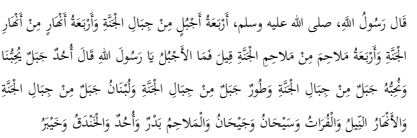
安拉的使者ﷺ说:“有四座山是来自乐园(天堂)的山,四条河是来自乐园的河,四场激烈的大战将是来自乐园的战役。”有人问:“安拉的使者啊,是哪几座山?”他说:“乌侯德山是一座爱我们、我们也爱它的山,是乐园的山之一;西奈山(Tur)是乐园的山之一;黎巴嫩山(Lubnan)是乐园的山之一。”河流则是尼罗河、幼发拉底河、赛哈尼河(Saihan,即Oxus)和贾哈尼河(Jaihan,即Jaxartes)。而那激烈的大战是白德尔之战、乌侯德之战、壕沟之战和海巴尔之战。
The Messenger of Allah (peace be upon him) said: “Four mountains are from the mountains of Jannah (paradise) and four rivers are from the rivers of paradise and four fierce great battles will be from the battles of paradise” It was asked: “Which mountains O Messenger of Allah?” He said: “Uhud, a mountain that loves us and we love it, is a mountain from the mountains of paradise, Tur is a mountain from the mountains of paradise and Lubnan is a mountain from among the mountains of paradise. And the rivers are the Nile, Euphrates, Saihan (Oxus) and Jaihan (Jaxartes), while the fierce great battles are Badr, Uhud, Khandaq and Khaibar”.
- 穆罕默德·本·阿里·本·穆阿伊姆·阿尔-巴拉迪向我们转述,据穆罕默德·本·阿卜杜拉·本·乌马尔,又据马阿法·本·伊姆兰,又据卡西尔·本·阿卜杜拉·本·阿穆尔,又据其父,再据其祖父:先知ﷺ说:
- Muhammad bin ‘Ali bin Mu’aim Al-Baladi related to us from Muhammad bin Abdullah bin ‘Umar, from Ma’afa bin ‘Imran, from Kathir bin Abdullah bin ‘Amr, from his father, from his grandfather: That the Prophet (peace be upon him) said:

“古莱什人啊,请你们在我的同伴、他们的儿子以及他们孙子的事上,念及我。”
“O gathering of the Quraish, keep me in mind in respect to my companions, their sons and the sons of their sons”.
穆罕默德·本·拉比尔·本·苏莱曼·阿尔-吉兹伊向我们讲述:阿布·乌迈耶·阿尔-塔尔苏西告诉他,穆阿维叶·本·阿慕尔告诉他,阿布·伊斯哈格·阿尔-法扎里告诉他,伊本·卡西尔·本·阿卜杜拉告诉他,他从父亲那里听闻,父亲又从祖父那里听闻,祖父说:
- Muhammad bin Rabi’ bin Sulaiman Al-Jiziy related to us from Abu Umayyah At-Tarsusiy, from Mu’awiyah bin ‘Amr, from Abu Ishaq Al- Fazariy, from Ibn Kathir bin Abdullah, from his father, from his grandfather, who said:

使者说:“不得劫掠,不得抢夺,不得窃取战利品;谁窃取战利品,他在审判日必将带着所窃之物而来。”ﷺ
The Messenger of Allah (peace be upon him) said: “There is no plundering, no looting and no stealing from the spoils and whoever steals from the spoils will come on the Day of Judgement with that which he stole”.
- 穆罕默德·本·艾哈迈德·本·侯赛因·艾哈瓦齐伊向我们转述,他从阿穆尔·本·阿里处听闻,阿穆尔从穆罕默德·本·哈立德·本·阿斯玛处听闻,阿斯玛从卡西尔·本·阿卜杜拉·穆扎尼处听闻,卡西尔从他的父亲处听闻,他的父亲从他的祖父处听闻,他的祖父说:
- Muhammad bin Ahmad Bin Al-Hussein Al-Ahwaziy related to us from ‘Amr bin ‘Ali, from Muhammad bin Khalid bin ‘Athmah, from Kathir bin Abdullah Al-Muzani, from his father, from his grandfather, who said:

真主的使者ﷺ说:"直到真主征服君士坦丁堡和罗马,并伴随着赞颂真主(Tasbih)与高呼真主至大(Takbir),末日才会来临。"
The Messenger of Allah (peace be upon him) said: “The final hour will not come until Allah conquers Constantinople and Rome accompanied by Tasbih and Takbir”.
- 艾哈迈德·本·穆罕默德·本·阿卜杜勒·阿齐兹·本·贾阿德告诉我们,他从穆罕默德·本·伊斯哈格·阿勒-马斯比那里,从阿卜杜拉·本·穆罕默德·本·萨勒姆那里,从阿卜杜勒·拉赫曼·本·易卜拉欣那里,从阿卜杜拉·本·纳菲那里,从卡希尔·本·阿卜杜拉那里,从他父亲那里,从他祖父那里,从先知ﷺ那里传述:
- Ahmad bin Muhammad bin Abdul ‘Aziz bin Al-Ja’d related to us from Muhammad bin Ishaq Al-Masibi, from Abdullah bin Muhammad bin Salm, from Abdur Rahman bin Ibrahim, from Abdullah bin Nafi’, from Kathir bin Abdullah, from his father, from his grandfather, from the Prophet (peace be upon him):

“已付天课者必获成功。”他说:这是开斋的天课。
“The one who gives Zakah has attained success” He said: Zakat ul-Fitr.
- 伊本·萨alm 告诉我们,他从阿卜杜勒·拉赫曼那里得知,阿卜杜拉·本·纳菲尔从卡西尔·本·阿卜杜拉那里得知,卡西尔从他的父亲那里得知,他的父亲从他的祖父那里得知,先知ﷺ说道:
- Ibn Salm related to us from Abdur Rahman, from Abdullah bin Nafi’, from Kathir bin Abdullah, from his father , from his grandfather, that the Prophet (peace be upon him) said:

“当心学者的失误或过失,并等待其再次出现。”艾哈迈德·本·哈夫斯向我们转述,据祖拜尔·本·巴卡尔,从阿卜杜拉·本·纳菲尔,内容同上。艾哈迈德·本·阿里·阿尔-马达伊尼向我们转述,据艾哈迈德·本·穆罕默德·艾布·巴克尔·阿尔-哈提比,从伊斯哈格·阿尔-詹比伊,他说:卡西尔·本·阿卜杜拉·阿尔-穆扎尼提到,从他的父亲,从他的祖父,他说:安拉的使者ﷺ说:同上(即“当心学者的失误”)。
“Take guard from the slip or lapse of the ‘Aalim (scholar) and so await its recurrence”. Ahmad bin Hafs related to us from Az-Zubair bin Bakkar, from Abdullah bin Nafi’ the same as above. Ahmad bin ‘Ali Al-Mada’ini related to us, from Ahmad bin Muhammad Abu Bakr Al-Hatibi, from Ishaq Al-Janbiy who said: Kathir bin Abdullah Al-Muzani mentioned it from his father, from his grandfather, who said: The Messenger of Allah (peace be upon him) said: The same as above (i.e. “Take guard from the lapse of the ‘Aalim”).
- 艾哈迈德·本·阿里向我们转述,他从穆罕默德·本·胡莱姆·安-盖扎兹那里听来,后者从希沙姆·本·哈立德那里,希沙姆从麦尔旺·本·穆阿维叶那里,麦尔旺从卡西尔·本·阿卜杜拉·阿-穆自尼那里,卡西尔从他父亲那里,他父亲从他祖父那里转述:
- Ahmad bin ‘Ali related to us from Muhammad bin Khuraim Al- Qazzaz, from Hisham bin Khalid, from Marwan bin Mu’awiyah, from Kathir bin Abdullah Al-Muzani, from his father, from his grandfather:

据传,先知(愿主赐福他并使他平安)对毕拉勒·本·哈里斯说:“毕拉勒啊,你要知道!”他说:“真主的使者啊,我已准备好听!”他又说:“毕拉勒啊,你要知道!”他说:“真主的使者啊,我已准备好听!”先知说:“毕拉勒啊,你要知道,凡是复兴我的逊奈中在我之后已经消失的一项逊奈的人,他将获得与依此而行之人相同的报酬,而不减少他们的任何报酬。凡是创立真主和祂的使者都不喜悦的错误创新的人,他将承担与依此而行之人相同的罪过,而这并不减少那些人的任何罪过。”ﷺ
“That the Prophet (peace be upon him) said to Bilal bin Al-Harith: “O Bilal, Know!”. He said: “I am ready to know O Messenger of Allah!” He said (again) “O Bilal, know!” He said: “I am ready to know O Messenger of Allah!” He said: “O Bilal, know that indeed whoever revives a Sunnah from my Sunnah which has died out after me, then for him is a reward similar to whoever acts upon it without diminishing anything from their rewards. And whoever introduces an erroneous innovation which Allah is not pleased with, nor His Messenger, then he shall receive sins similar to whoever acts upon it, without that diminishing anything from the sins of the people”.
——以同一isnad,由他的祖父传述,他说:
- With the same Isnad from his grandfather, who said:

“我从安拉的使者(愿安拉赐福于他)那里背记了宗教基础中的16条基础。”他说:安拉的使者(愿安拉赐福于他)说:ﷺ
“I memorised from the Messenger of Allah (peace be upon him) 16 foundations from the foundations of the Deen”. He said: The Messenger of Allah (peace be upon him) said:

“没有赔偿(血钱)于牲畜(即被其攻击而造成的伤害),没有赔偿于井(即与井有关的意外),而埋藏的宝藏(Rikaz)须缴纳五分之一。”
“There is no liability (blood money) for beasts (i.e. from being attacked), there is no liability for wells (i.e. accidents related to them) and a fifth is due from the buried treasure (Rikaz)”.

他说:“没有跟随的驱赶(Jalab),也没有侧牵的驱赶(Janab)(意思是不应把牲畜从其放牧之处赶到收取天课者那里),没有阻拦,也没有城里人替乡下人做的买卖。”
He said: “There is no Jalab and no Janab (meaning that animals should not be moved away from their place of grazing to the collector of Zakah), there is no obstruction and there is no trade of a townsperson
对于贝都因人而言。并且,不存在非法占有、掠夺、抢劫,也没有从战利品中盗窃之事;谁从战利品中偷窃,谁在审判日就会带着他所偷的东西前来。”
for a Bedouin. And there is no unlawful taking of possession, no plundering, no looting and no stealing from the spoils and whoever steals from the spoils will come with that which he stole on the Day of Judgement”.

他说:“谁若擅自归属于非其主人的人,作为其所属者的主人以外的人,那么安拉的诅咒和祂的愤怒将降临于他,他的任何善功都不会被接受。” Note: "Mawla" and "Mawali" are rendered by their meaning in context (master/client). Let me correct the wording to stay faithful to the original: 他说:“谁若擅自归属于非其主人的人,安拉的诅咒和祂的愤怒将降临于他,他的任何(善功)都不会被接受。”
He said: “Whoever takes charge of a Mawla from other than his Mawali, then the curse of Allah and His anger will be upon him, and nothing will be accepted from him”.

他说:"谁犯了罪(即侵犯他人的权利或违背盟约),那么安拉的诅咒和祂的愤怒将降临于他,而他的任何功修都不会被接受。"
He said: “Whoever commits a crime (i.e. breaching the rights of others or the covenant), then the curse of Allah and His anger will be upon him, and nothing will be accepted from him”.
以同一串传述链,从他的祖父传述:安拉的使者ﷺ说:
- With the same Isnad from his grandfather, he said: The Messenger of Allah (peace be upon him) said:

穆斯林须遵守他们所订立的条件,但使合法之事变为非法,或使非法之事变为合法的条件除外。
“The Muslims are upon their conditions apart from the condition which makes the Halal (lawful) Haram (unlawful) or a condition that makes the Haram (unlawful) Halal (lawful)”.
- 阿卜杜勒·瓦哈卜·本·阿布·乌斯玛告诉我们:伊斯玛仪·本·叶齐德·阿斯巴哈尼传述,从马尼·本·伊萨,从卡西尔·本·阿卜杜拉·穆载尼,从他的父亲,从他的祖父,他说:
- Abdul Wahhab bin Abu ‘Usmah related to us from Isma’il bin Yazid Al-Asbahani, from Ma’n bin ‘Eisa, from Kathir bin Abdullah Al- Muzani, from his father, from his grandfather who said:

我听到安拉的使者ﷺ说:"他站起来,赞美安拉并颂扬祂。然后他说:'人们啊,在朝觐和副朝的人,以及在荒地上旅行的人,对水和阴凉更有权利,所以不要阻止人们使用这片土地(即通行)。'"
I heard the Messenger of Allah (peace be upon him): “He stood, praised Allah and extolled Him. He then said: O people, whoever from those undertaking Hajj and ‘Umrah and those who are travelling are upon deserted land have more right to water and shade and so do not prevent the people from the land (i.e. access)”.
随后,在这一印刷版中,出现了若干与卡西尔·本·阿卜杜拉毫无关联的圣训。看来错误的根源在于手稿本身;如果能够找到其他手稿,可以对其进行校订并与此本比对……(在提及那些不相关的圣训之后,伊本·阿迪继续说道):
Following this, there came, in this printed edition, a number of unconnected Ahadeeth which had no relationship with Kathir bin Abdullah at all. It appears that the origin of the error is the manuscript itself and other manuscripts can be revised and compared to this one if they can be found … (Following the mention of those unrelated Ahadeeth Ibn Adiy continues):
- 他(伊本·阿迪)说:艾哈迈德·本·哈夫斯·阿斯-萨阿迪伊告诉我们,从艾哈迈德·本·易卜拉欣·阿德-杜拉奇伊,从阿卜杜拉·本·纳菲尔,从卡西尔·本·阿卜杜拉·穆扎尼,从他的父亲,从他的祖父,祖父说:
- He (Ibn ‘Adiy) said: Ahmad bin Hafs As-Sa’diy related to us from Ahmad bin Ibrahim Ad-Duraqiy, from Abdullah bin Nafi’, from Kathir bin Abdullah Al-Muzani, from his father, from his grandfather, who said:

安拉的使者ﷺ说:“只要那些阿比西尼亚人不惹你们,你们也就不要去惹他们。”
The Messenger of Allah (peace be upon him) said: “Leave be those Abyssinians as long as they leave you be”.
穆罕默德·本·哈桑·阿尔-巴士里传述,来自穆罕默德·本·巴卡尔·阿尔-阿伊希,来自穆罕默德·本·伊斯玛仪·本·艾布·法代克,来自卡西尔·本·阿卜杜拉·阿尔-穆扎尼,来自他的父亲,来自他的祖父,他说:
- Muhammad bin Al-Hasan Al-Basriy related from Muhammad bin Bakkar Al-‘Aishi, from Muhammad bin Isma’il bin Abu Fadaik, from Kathir bin Abdullah Al-Muzani, from his father, from his grandfather, who said:

先知ﷺ听到一个人称之为“绿色的”(繁茂的),于是他说:“我们听从您的吩咐。我们已经取用了,而您也取用了你们所拥有的东西。”
“The Prophet (peace be upon him) heard a man calling it green (luscious) and so he said: We are at your service. We have taken and you have from what is among you” .
- 穆罕默德·本·哈桑·阿尔-巴斯里传述,来自阿拔斯·本·阿卜杜勒·阿齐姆,来自阿卜杜拉·本·贾法尔·本·阿布·卡西尔·阿尔-安萨里,来自卡西尔·本·阿卜杜拉·本·阿穆尔·本·奥夫·阿尔-穆扎尼,来自他的父亲,来自他的祖父,来自比拉勒·本·哈里斯·阿尔-穆扎尼:
- Muhammad bin Al-Hasan Al-Basriy related from Al-‘Abbas bin Abdul ‘Azhim, from Abdullah bin Ja’far bin Abu Kathir Al-Ansari, from Kathir bin Abdullah bin ‘Amr bin ‘Awf Al-Muzani, from his father, from his grandfather, from Bilal bin Al-Harith Al-Muzani:

据传,先知ﷺ想要大小便时,会走到远离人群的地方。
“That when the Prophet (peace be upon him) wanted to relive himself, he would move away at a distance”.
- 阿卜杜拉·本·阿卜杜勒·哈米德·阿尔-瓦西提传述,来自al-Nadr bin Salamah,来自Abu ‘Uziyyah Muhammad bin Musa Al-Ansari,他是麦地那的卡迪(法官),来自Kathir bin Abdullah,来自他的父亲,来自他的祖父‘Amr bin ‘Awf,他说:
- Abdullah bin Abdul Hamid Al-Wasitiy related from An-Nadr bin Salamah, from Abu ‘Uziyyah Muhammad bin Musa Al-Ansari, the Qadi (Judge) of Al-Madinah, from Kathir bin Abdullah, from his father, from his grandfather ‘Amr bin ‘Awf, who said:

“我看见安拉的使者ﷺ站在马嘎姆上,他说:‘众人啊,这个禁拉(克尔白)是清真寺的禁拉,而清真寺是今世的禁拉。’”
“I saw the Messenger of Allah (peace be upon him) standing upon the Maqam and he was saying: O people, this Qiblah, it is the Qiblah of the Masjid and the Masjid is the Qiblah of the Dunyaa (world)”.
- 穆罕默德·本·优素福·本·阿西姆·布哈里向我们转述,他从艾哈迈德·本·伊斯玛仪·古莱details 说起。 Let me correct that: - 穆罕默德·本·优素福·本·阿西姆·布哈里向我们转述,从艾哈迈德·本·伊斯玛仪·古莱什,从阿卜杜拉·本·纳菲尔,从凯西尔·本·阿卜杜拉,从他的父亲,从他的祖父。
- Muhammad bin Yusuf bin ‘Asim Al-Bukhari related to us from Ahmad bin Isma’il Al-Qurashi, from Abdullah bin Nafi’, from Kathir bin Abdullah, from his father, from his grandfather:

“使者(愿安拉赐福他并使他平安)当时在清真寺里。他听到身后有人说话,说话的人是这样说的:“主啊,求你帮助我,使我免于你使我所畏惧的事物”。于是,使者(愿安拉赐福他并使他平安)听到这话后说:“你不把它的姐妹也一并加上吗?”那人接着说:“主啊,把你为真诚者所喜爱的事物赐予我,使我也渴慕它”。使者(愿安拉赐福他并使他平安)随后对在他身边的安内斯·本·马立克说:“安内斯啊,你去找他,告诉他,使者(愿安拉赐福他并使他平安)对你说:‘请为我求饶。’”安内斯便去找他,把这话转告给他。那人便说:“安内斯啊,你是使者(愿安拉赐福他并使他平安)派来见我的使者吗?”他回答说:“就像你一样。”那人便回去核实此事。使者(愿安拉赐福他并使他平安)随即说:“告诉他,是的。”于是,那人对他说:“你去告诉他,安拉使你胜过众先知,正如祂使斋月胜过其他月份;安拉也使你的乌玛(民族)胜过众民族,正如祂使主麻日胜过其他所有日子。”他们去寻找,结果发现那人是呼祖尔,愿他平安。
“That the Messenger of Allah (peace be upon him) was in the Masjid. He heard speech behind him and the one saying it was saying: “O Allah assist me with which will save me from that which you have made me fearful of”. So, the Messenger of Allah (peace be upon him) said when he heard that: “Will you not include its sister alongside it?” The man then said: “O Allah bestow upon me the longing of the truthful to that which you have made desirable for them”. The Messenger of Allah (peace be upon him) then said to Anas bin Malik who was in his company: “Go to him O Anas and say to him that the Messenger of Allah (peace be upon him) says to you: “Seek forgiveness for me”. So, Anas went to him and conveyed that to him. The man then said: “O Anas, you are the messenger of the Messenger of Allah (peace be upon him), to me. He replied: “Just as you are”. He returned to verify it. The Messenger of Allah (peace be upon him) then said: “Say to him yes”. So, he (the man) said to him: “Go and say to him that Allah has favoured you over the Prophets like He has favoured the month of Ramadan over other months and that He has favoured your Ummah (nation) over the nations like He has favoured the day of Jumu’ah over all of the other days”. They went looking and behold it was Khadir, peace be upon him”.
- 艾哈迈德·本·贾阿法尔向我们转述,来自雅可布·本·易卜拉欣·阿德-杜拉奇,来自易卜拉欣·本·阿卜杜拉·阿尔-拉法伊,来自卡西尔·本·阿卜杜拉,来自他的父亲,来自他的祖父:
- Ahmad bin Ja’far related to us from Ya’qub bin Ibrahim Ad-Duraqi, from Ibrahim bin Abdullah Ar-Rafa’iy, from Kathir bin Abdullah, from his father, from his grandfather:

“先知穆罕默德ﷺ为纳加希(阿比西尼亚的国王)举行了葬礼拜,并念了五次塔克比尔”。
“That the Messenger of Allah (peace be upon him) prayed over the Najashi (Negus of Abyssinia) and did five Takbirs”.
- 伊姆兰·本·穆萨向我们转述,他从易卜拉欣·本·穆迪尔处听闻,后者从阿布·贾德·阿卜杜勒·拉赫曼·本·阿卜杜拉·萨勒米处听闻,后者从卡西尔·本·阿卜杜拉·穆扎尼处听闻,卡西尔从他的父亲处听闻,他的父亲从他的祖父处听闻,祖父说:
- ‘Imran bin Musa related to us from Ibrahim bin Al-Mundhir, from Abu Al-Ja’d Abdur Rahman bin Abdullah As-Salmiy, from Kathir bin Abdullah Al-Muzani, from his father, from his grandfather, who said:

真主的使者ﷺ说:“马在饮水的那天被呈献。”
“The Messenger of Allah (peace be upon him) said: “the horse is offered the day of its watering”.
仍有少量由Kathir bin Abdullah从其父、从其祖父所转述的圣训存在,而我所提及的大部分圣训以及他所转述的大部分内容,都没有能与之相符或佐证的其他传述(即他是独自转述这些圣训的)。 - Bahlul bin Ishaq 告诉我们:他从 Isma'il bin Abu Uwais 那里得知,后者从 Kathir bin Abdullah Al-Muzani 那里得知,后者从 Rubaih bin Abdur Rahman bin Abu Sa'id Al-Kudri 那里得知,后者从其父那里得知,其父从其祖父那里得知,他说:
There are still a small number of Ahadeeth related by Kathir bin Abdullah from his father, from his grandfather remaining and most of his Ahadeeth which I mentioned and most of what he related, does not have that which conforms (or supports) them (i.e. he is alone in narrating them). - Bahlul bin Ishaq related to us from Isma’il bin Abu Uwais, from Kathir bin Abdullah Al-Muzani, from Rubaih bin Abdur Rahman bin Abu Sa’id Al-Kudri, from his father, from his grandfather, who said:

“我看见一些阿拉伯人(即贝都因人)走近安拉的使者ﷺ。他们说:‘安拉的使者啊,我们是拥有牲畜的人,我们从中取出我们的萨达格(即天课),那么斋月的天课是否也足以替代我们的天课呢?’安拉的使者ﷺ说:‘不,它要从孩子和成人、自由人和奴隶身上收取。这是对你们的净化。’艾布·赛义德·胡德里说:我看到那一年牲畜繁多,而白色作物(小麦之类)比黑色作物减少得更多。随后我又看到第二年作物丰收,而黑色牲畜比白色牲畜减少得更多。’我不知道除了凯西尔·本·阿卜杜拉之外,还有谁从鲁拜赫那里转述这段圣训。’——伊本·阿迪引述结束。”
“I saw men from the Arabs (i.e. Bedouins) approaching the Messenger of Allah (peace be upon him). They said: “O Messenger of Allah, we are people possessing livestock and we take out from them our Sadaqah (i.e. Zakat) and so does that also cover for us the Zakat of Ramadan?” The Messenger of Allah (peace be upon him) said: “No, it is taken from the child and the adult, from the free and the slave. It is a purification for you”. Abu Sa’id Al-Khudri said: I saw in the year that the herds were plentiful and that the white crops diminished more than the black. I then saw in the year following that the crops were plentiful and that the black herds were diminished more than the white”. I do not know anyone relating this Hadith from Rubaih apart from Kathir bin Abdullah] [End of quote of Ibn ‘Adiy].
关于伊本·阿迪依的这段话:“卡希尔·本·阿卜杜拉从他父亲、再从他祖父所传的圣训,仍有少量留存;我所提及的大部分圣训,以及他所传的大部分内容,都没有能与之相符合(或作为佐证)的记载(即他独自传述这些圣训)”,这并不意味着宣布其不可信或判定其为弱者。因为仅仅独自传述圣训,即“他所传的大部分内容没有能与之相符合的佐证”,尤其是对于那些出自圣门弟子著名再传后裔的人(例如巴赫兹·本·哈基姆的情况),并不能断定其为弱者或不可信。仿佛伊本·阿迪依更愿意保持稳妥,选择避免对此人作出裁定。因为当他想要表明某人不可信或有缺陷时,通常会说:“他的圣训中弱点明显”或与之相近的措辞;而当他想要宣布某位传述者可信且可靠时,则会说:“我没有发现他有任何Munkar(不可接受的内容)”,或“如果一位Thiqah(可信可靠的传述者)从他那里传述,我没有发现其中有任何Munkar”。显然,布哈里传来的内容中,除了他的老师伊斯玛仪·本·阿布·乌韦斯传给他的那段之外,没有其他的记载:“我听(或从)卡希尔·本·阿卜杜拉·本·阿穆尔·本·奥夫·本·叶齐德·本·米尔哈·穆宰尼传述,时间是158年,之后是161年或162年。”
I say: Concerning the statement of Ibn ‘Adiy: “There are still a small number of Ahadeeth related by Kathir bin Abdullah from his father, from his grandfather remaining and most of his Ahadeeth which I mentioned and most of what he related, does not have that which conforms (or supports) them (i.e. he is alone in narrating them)”, then this does not mean the declaration of unreliability or classification of weakness. That is because the mere being alone in relating Ahadeeth “most of what he related, does not have that which conforms (or supports) them”, especially in respect to the one who is from the infamous grandchildren of the Sahabah (like the case of Bahz bin Hakim for instance), does not dictate weakness or unreliability. It is as if Ibn ‘Adiy preferred to remain safe and chose to escape from issuing a verdict upon the man. That is because when he wants to express the unreliability or defectiveness of a man, he usually states: “And the weakness is evident in his Hadith” or words which are similar to that. That is whilst if he wants to declare the reliability and soundness of a narrator he says: “I did not find anything Munkar (rejectable) in relation to him” or “I did not find anything Munkar of his if a Thiqah (reliable and trustworthy narrator) related from him”. It is apparent that nothing reached him from Al-Bukhari apart from what his Sheikh Isma’il bin Abu Uwais related to him: “I heard (or received from) Kathir bin Abdullah bin ‘Amr bin ‘Awf bin Yazid bin Milhah Al-Muzani in the year 158 then the year 161 or 162”.


“使者(愿安拉赐福他并使他平安)当时在清真寺里。他听到身后有人说话,说话的人是这样说的:“主啊,求你帮助我,使我免于你使我所畏惧的事物”。于是,使者(愿安拉赐福他并使他平安)听到这话后说:“你不把它的姐妹也一并加上吗?”那人接着说:“主啊,把你为真诚者所喜爱的事物赐予我,使我也渴慕它”。使者(愿安拉赐福他并使他平安)随后对在他身边的安内斯·本·马立克说:“安内斯啊,你去找他,告诉他,使者(愿安拉赐福他并使他平安)对你说:‘请为我求饶。’”安内斯便去找他,把这话转告给他。那人便说:“安内斯啊,你是使者(愿安拉赐福他并使他平安)派来见我的使者吗?”他回答说:“就像你一样。”那人便回去核实此事。使者(愿安拉赐福他并使他平安)随即说:“告诉他,是的。”于是,那人对他说:“你去告诉他,安拉使你胜过众先知,正如祂使斋月胜过其他月份;安拉也使你的乌玛(民族)胜过众民族,正如祂使主麻日胜过其他所有日子。”他们去寻找,结果发现那人是呼祖尔,愿他平安。
“That the Messenger of Allah (peace be upon him) was in the Masjid. He heard speech behind him and the one saying it was saying: “O Allah assist me with which will save me from that which you have made me fearful of”. So, the Messenger of Allah (peace be upon him) said when he heard that: “Will you not include its sister alongside it?” The man then said: “O Allah bestow upon me the longing of the truthful to that which you have made desirable for them”. The Messenger of Allah (peace be upon him) then said to Anas bin Malik who was in his company: “Go to him O Anas and say to him that the Messenger of Allah (peace be upon him) says to you: “Seek forgiveness for me”. So, Anas went to him and conveyed that to him. The man then said: “O Anas, you are the messenger of the Messenger of Allah (peace be upon him), to me. He replied: “Just as you are”. He returned to verify it. The Messenger of Allah (peace be upon him) then said: “Say to him yes”. So, he (the man) said to him: “Go and say to him that Allah has favoured you over the Prophets like He has favoured the month of Ramadan over other months and that He has favoured your Ummah (nation) over the nations like He has favoured the day of Jumu’ah over all of the other days”. They went looking and behold it was Khadir, peace be upon him”.
我们在所有可能的地方搜寻过这则圣训,但除了通过伊玛目伊本·阿迪(Ibn ‘Adiy)的这条传述路线之外,未能找到它。这则圣训也被归于他,见于《Unais As-Saari Fee Takhrij Ahadeeth Fat’h ul-Baari》(9/6578/4610)一书。
We searched for this narration in every conceivable place but we were unable to find it except from this path of Imam Ibn ‘Adiy. The narration is also attributed to him in the book “Unais As-Saari Fee Takhrij Ahadeeth Fat’h ul-Baari” (9/6578/4610):

‘Amr bin ‘Awf 传述:“先知(愿主福安之)在清真寺中时听到有人说话,于是说:‘阿奈斯啊,你去找说那话的人,让他为我求饶。’阿奈斯便去找那人,那人对他说:‘你告诉(先知),真主因斋月胜过其余的月份,而使你胜过众先知。’他说:然后他们去看,结果那人竟是哈氐尔。”阿尔-哈菲兹(伊本·哈哲尔)说:“这是一段弱圣训,由伊本·阿迪伊经卡西尔·本·‘Amr bin ‘Awf 的传述线,从他的父亲、从他的祖父传出,其传述链也是弱的。”伊本·阿塞尔也从阿奈斯的圣训中传述了类似的内容,但其传述链比它更弱。(7/245——先知圣训篇:哈氐尔与穆萨(愿主福安之)的圣训章)这是非常弱的。他既传述了‘Amr bin ‘Awf 的圣训,也传述了阿奈斯的圣训。至于‘Amr bin ‘Awf 的圣训,伊本·阿迪伊(6/2083)经阿卜杜拉·本·纳菲尔·阿赛格,从卡西尔·本·阿卜杜拉、从他的父亲、从他的祖父传出:“真主的使者(愿主福安之)在清真寺中时听到有人说话,然后……等等……”
[‘Amr bin ‘Awf related: “That the Prophet (peace be upon him) heard speech whilst he was in the Masjid and then said: “O Anas, go to the one who said that and ask him to seek forgiveness for me”. Anas went to the man and he (the man) said to him: “Say (to him i.e. the Prophet) that verily Allah has favoured you over the Prophets by that which he has favoured Ramadan over the remaining months”. He said: They then went to see and behold it was Khadir”. Al-Hafizh (Ibn Hajar) said: “It is a weak Hadith which Ibn ‘Adiy extracted via the path of Kathir bin ‘Amr bin ‘Awf, from his father, from his grandfather, and it is a weak Isnad (chain of transmission)”. Ibn ‘Asakir related similar to it from the Hadith of Anas, with a chain of transmission which is weaker than it” (7/245 – The book of the Ahadeeth of the Prophets – Chapter: The Hadith of Al-Khadir with Musa, peace be upon him). It is very weak. He related from the Hadith of ‘Amr bin ‘Awf and the Hadith of Anas. As for the Hsdith of ‘Amr bin ‘Awf, then Ibn ‘Adiy extracted it (6/2083) via the path of Abdullah bin Nafi’ As-Sa’igh from Kathir bin Abdullah, from his father, from his grandfather: “That the Messenger of Allah (peace be upon him) was in the Masjid and then he heard speech … etc …].
如所见,阿里哈菲兹(伊本·哈哲尔)将该段圣训归于卡西尔·本·阿卜杜拉,而《Unais As-Saari》的作者阿布·胡迪法·纳比勒·本·曼苏尔·本·叶尔古卜·本·苏丹·阿尔-比萨拉·阿尔-库维蒂则将其归于阿卜杜拉·本·纳菲尔·阿尔-萨伊格,其传自卡西尔·本·阿卜杜拉。然而,他们二人在此问题上都犯有严重的疏漏。
As can be seen, Al-Hafizh (Ibn Hajar) attributed the narration to Kathir bin Abdullah whilst Abu Hudhaifah Nabil bin Mansur bin Ya’qub bin Sultan Al-Bisarah Al-Kuwitiy, the author of “Unais As- Saari”, attributed it to Abdullah bin Nafi’ As-Sa’igh from Kathir bin Abdullah. However, both of them are guilty of an obscene shortcoming in respect to this.
事实上,这并非出自卡西尔·本·阿卜杜拉的圣训,也不是出自阿卜杜拉·本·纳菲尔·阿-萨伊格从卡西尔所传的圣训,而是出自艾哈迈德·本·伊斯玛仪·阿勒-古莱什的伪造之作。
The truth is that it is not from the Hadith of Kathir bin Abdullah nor the Hadith of Abdullah bin Nafi’ As-Sa’igh from Kathir. Rather, it is from the handiworks of Ahmad bin Isma’il Al-Qurashi.
以下内容见于《伊斯兰史》(第6卷,第20页)所载:
- The following came stated in “Tarikh ul-Islam” (6/20):
[الخطيب قال: قرأتُ بخطّ الدارقطني: أحمد بن إسماعيل أبو حذيفة ضعيفٌ في الحديث. كان غافلاً. روى «الموطأ» عن مالك صحيحاً، ثم أُدخلت عليه أحاديث عن مالك من غير «الموطأ» فقبلها. وليس بثقةٍ يُعتمد عليه. وقال ابن عديّ: «روى الموطأ عن مالك، وروى عنه وعن غيره بالبواطيل». وقال الخطيب: «ولم يكن من الذين تعمّدوا الكذب»].

“真主的使者ﷺ说:‘伊斯兰教将退回到希贾兹,正如蛇退回到它的洞穴;伊斯兰教将在希贾兹寻求庇护,正如山羊在山顶寻求庇护。伊斯兰教起初是陌生的,将来也会再次变得陌生。陌生人是有福的;他们会纠正后人对我的逊奈所造成的败坏。’”
That the Messenger of Allah (peace be upon him) said: “Verily, the Deen will retreat back to the Hijaz as a snake retreats back to its hole, and the Deen will seek refuge in the Hijaz as the mountain goat seeks refuge in the mountain top. The Deen began as something strange and will return as something strange. Blessed are the strangers; those who will rectify what the people after me have corrupted from my Sunnah”.
有人谈论过卡西尔,若他们对他保持沉默,对他们自己反而更有益。的确,只有无知的人才谈论他以及他的动机(或关系)。 我听伊本·尤瓦斯说:马立克曾就他的圣训询问我,叶哈雅·本·赛义德·安萨里也从他那里转述过。我毫不怀疑,我听易卜拉欣·本·穆迪尔说(如果我不是从他那里听到的,那么是一位可信者转述给我的),他说:“卡西尔常声称先知(愿主赐福他并使他平安)曾把土地赐给他的祖父,他还与该地区的人争执。他非常好争吵。他曾去找伊本·伊姆兰争论,伊姆兰便对他说:‘哦,卡西尔,你确实是个游手好闲、爱在自己并不了解的事情上争吵的人,你主张不属于你的东西,而你所要求的,又没有任何证据。所以,不要来找我,除非你看到我已经为了虚假之人腾出了时间。如果你看到了,那就来吧。’” 有一天,伊本·伊姆兰与我们同在,忽然卡西尔·本·阿卜杜拉来到他面前。伊本·伊姆兰说:“我不是告诉过你,除非看到我为了虚假之人腾出时间,否则不要来找我吗?”卡西尔回答说:“你说得对,愿真主使法官的事务安好。我只是在虚假之人来找你的时候才来找你的。某某人和某某人来找你,他们两个都是虚假之人,所以我便和他们二人一同来了。”这是伊本·伊姆兰对他的命令。 艾布·优素福说:“他命令他留在柱旁,直到他从审判程序中站起来为止。”艾布·优素福说:“他们是伊本·伊姆兰的拥护者之一。”此事也记载于《Ash-Shamela Lil-Ma'rifah Wa At-Tarikh》的抄本中(第62页,按Shamela电子图书馆的编号)。
Some have spoken about Kathir who had they been silent about him it would have been more beneficial. Indeed, only the ignorant have spoken about him and his motives (or relations). I heard Ibn Uwais saying: Malik asked me about his Hadith and Yahya bin Sa’id Al-Ansari related from him. I have no doubt that I heard Ibrahim bin Al- Mundhir (And if I didn’t hear it from him, then a Thiqah related it to me) that he said: “Kathir used to claim that the Prophet (peace be upon him) had granted his grandfather land and he used to dispute with those in that area. He used to quarrel a lot. He went to Ibn ‘Imran to quarrel and so ‘Imran said to him: “O Kathir, indeed you are an idle man who quarrels a lot in respect to that which you don’t know, you claim that which does not belong to you and you have no evidence from what you demand. So, don’t approach me and I will not let me see you unless you see that I have freed my time for the people of falsehood. If you see that, then come”. One day Ibn ‘Imran was with us and then behold Kathir bin Abdullah had approached him. He (Ibn ‘Imran) said: “Did I not tell you to not come to me unless you see me having freed my time for the people of falsehood?” Kathir then replied: ““You have said the truth, may Allah make good the affair of the Qadi. Indeed, I only came to you when the people of falsehood came to you. So and so and so and so person came to you. They are both people of falsehood and so I came along with them both”. It was from the command of Ibn ‘Imran to him. Abu Yusuf said: “He commanded to remain fast to the column until he had stood from judicial proceedings”. Abu Yusuf said: “They were from those devoted to Ibn ‘Imran]. This has also been recorded in the transcript of “Ash-Shamela Lil- Ma’rifah Wa At-Tarikh” (p. 62 – by the numbering of the Shamela E- library).