5.5 Imparcialidade em relação a Kathir bin Abdullah bin ‘Amr bin ‘Awf Al-Muzani
5.5 Fairness to Kathir bin Abdullah bin ‘Amr bin ‘Awf Al- Muzani
- O seguinte foi declarado no “Taqrib At-Tahdhib” [Ibn Hajar] (1/460/5617): [Kathir bin Abdullah bin ‘Amr bin ‘Awf Al-Muzani Al- Madani é Da’if (fraco). Aqueles que o acusaram de mentir foram excessivos. (Ele pertencia) à sétima (ou seja, geração ou linha de transmissão)].
- The following came stated in in “Taqrib At-Tahdhib” [Ibn Hajar] (1/460/5617): [Kathir bin Abdullah bin ‘Amr bin ‘Awf Al-Muzani Al- Madani is Da’if (weak). Those who attributed lying to him were excessive. (He was from) the seventh (i.e. generation or line of transmission)].
- No entanto, em “Irwaa’ Al-Ghalil”, de Al-Albani (5/155), foi afirmado o seguinte: [Al-Hafizh (isto é, Ibn Hajar) disse [em Al-Fat’h – (4/371)]: [E Kathir bin Abdullah é Da’if na opinião da maioria, porém Al-Bukhari e aqueles que o seguiram, como At-Tirmidhi e Ibn Khuzaimah, fortalecem a sua situação (ou status)].
- However, in “Irwaa’ Al-Ghalil”, by Al-Albani (5/155), the following was stated: [Al-Hafizh (i.e. ibn Hajar) said [in Al-Fat’h – (4/371)]: [And Kathir bin Abdullah is Da’if in the view of the majority however Al- Bukahri and those who followed him like At-Tirmidhi and Ibn Khuzaimah strengthen his affair (or status)].
- O seguinte foi registrado em “At-Tarikh Al-Kabir” [Al-Bukhari] (7/217/945): [Kathir bin Abdullah bin ‘Amr bin ‘Awf Al-Muzani Al-Madani ouviu (ou recebeu) de seu pai, enquanto Marwan bin Mu’awiyah, Isma’il bin Abu Uwais e Yahya Al-Ansari transmitiram dele]. Isso consta em outra edição de “At-Tarikh Al-Kabir” de Al-Bukhari (7/96/945). Al-Bukhari não o classificou como Da’if (fraco), e não falou sobre ele, nem mesmo uma única letra! - O seguinte foi declarado em “Al-Jarh Wa At-Ta’dil” [Ibn Abu Hatim] (7/154/858): [Kathir bin Abdullah bin ‘Amr bin ‘Awf Al-Muzani transmitiu de seu pai, além de Muhammad bin Ka’b e Rubaih bin Abdur Rahman, enquanto Abdul ‘Aziz bin Muhammad, Marwan bin Mu’awiyah, Ma’n bin ‘Eisa, Abdullah bin Wahb, Abdullah bin Nafi’ As-Sa’igh, Muhammad bin Khalid bin ‘Athma, Abu ‘Amir Al-‘Aqadiy, Khalid bin Makhlad, Ibn Qa’nab e Ibn Abu Uwais transmitiram dele. Eu ouvi meu pai dizendo isso. Abdur Rahman nos transmitiu de Muhammad bin Hamawaih bin Al-Hasan, que disse: Ouvi Abu Talib dizer: perguntei a Ahmad (ou seja, Ahmad bin Hanbal) sobre Kathir bin Abdullah bin ‘Amr bin ‘Awf, e ele disse: “Munkar (isto é, rejeitável por defeito quanto ao Hadith), sem valor”. Abdur Rahman nos transmitiu: Ele disse: foi lido para Al-‘Abbas bin Muhammad Ad-Dawri, de Yahya bin Ma’een, que disse: “Kathir bin Abdullah Al-Muzani é Da’if (fraco) no Hadith”. Abdur Rahman nos transmitiu. Ele disse: perguntei a Abu Zur’ah sobre Kathir bin Abdullah bin ‘Amr bin ‘Awf. Ele disse: “Fraco no Hadith e não forte”. Perguntei-lhe: entre Bahz bin Hakim, Abdul Muhaimin e Kathir bin Abdullah, qual deles é o mais querido para você? Ele disse: “Bahz e Abdul Muhaiman são mais queridos para mim do que ele”. Abdur Rahman nos transmitiu: Ele disse: meu pai foi perguntado sobre Kathir bin Abdullah bin ‘Amr bin ‘Awf, e disse: “Ele não é sólido/forte (Matin)”.
- The following came recorded in “At-Tarikh Al-Kabir” [Al-Bukhari] (7/217/945): [Kathir bin Abdullah bin ‘Amr bin ‘Awf Al-Muzani Al- Madani listened to (or received from) his father, while Marwan bin Mu’awiyah, Isma’il bin Abu Uwais and Yahya Al-Ansari related from him]. It is recorded in another edition of “At-Tarikh Al-Kabir” by Al- Bukhari (7/96/945). Al-Bukhari did not classify him as Da’if (weak) and he did not speak about him, not even a single letter! - The following came stated in “Al-Jarh Wa At-Ta’dil” [Ibn Abu Hatim] (7/154/858): [Kathir bin Abdullah bin ‘Amr bin ‘Awf Al-Muzani related from his father in addition to Muhammad bin Ka’b and Rubaih bin Abdur Rahman, while Abdul ‘Aziz bin Muhammad, Marwan bin Mu’awiyah, Ma’n bin ‘Eisa, Abdullah bin Wahb, Abdullah bin Nafi’ As-Sa’igh, Muhammad bin Khalid bin ‘Athma, Abu ‘Amir Al-‘Aqadiy. Khalid bin Makhlad, Ibn Qa’nab and Ibn Abu Uwais related from him. I heard my father saying that. Abdur Rahman related to us from Muhammad bin Hamawaih bin Al-Hasan who said: I heard Abu Talib who said: I asked Ahmad (meaning Ahmad bin Hanbal) concerning Kathir bin Abdullah bin ‘Amr bin ‘Awf and he said: “Munkar (i.e. rejectable due to defectiveness in respect to) Al-Hadith, of no worth”. Abdur Rahman related to us: He said: It was read to Al-‘Abbas bin Muhammad Ad- Dawri from Yahya bin Ma’een That he said: “Kathir bin Abdullah Al- Muzani is Da’if (weak) in Hadith”. Abdur Rahman related to us. He said: I asked Abu Zur’ah about Kathir bin Abdullah bin ‘Amr bin ‘Awf. He said: “Feeble/weak in Hadith and not strong”. I said to him: Out of Bahz bin Hakim, Abdul Muhaimin and Kathir bin Abdullah, which of them is the most beloved to you? He said: “Bahz and Abdul Muhaiman are more beloved to me than him”. Abdur Rahman related to us: He said: My father was asked about Kathir bin Abdullah bin ‘Amr bin ‘Awf and he said: “He is not solid/strong (Matin)”.
Esta afirmação "Ele não é sólido/forte (Matin)" não é como a afirmação "Ele não é Qawiy (forte)", nem é sinônimo da afirmação "Da'if" (fraco). Isso porque o narrador "Matin" é aquele que alcançou o ápice em relação à força e à confiabilidade. - Afirmações contraditórias foram registradas em "Tarikh ul-Islam" (10/224/330): [Kathir bin Abdullah bin 'Amr bin 'Awf bin Zaid bin Talha Al-Yashkuri Al-Muzani Al-Madani … Ele transmitiu de seu pai e de seu avô (por transcrição), além de Nafi' e Muhammad bin Ka'b Al-Qurazhi. E transmitiram dele o seguinte: Ibn Wahb, Abdullah bin Nafi', Al-Qa'nabi, Isma'il bin Abi Uwais e Khalq.
I say: This statement “He is not solid/strong (Matin)” is not like the statement “He is not Qawiy (strong))” and it is not synonymous with the statement “Da’if” (weak). That is because the “Matin” narrator is the one who has reached the pinnacle in respect to strength and reliability. - Contradictory statements came stated in “Tarikh ul-Islam” (10/224/330): [Kathir bin Abdullah bin ‘Amr bin ‘Awf bin Zaid bin Talha Al-Yashkuri Al-Muzani Al-Madani … He related from his father and from his grandfather (by transcript), in addition to Nafi’ and Muhammad bin Ka’b Al-Qurazhi. And the following related from him: Ibn Wahb, Abdullah bin Nafi’, Al-Qa’nabi, Isma’il bin Abi Uwais and Khalq.
Eles concordaram quanto à sua classificação como fraco, e Ahmad bin Hanbal rejeitou o seu hadith.
They agreed upon his classification of weakness and Ahmad bin Hanbal rejected his Hadith.
Ash-Shafi'iy disse: Ele é um dos pilares do Al-Kadhib (mentira/falsidade). Abu Dawud disse algo semelhante a isso.
Ash-Shafi’iy said: He is a pillar from among the pillars of Al-Kadhib (deceit/untruth). Abu Dawud said similar to that.
‘Abbas relatou de Ibn Ma’een (que ele, isto é, Kathir, é): “Da’if (fraco)”. Ad-Darimiy relatou de Ibn Ma’een: Ele não tem valor.
‘Abbas related from Ibn Ma’een (that he i.e. Kathir is): “Da’if (weak)”. Ad-Darimiy related from Ibn Ma’een: He has no worth.
An-Nasa'i disse: "Ele é abandonado ou desconsiderado (ou seja, não se narra dele)", e Ad-Daraqutniy disse o mesmo.
An-Nasa’i said: “He is left or disregarded (i.e. not related from)” and Ad-Daraqutniy said the same.
Quanto a At-Tirmidhi, ele então começou a ditar e disse: "Eu disse a Muhammad ﷺ: Há o Hadith de Kathir bin Abdullah, de seu pai, de seu avô, relacionado ao (assunto) do horário da oração do Jumu'ah. Ele disse: É um Hadith Hasan, porém Ahmad bin Hanbal classifica Kathir como Da'if (fraco)".
As for At-Tirmidhi, then he began to dictate and said: “I said to Muhammad: There is the Hadith of Kathir bin Abdullah, from his father, from his grandfather, related to the (subject area) of the time of the Jumu’ah prayer. He said: It is a Hasan Hadith, however Ahmad bin Hanbal classifies Kathir as being Da’if (weak)”.
Ibn Hibban disse: "Kathir relata, de seu pai, de seu avô, uma transcrição fabricada. Não é permitido mencioná-lo a não ser do ângulo do espanto". Eu disse: Ele faleceu no ano 163 AH] [Fim da citação].
Ibn Hibban said: “Kathir relates from his father, from his grandfather a fabricated transcript. It is not permissible to mention him except from the angle of astonishment”. I said: He died in the year 163 AH] [End of quote].
Eu digo: Não há sentido (nem relevância) na afirmação: "Concordaram em classificá-lo como fraco", quando existe um atestado de credibilidade do chefe da justiça e da moderação, o Imam Al-Bukhari, além da fala sem valor de Abu Hatim, que é dos propensos ao extremismo e à teimosia! A verdade é que Ad-Daraqutni apenas o mencionou como parte de uma lista, sem comentário, entre um grupo de narradores, em seu livro "Os fracos e os abandonados" (Ad-Du'afa' Wa Al-Matrukin). A fala atribuída a Abu Dawud contradiz o fato de ele ter publicado alguns dos hadiths de Kathir bin Abdullah, sem que surgisse qualquer divergência sobre eles, quando escreveu com eles às pessoas de Makkah. A explicação mais provável, em minha opinião, é que ele relatou a fala do Imam Ash-Shafi'iy e a seguiu no início, como se evidencia em "Tahdhib Al-Kamal" (24/136/4948) e em "Tahdhib At-Tahdhib" (8/377/753); cujos textos serão apresentados em breve. Depois disso, tornou-se evidente para ele a incorreção da acusação, e por isso registrou seus relatos em seu Sunan. O próprio Al-Hafizh bin Hajar parece estar dividido, pois sua fala em "Al-Fath" não é consistente com o que afirmou em seu resumo em "At-Taqrib". A questão é, portanto, ambígua, e por isso é necessário realizar um estudo preciso das circunstâncias ou da situação deste homem.
I say: There is no meaning (or significance) to the statement: “They agreed upon his classification of weakness” when there exists an attestation of credibility from the chief of fairness and moderation Imam Al-Bukhari, in addition to the insignificant speech of Abu Hatim, who is from the prone to extremity and stubbornness! The truth is that Ad-Daraqutni only mentioned him as part of a list, without commentary, amongst a group of narrators, in his book “The weak and disregarded” (Ad-Du’afa’ Wa Al-Matrukin”. The speech attributed to Abu Dawud contradicts the fact that he published some of the Hadith of Kathir bin Abdullah and no disagreement resulted over them, when he wrote with them to the people of Makkah. The most likely explanation in my view, is that he related the speech of Imam Ash-Shafi’iy and followed it in the beginning, as is evident in “Tahdhib Al-Kamal” (24/136/4948) and in “Tahdhib At-Tahdhib” (8/377/753); the texts of which will be presented soon. Then (after that), it the incorrectness of the accusation became evident to him and so he recorded his relations within his Sunan. Al-Hafizh bin Hajar himself appears to be of two minds as his speech in “Al-Fat’h” is not consistent with what he stated in his summary in “At-Taqrib”. The matter is therefore ambiguous and as such it is necessary to undertake a precise study of the circumstances or status of this man.
Foi registrado em "Ad-Du'afaa' Al-Kabir" de Al-'Uqailiy (4/4/1555): [Kathir bin Abdullah bin 'Amr bin 'Awf Al-Muzani. Ahmad bin Zukair Al-Hadrami nos relatou, de Ahmad bin Sa'id Al-Fihriy, de Ibrahim bin Al-Mundhir, de Mutarrif bin Abdullah, que disse: "Vi Kathir bin Abdullah bin 'Amr bin Awf Al-Muzani. Ele era muito briguento, e nenhum dos nossos companheiros aceitava nada dele". Então, Ibn 'Imran Al-Qadi lhe disse: "Ó Kathir, você é uma pessoa tola, discute sobre aquilo que não conhecemos. Você reivindica o que não possui e não tem provas para o que busca. Portanto, não se aproxime de mim a menos que me veja reservando tempo para as pessoas de tolice ou ociosidade. Se vir as pessoas de tolice na minha companhia, então venha". Ibrahim disse: Mutarrif me disse: Ibn 'Imran estava entre nós um dia, quando Kathir bin Abdullah veio até ele, e ele disse: "Não lhe disse que não se aproximasse de mim a menos que me visse com as pessoas tolas (ou ociosas)?" Kathir então lhe respondeu: "Você falou a verdade, que Allah faça prosperar os assuntos do Qadi. Na verdade, só vim até você quando as pessoas de tolice vieram até você. Fulano e fulano vieram até você. Ambos são das pessoas de tolice (ou ociosidade), e por isso vim junto com eles". Abdullah bin Ahmad nos relatou: Ele disse: Ouvi meu pai dizer: "Hussein bin Abdullah bin Dumairah e Kathir bin Abdullah bin 'Amr bin 'Awf não somam nada juntos, são semelhantes, não valem nada". Meu pai rejeitou os Ahadeeth de Kathir bin Abdullah bin 'Amr bin 'Awf e, por isso, não nos os relatou. Muhammad bin 'Eisa nos relatou, de 'Abbas, que disse: Ouvi Yahya dizer: Kathir bin Abdullah bin 'Amr bin 'Awf Al-Muzani, seu avô teve companhia (Suhbah, isto é, com o Profeta ﷺ), mas Kathir é fraco (Da'if) quanto ao Hadith]. Ahmad bin Mahmud relatou-nos, de Uthman bin Sa’id: Eu disse a Yahya bin Ma’een: “Kathir bin Abdullah Al-Muzani, (aquele) de quem Ma’n narra, qual é a sua condição?” Ele disse: “Ele não é nada ou não tem valor”.
- The following came recorded in “Ad-Du’afaa’ Al-Kabir” by Al- ‘Uqailiy (4/4/1555): [Kathir bin Abdullah bin ‘Amr bin ‘Awf Al-Muzani. Ahmad bin Zukair Al-Hadrami related to us from Ahmad bin Sa’id Al-Fihriy, from Ibrahim bin Al-Mundhir, from Mutarrif bin Abdullah, who said: “I saw Kathir bin Abdullah bin ‘Amr bin Awf Al-Muzani. He was very quarrelsome and none of our companions would take from him”. So, Ibn ‘Imran Al-Qadi said to him: “O Kathir, you are a foolish person, you quarrel in respect to that which we don’t know. You make claims to that which you don’t have and you don’t have evidence for what you seek. So, don’t approach me unless you see me making time for the people of foolishness or idleness. If you see the people of foolishness in my company then come on over”. Ibrahim said: Mutarrif said to me: Ibn ‘Imran was among us one day, when Kathir bin Abdullah came to him and so he said: “Did I not say to you, don’t approach me unless you see me with the foolish (or idle) people?” Kathir then said to him: “You have said the truth, may Allah make good the affair of the Qadi. Indeed, I only came to you when the people of foolishness came to you. So and so and so and so came to you. They are both from the people of foolishness (or idleness) and so I came along with them both”. Abdullah bin Ahmad related to us: He said: I heard my father saying: “Hussein bin Abdullah bin Dumairah and Kathir bin Abdullah bin ‘Amr bin ‘Awf do not add up to anything together, they are similar, not worth anything”. My father rejected the Ahadeeth of Kathir bin Abdullah bin ‘Amr bin ‘Awf and as such, he did not relate them to us. Muhammad bin ‘Eisa related to us from ‘Abbas who said: I heard Yahya saying: Kathir bin Abdullah bin ‘Amr bin ‘Awf Al-Muzani, his grandfather had companionship (Suhbah i.e. with the Prophet), (but) Kathir is weak (Da’if) in respect to the Hadith”. Ahmad bin Mahmud related to us from Uthman bin Sa’id: I said to Yahya bin Ma’een: “Kathir bin Abdullah Al-Muzani, (the one) who Ma’n relates from, how is he (i.e. his condition)?” He said: “He is nothing or of no worth”].
O seguinte foi citado em “Tahdhib Al-Kamal” [Al-Mizzi] (24/136/4948): [Kathir bin Abdullah bin ‘Amr bin ‘Awf bin Zaid bin Milhah Al-Muzani Al-Madani transmitiu de Bakr bin Abdur Rahman Al-Muzani Al-Basari, Rabih bin Abdur Rahman bin Abu Sa’id Al-Khudri, seu pai Abdullah bin ‘Amr bin ‘Awf Al-Muzani, Muhammad bin Ka’b Al-Qurazhi e Nafi’, o liberto de Ibn ‘Umar. Enquanto todos os seguintes transmitiram dele: Ibrahim bin ‘Ali Ar-Rafi’iy, Abu Ishaq Ibrahim bin Muhammad Al-Farazi, Ishaq bin Ibrahim Al-Hanini, Ishaq bin Ja’far Al-‘Alawiy, Isma’il bin Abu Uwais, Khalid bin Makhlad Al-Qatawani, Zaid bin Al-Habbab, Al-‘Abbas bin Abu Shamla At-Taimi, Abu Uwais Abdullah bin Al-Madani, Abdullah bin Kathir bin Ja’far bin Akhi (irmão de) Isma’il bin Ja’far, Abdullah bin Maslamah Al-Qa’nabi, Abdullah bin Nafi’ As-Sa’igh, Abdullah bin Wahb Al-Misriy, Abu Al-Ja’d Abdur Rahman bin Abdullah As-Silmiy, Abdul ‘Aziz bin Abu Thabit Az-Zuriy, Abdul ‘Aziz bin Muhammad Ad-Darawardi, Abu ‘Amir Abdul Malik bin ‘Amr Al-‘Aqadiy, ‘Attaf bin Khalid Al-Makhzumi, Al-Qasim bin Abdullah bin ‘Umar Al-‘Umariy, Muhammad bin Isma’il bin Abu Fudaik, Muhammad bin Khalid bin ‘Athma, Muhammad bin ‘Umar Al-Waqidi, Muhammad bin Fulaih bin Sulaiman, Abu Ghaziya Muhammad bin Musa Al-Ansari (o Qadi de Al-Madinah), Marwan bin Mu’awiyah Al-Fazari, Al-Mu’afi bin ‘Imran Al-Musuli, Ma’n bin ‘Eisa Al-Qazzaz, Yahya bin Sa’id Al-Ansari (e este era mais velho que ele). Abu Talib disse: Perguntei a Ahmad bin Hanbal sobre ele e ele disse: “Munkar Al-Hadith (ou seja, seus hadiths são rejeitados); não tem nenhum valor”. Abdullah bin Ahmad bin Hanbal disse: “Meu pai descartou o hadith de Kathir bin Abdullah no Musnad e não transmitiu dele”. Abu Khaithamah disse: Ahmad bin Hanbal me disse: “Não transmita nada dele”. ‘Abbas Ad-Dawri relatou que Yahya bin Ma’een disse ao seu avô: “Kathir é fraco (Da’if) no hadith”. Em outro lugar, ele disse: “Ele não tem nenhum valor”.] Uthman bin Sa’id Ad-Darimi relatou de Yahya bin Ma’een que ele disse: “Ele não tem nenhum valor”. Abu ‘Ubaid Al-Aajiri disse: Abu Dawud foi questionado sobre Kathir bin Abdullah bin ‘Amr bin ‘Awf Al-Muzani e então disse: “Ele era um dos mentirosos. Ouvi Muhammad bin Al-Wazir Al-Misriy dizer: ouvi Ash-Shafi’iy, quando Kathir bin ‘Amr bin ‘Awf foi mencionado, dizer: ‘Ele é um dos mentirosos ou um dos pilares da mentira/engano’”. Abdur Rahman bin Abu Hatim disse: Perguntei a Abu Zur’ah sobre ele e ele disse: “Ele é fraco no Hadith e não é forte”. Eu lhe disse: “Bahz bin Hakim, Abdul Muhaiman e Kathir bin Abdullah: qual deles é o mais querido para você?” Ele disse: “Bahz e Abdul Muhaiman são mais queridos para mim do que ele”. Abu Hatim disse: “Ele não é Matin (sólido/muito forte)”. At-Tirmidhi disse: Perguntei a Muhammad a respeito do Hadith de Kathir bin Abdullah, de seu pai, de seu avô, sobre o momento que se aspira no dia de Jumu’ah: como ele é? (ou seja, Kathir). Ele disse: “O Hadith é Hasan, porém Ahmad bin Hanbal classifica Kathir como Da’if (fraco)”. Yahya ibn Sa’id Al-Ansari (apesar de ser um Imam) relatou de Kathir bin Abdullah. An-Nasa’i e Ad-Daraqutni disseram que ele é Matruk (descartado) no que diz respeito ao Hadith. An-Nasa’i disse em outro lugar: “Ele não é Thiqah (confiável, digno de confiança)”. Abu Hatim bin Hibban disse: “Ele (ou seja, Kathir) relatou de seu pai, de seu avô, um manuscrito forjado. Não é permitido mencioná-los (ou seja, seus Ahadeeth) nos livros, nem relatar dele, exceto pelo ângulo do espanto”. Ibn ‘Adi disse: “A maioria do que ele relata não é seguida”. Ibrahim bin Al-Mundhir Al-Hizami relatou de Mutarrif bin Abdullah Al-Madani, que disse: “Eu o vi; ele era muito briguento, e nenhum dos nossos companheiros costumava receber dele”. Então, Ibn ‘Imran Al-Qadi lhe disse: “Ó Kathir, você é uma pessoa tola, você discute a respeito daquilo que não conhece. Você faz alegações para as quais não tem fundamento, e busca o que não tem evidência. Portanto, não se aproxime de mim a menos que me veja dedicando tempo às pessoas de tolice ou ociosidade. Se vir as pessoas de tolice na minha companhia, então venha até mim. Mutarrif disse: Ibn 'Imran estava entre nós um dia, quando Kathir bin Abdullah chegou até ele, e ele disse: "Não te disse: não te aproximes de mim a menos que me vejas com as pessoas tolas (ou ociosas)?" Kathir então lhe disse: "Disseste a verdade; que Allah faça prosperar os assuntos do Qadi. Na verdade, só vim até ti quando as pessoas de tolice vieram até ti. Fulano e fulano vieram até ti. Ambos são das pessoas de tolice (ou ociosidade), e por isso vim junto com eles os dois". Al-Bukhari transmitiu isso dele no capítulo: "Recitação atrás do Imam", e em "Ações dos Servos", assim como Abu Dawud, At-Tirmidhi e Ibn Majah também narraram dele.
- Segue o que foi afirmado em "Tahdhib At-Tahdhib" (8/377/753):
- The following came stated in “Tahdhib At-Tahdhib” (8/377/753):
[Al-Bukhari na parte sobre a recitação, além de Abu Dawud, At-Tirmidhi e Ibn Majah: Kathir bin Abdullah bin ‘Amr bin ‘Awf bin Zaid bin Milhah Al-Yashkuri Al-Muzani Al-Madani narrou de seu pai, Muhammad bin Ka’b Al-Qurazhi, Nafi’, liberto de Ibn ‘Umar, Rabih bin Abdur Rahman bin Abu Sa’id Al-Khudri e Bukair bin Abdur Rahman Al-Muzani. E um grupo narrou dele (incluindo): Yahya bin Sa’id Al-Ansari, Abu Uwais, Zaid bin Al-Habbab, Abdullah bin Wahb, Abdullah bin Nafi’, Ibrahim bin ‘Ali Ar-Rafi’, Ishaq bin Ja’far Al-‘Alawiy bin Ishaq bin Ishaq Al-Hanini, Abu ‘Amir Al-‘Aqadiy, Marwan bin Mu’awiyah, Abu Al-Ja’d Abdur Rahman bin Abdullah As-Salmi, Muhammad bin Khalid bin ‘Athamah, Khalid bin Makhlad bin Abu Uwais, Al-Qa’nabi e outros. Abu Talib narrou de Ahmad que ele disse (a respeito de Kathir): “Ele é Munkar Al-Hadith (ou seja, seus hadiths são rejeitados) e não tem valor”. Abdullah bin Ahmad disse: “Meu pai rejeitou o hadith de Kathir bin Abdullah em seu Musnad e não narrou para nós dele”. Abu Khaithamah disse: Ahmad me disse: “Não narre nada dele”. Ad-Dawriy narrou de Ibn Ma’een: “Seu avô teve Suhbah (companhia com o Profeta ﷺ) e ele é fraco em hadith”. Disse em uma ocasião: “Ele não tem valor algum”. Ad-Darimi também narrou de Yahya bin Ma’een que ele disse: “Ele não tem valor algum”. Abu ‘Ubaid Al-Aajiri disse: Perguntaram a Abu Dawud sobre ele, e ele disse: “Ele era um dos mentirosos. Ouvi Muhammad bin Al-Wazir Al-Misriy dizer: ouvi Ash-Shafi’iy, quando Kathir bin ‘Amr bin ‘Awf foi mencionado, dizer: ‘Esse é um dos mentirosos ou um dos pilares da mentira/engano’”. Ibn Abu Hatim disse: Perguntei a Abu Zur’ah sobre ele, e ele disse: “Ele é fraco em hadith e não é forte”. Eu lhe disse: “Bahz bin Hakim, Abdul Muhaiman e Kathir bin Abdullah: qual deles é mais querido para você?” Ele disse: “Bahz e Abdul Muhaiman me são mais queridos do que ele”.] Abu Hatim disse: “Ele não é Matin (sólido/muito forte)”. At-Tirmidhi disse: Perguntei a Muhammad sobre o Hadith de Kathir bin Abdullah, de seu pai, de seu avô, a respeito do horário que se espera no dia de Jumu’ah: como ele é? (ou seja, Kathir). Ele disse: “O Hadith é Hasan, porém Ahmad bin Hanbal classifica Kathir como Da’if (fraco)”. Yahya bin Sa’id Al-Ansari relatou de Kathir bin Abdullah. An-Nasa’i e Ad-Daraqutni disseram que ele é Matruk (descartado) quanto ao Hadith. An-Nasa’i disse em outro lugar: “Ele não é Thiqah (confiável, digno de fé)”. Ibn Hibban disse: “Ele (ou seja, Kathir) relatou de seu pai, de seu avô, um manuscrito fabricado. Não é permitido mencioná-los (ou seja, seus Ahadeeth) nos livros nem relatar dele, exceto pelo ângulo do espanto”. Abu Ahmad bin ‘Adi disse: “A maior parte do que ele relata não tem seguimento”. Ibrahim bin Al-Mundhir Al-Hizami relatou de Mutarrif bin Abdullah Al-Madani, que disse: “Vi Kathir bin Abdullah bin ‘Amr bin Awf Al-Muzani. Ele era muito briguento, e nenhum de nossos companheiros aceitava dele”. Assim, Ibn ‘Imran Al-Qadi lhe disse: “Ó Kathir, você é uma pessoa tola, discute sobre aquilo que não conhece. Você faz alegações sobre o que não possui e não tem aquilo que se busca”. Eu digo: E Abu Na’eem disse: “‘Ali bin Al-Madini o classificou como Da’if (fraco)”. Ibn Sa’d disse: “Ele tinha poucos Hadiths, que foram classificados como fracos”. Ibn As-Sakan disse: “Ele relata Ahadeeth de seu pai, de seu avô, que requerem exame/escrutínio”. Al-Hakim disse: “Ele relatou de seu pai, de seu avô, um manuscrito contendo Manakir (ou seja, Hadiths rejeitados devido a defeitos ou contradições com Hadiths sahih)”. E As-Sajiy, Ya’qub bin Sufyan e Ibn Al-Barqiy o classificaram como Da’if (fraco). Ibn Abdul Barr disse: “Há consenso sobre sua fraqueza”. A fala de Ibn Hazam contém uma precedência em relação a Kathir bin Zaid, enquanto Al-Bukhari o mencionou entre "Al-Awsat" no capítulo (ou tópico) "Aqueles que faleceram entre 150-160 AH] [Fim da citação].
- Ibn Hibban foi excessivo em seu discurso sobre ele, como afirmou em seu “Al-Majroohin” (Os examinados quanto a defeitos) (2/221/893): [Kathir bin Abdullah bin ‘Amr bin ‘Awf Al-Muzani narra de seu pai, de seu avô. Marwan bin Mu’awiyah e Isma’il bin Abu Uwais narraram dele. Ele é muito Munkar Al-Hadith (ou seja, seus hadiths são rejeitados por causa de defeitos). Ele narra de seu pai, de seu avô um manuscrito forjado. Não é permitido mencioná-lo nos livros nem narrar dele].
- Ibn Hibban was excessive in his speech concerning him as he stated in his “Al-Majroohin” (Those examined for defects) (2/221/893): [Kathir bin Abdullah bin ‘Amr bin ‘Awf Al-Muzani relates from his father from his grandfather. Marwan bin Mu’awiyah, Isma’il bin Abu Uwais related from him. He is very Munkar Al-Hadith (i.e. his Hadith are rejected due to defects). He relates from his father from his grandfather a fabricated manuscript. It is not permissible to mention it in the books nor to narrate from him].
- No entanto, foi mencionado em “Al-Kamil Fee Du’afaa’ Ar- Rijal” [Ibn ‘Adiy] (7/187/1599): [Kathir bin Abdullah bin ‘Amr bin ‘Awf Al-Muzani Al-Madani: Yahya bin Zakariya bin Hawawaih nos relatou, por meio de Ayub bin Sulaiman bin Safiri, que disse: Abu Khaithama me disse: “Ahmad bin Hanbal não narra nada de Kathir bin Abdullah Al-Muzani”.
- However, the following came stated in “Al-Kamil Fee Du’afaa’ Ar- Rijal” [Ibn ‘Adiy] (7/187/1599): [Kathir bin Abdullah bin ‘Amr bin ‘Awf Al-Muzani Al-Madani: Yahya bin Zakariya bin Hawawaih related to us from Ayub bin Sulaiman bin Safiri who said: Abu Khaithama said to me: “Ahmad bin Hanbal does not narrate anything from Kathir bin Abdullah Al-Muzani”.
Ibn Abu ‘Usmah relatou, por meio de Abu Talib, que Ahmad bin Humaid disse: Perguntei a Ahmad bin Hanbal sobre Kathir bin Abdullah bin ‘Amr bin ‘Awf, e ele disse: (Ele é) “Munkar al-Hadith” (ou seja, seus hadiths são rejeitados devido a defeitos). Ele não tem nenhum valor”.
Ibn Abu ‘Usmah related from Abu Talib Ahmad bin Humaid who said: I asked Ahmad bin Hanbal about Kathir bin Abdullah bin ‘Amr bin ‘Awf and he said: (He is) “Munkar Al-Hadith (i.e. his Hadith are rejected due to defects). He is not of any worth”.
E eu perguntei a ele sobre Kathir bin Abdullah bin ‘Amr bin ‘Awf Al-Muzani, por seu pai, por seu avô, que disse: “Ouvi o Profeta ﷺ dizer: ‘Quem sacar uma espada (ou arma) contra nós, não é dos nossos’”. Ele disse: “(Ele é) Munkar Al-Hadith” (ou seja, seus hadiths são rejeitados devido a defeitos).
And I asked him about Kathir bin Abdullah bin ‘Amr bin ‘Awf Al- Muzani, from his father, from his grandfather who said: “I heard the Prophet (peace be upon him) saying: “Whoever draws a sword (or weapon) against us, he is not from us”. He said: “(He is) Munkar Al- Hadith” (i.e. his Hadith are rejected due to defects).
Ibn Hammad relatou de Abdullah, de seu pai, que disse: “Kathir bin Abdullah bin ‘Amr bin ‘Awf não vale nada”. Abdullah disse: “Meu pai rejeitou os hadiths de Kathir bin Abdullah em seu Musnad e não os relatou”.
Ibn Hammad related from Abdullah, from his father who said: “Kathir bin Abdullah bin ‘Amr bin ‘Awf does not equal (or add up to) anything”. Abdullah said: “My father rejected the Hadith of Kathir bin Abdullah in his Musnad and he did not relate them”.
‘Alaan nos relatou, por meio de Ibn Abu Maryam, que disse: ouvi Yahya bin Ma’een dizer: “Kathir bin Abdullah Al-Muzani; seus ahadith não têm nenhum valor/importância e não são escritos (ou registrados)”. Muhammad bin ‘Ali nos relatou, por meio de Uthman bin Sa’id (que disse): perguntei a Yahya bin Ma’een: “E Kathir bin Abdullah Al-Muzani; como ele é (ou seja, qual é sua condição)?” Ele disse: “Ele não tem nenhum valor”.
‘Alaan related to us from Ibn Abu Maryam who said: I heard Yahya bin Ma’een saying: “Kathir bin Abdullah Al-Muzani; his Hadith are not of any worth/significance and they are not written (or recorded)”. Muhammad bin ‘Ali related to us from Uthman bin Sa’id (who said): I said to Yahya bin Ma’een: “And Kathir bin Abdullah Al-Muzani; how is he (i.e. his status/condition)?” He said: “He is not of any worth”.
Ibn Hammad relatou de Mu'awiyah, de Yahya (que disse): Ouvi Yahya bin Ma'een dizer: "Kathir bin Abdullah Al-Madani é Da'if (fraco)". Abdur Rahman bin Abu Bakr e Ibn Hammad nos relataram: Disseram: 'Abbas nos relatou de Yahya, que disse: "Kathir bin Abdullah bin 'Amr bin 'Awf; seu avô teve Suhbah (ou seja, companhia) ao Profeta ﷺ, e Kathir (ou seja, ele mesmo) é Da'if (fraco)".
Ibn Hammad related from Mu’awiyah from Yahya (who said): I heard Yahya bin Ma’een saying: “Kathir bin Abdullah Al-Madani is Da’if (weak)”. Abdur Rahman bin Abu Bakr and Ibn Hammad related to us: They said: ‘Abbas related to us from Yahya, who said: “Kathir bin Abdullah bin ‘Amr bin ‘Awf; his grandfather had Suhbah (i.e. companionship to the Prophet) and Kathir (i.e. himself) is Da’if (weak)”.
Al-Junaidi relatou-nos a partir de Al-Bukhari, que disse: Isma'il bin Abu Uwais nos relatou. Ele disse: "Ouvi (ou recebi de) Kathir bin Abdullah bin 'Amr bin 'Awf bin Yazid bin Milhah Al-Muzani no ano 158, depois no ano 161 ou 162. Yahya bin Sa'id Al-Ansari relatou de Kathir bin Abdullah." An-Nasa'i disse: "Kathir bin Abdullah bin 'Amr bin 'Awf é Matruk Al-Hadith (ou seja, seus hadiths são abandonados e descartados)".
Al-Junaidi related to us from Al-Bukhari, who said: Isma’il bin Abu Uwais related to us. He said: “I heard (or received from) Kathir bin Abdullah bin ‘Amr bin ‘Awf bin Yazid bin Milhah Al-Muzani in the year 158 then the year 161 or 162. Yahya bin Sa’id Al-Ansari related from Kathir bin Abdullah. An-Nasa’i said: “Kathir bin Abdullah bin ‘Amr bin ‘Awf is Matruk Al-Hadith (i.e. his Hadith are left and discarded)”.
- Bahlul bin Ishaq bin Bahlul nos transmitiu, de Muhammad bin Ja'far Al-Imam, de Isma'il bin Abu Uwais, de Kathir bin Abdullah bin 'Amr bin 'Awf bin Zaid bin Milhah Al-Mazina, de seu pai, de seu avô, que disse:
- Bahlul bin Ishaq bin Bahlul related to us from Muhammad bin Ja’far Al-Imam, from Isma’il bin Abu Uwais, from Kathir bin Abdullah bin ‘Amr bin ‘Awf bin Zaid bin Milhah Al-Mazina, from his father, from his grandfather, who said:

Saímos em uma expedição militar com o Mensageiro de Allah ﷺ, a primeira expedição de Al-Abwaa' (montanha entre Makkah e Al-Madinah), até chegarmos a Ar-Rawhaa'. Ele desceu em 'Araq Azh-Zhibya e então orou. Depois disse: "Sabem o nome desta montanha?" Eles disseram: "Allah e Seu Mensageiro sabem melhor". Ele disse: "Esta é Hamn. É uma montanha das montanhas do Paraíso (Jannah). Ó Allah, abençoa-a e abençoa o seu povo nela". Em seguida disse: "Esta Rawhaa' tem terreno moderado, e o seu vale é um dos vales do Paraíso. Setenta Profetas oraram nesta Masjid antes dele. Músa (que a paz esteja com ele) passou por ela, vestindo duas capas com fibras curtas, montado em uma camela cinzenta, acompanhado de setenta mil dos filhos de Israel, a caminho de realizar o Hajj à Casa sagrada. E a Hora (ou seja, o Dia do Juízo) não virá até que 'Eisa bin Maryam, servo de Allah e Seu Mensageiro, passe por ela a caminho do Hajj ou da 'Umrah, ou Allah reúna ambos para ele".
We went out on a military expedition with the Messenger of Allah (peace be upon him), the first expedition of the Abwaa’ (mountain between Makkah and Al-Madinah), until we reached Ar-Rawhaa’. He set down at ‘Araq Azh-Zhibya and then prayed. He then said: “Do you know the name of this mountain?” They said: “Allah and his Messenger know best”. He said: “This is Hamn. It is a mountain from among the mountains of Jannah (paradise). O Allah, bless it and bless its people in it”. He then said: “This Rawhaa’ (place) has moderate land, it’s valley is from the valleys of paradise. Seventy Prophets have prayed in this Masjid before him. Musa (peace be upon him) passed by it, wearing two cloaks with short fibres upon a grey she-camel, with seventy thousand from the children of Israel, going to perform Hajj to the sacred house. And the hour (i.e. Day of Judgement) will not come until ‘Eisa bin Maryam the slave of Allah and his Messenger will pass by it on the way to Hajj or ‘Umrah or Allah will combine that for him”..
- Bahlul nos relatou, por meio de Isma'il bin Abu Uwais, de Kathir Al-Muzani, de seu pai, de seu avô, que disse:
- Bahlul related to us from Isma’il bin Abu Uwais, from Kathir Al- Muzani, from his father, from his grandfather, who said:

Ouvi o Mensageiro de Allah ﷺ dizer: “Temo três coisas para a minha Ummah (nação) depois da minha morte”. Perguntaram: “Quais são elas, ó Mensageiro de Allah?” Ele disse: “O deslize (ou erro) do ‘Alim (sábio), ou o governo opressor, ou os desejos que são seguidos”.
I heard the Messenger of Allah (peace be upon him) saying: “I fear three actions (or matters) for my Ummah (nation) after my passing”. They asked: “What are they, O Messenger of Allah?” He said: “The slip (or error) of the ‘Alim (scholar), or the oppressive rule, or the desires which are followed”.
- Com a mesma cadeia de transmissão (isnad) de seu avô, que o Mensageiro de Allah ﷺ disse:
- With the same Isnad (chain of transmission) from his grandfather, that the Messenger of Allah (peace be upon him) said:

"Quem revivificar uma terra morta sem tomar o direito de um muçulmano, então ela será dele, e não de quem, injustamente, a tomou [isto é, aquele que se apossa ilicitamente daquilo que não lhe pertence]."
“Whoever revives a dead land without taking the right of a Muslim, then it is his and not to the unjust vein (or root) [i.e. the one who unlawfully takes possession of that which isn’t his]”.
- Com a mesma cadeia de transmissão, do seu avô, do Profeta ﷺ, que disse:
- With the same Isnad, from his grandfather, from the Prophet (peace be upon him), who said:

"Não há responsabilidade (ou dinheiro de sangue) pelo poço (isto é, aquele que morre acidentalmente), não há responsabilidade pelos ferimentos causados por animais e pelas minas, e um quinto é devido sobre o Rikaz (tesouro enterrado)". . - Com a mesma Isnad (cadeia de transmissão) do seu avô:
“There is no liability (or blood money) for the well (i.e. the one who dies accidentally), there is no liability for the wounds of beasts and for the mines, and a fifth is due from the Rikaz (buried treasure)”. . - With the same Isnad (chain of transmission) from his grandfather:

Que o Mensageiro de Allah ﷺ costumava fazer sete takbirs na primeira rak'ah e cinco takbirs na segunda rak'ah nas duas orações do 'Eid, antes da recitação.
“That the Messenger of Allah (peace be upon him) used to make Takbir in the two ‘Eid prayers with seven Takbirs in the first Rak’ah and with five Takbirs in the second Rak’ah, before the recital”.
- Com a mesma cadeia de transmissão (isnad) de seu avô, que o Mensageiro de Allah ﷺ disse:
- With the same Isnad (chain of transmission) from his grandfather, that the Messenger of Allah (peace be upon him) said:

“Não há jalab nem janab (significando que os animais não devem ser afastados de seu local de pastagem em direção ao coletor de Zakat), não há obstrução e não há comércio de um habitante da cidade com um beduíno.”
“There is no Jalab and no Janab (meaning that animals should not be moved away from their place of grazing to the collector of Zakah), there is no obstruction and there is no trade of a townsperson for a Bedouin”.
- Com a mesma cadeia de transmissão (isnad), do seu avô, que disse:
- With the same Isnad from his grandfather who said:


Ouvi o Mensageiro de Allah ﷺ dizer: “Uma alma não partirá até que haja uma confederação de muçulmanos”. Eles disseram: “Ó ‘Ali”. (Al-Muzanni disse: Refere-se a ‘Ali bin Abu Talib). Ele respondeu: “Às suas ordens, ó Mensageiro de Allah”. Disse ele ﷺ: “Sei que você lutará contra os filhos do povo amarelo, e que depois de você os crentes do povo do Hijaz lutarão contra eles, empreendendo a Jihad no caminho de Allah e não dando atenção à censura do censurador no caminho de Allah. Isso até que conquistem Constantinopla e Roma, acompanhados de Tasbih e Takbir. Eles derrubarão suas fortalezas e obterão grande riqueza, como nunca foi obtida antes. Isso até que você esteja lidando com a distribuição dos escudos (isto é, armamentos), e então um arauto clamará: ‘Ó povo do Islam, o Dajjal está em suas terras e entre os seus entes queridos (ou parentes)’. As pessoas então se dispersarão da riqueza. Entre elas haverá aqueles que pegam (parte dos despojos) e outros que os deixam. Tanto quem pegou quanto quem deixou se arrependerão. Perguntarão então: Quem é aquele que clamou? E não saberão quem foi. Dirão então: Enviem um destacamento à terra, e se o Masih (Dajjal) tiver saído, ele virá até vocês com seu conhecimento (ou sinal). Eles chegarão, examinarão a questão, mas não verão nada. Verão as pessoas em silêncio. Dirão então: Quem clamou não o fez senão por causa de uma grande notícia. Assim, decidirão e depois ficarão satisfeitos. E decidirão que sairemos todos juntos em direção a Allah ‘Azza Wa Jalla. Então, se o Masih Dajjal tiver saído, lutaremos contra ele até que Allah decida entre nós e ele, e Ele é o melhor dos juízes. Se, porém, for o contrário (isto é, ele não saiu), então estas são as suas terras, famílias e exército, se a elas retornarem”.
I heard the Messenger of Allah (peace be upon him) saying: “A soul will not depart until there is a confederation of Muslim”. They said: “O ‘Ali” (Al-Muzanni said: Meaning ‘Ali bin Abu Talib). He said: “At your service O Messenger of Allah”. He said: “I know that you will fight the sons of the yellow people and that after you believers from the people of the Hijaz will fight them; undertaking Jihad in the way of Allah and not paying any regard of the blame of the blamer in Allah’s way. That is until they conquer Constantinople and Rome accompanied by Tasbih and Takbir. They will bring down their fortress and gain great wealth, the like of which has never been gained. That is until you will be dealing with the (distribution) of the shields (i.e. weaponry) and then a caller will cry out “O people of Islam, the Dajjal is in your lands and among your loved ones (or kinfolk). The people will then disperse from the wealth. From among them will be those who take (some of the spoils) and from them will be some who leave (the spoils). Both the one who took and the one who left will be in regret. They will then ask: Who is this one who cried out? And they won’t know who it was. They will then say: Dispatch a detachment to the land and then if the Masih (Dajjal) has come out, then he will come to you with his knowledge (or sign). They will arrive and look into the matter but they will not see anything. They will see the people in silence. They will then say: The one who called out did not do so except due to great news. So, they will be resolved and then become satisfied. And so they resolved that we would go out altogether to Allah ‘Azza Wa Jalla. Then if the Masih Dajjal had come out, we would fight against him until Allah decides between us and him, and He is the best of judges. If, however it is the other (i.e. he has not come out), then they are your lands, families and army, if you return to them”..

Estávamos com o Profeta ﷺ quando ele chegou a Al-Madinah. Ele orou em direção a Bait ul-Maqdis durante 16 meses.
“We were with the Prophet (peace be upon him) when he came to Al- Madinah. He prayed towards Bait ul-Maqdis for 16 months”.
- Com o mesmo isnad,
- With the same Isnad,

que o Mensageiro de Allah ﷺ permitiu cortar as fibras da palmeira e duas Qaamah (cerca de 12 pés), e que o planalto é a vara do animal de montaria.
that the Messenger of Allah (peace be upon him) permitted cutting the palm fibres and two Qaamah (about 12 foot) and the highlands (or plateau) is the stick of the riding animal.
Com a mesma cadeia de narração, de seu avô, que disse: O Mensageiro de Allah ﷺ disse:
- With the same Isnad, from his grandfather, who said: The Messenger of Allah (peace be upon him) said:

"Em verdade, a religião (Deen) recuará de volta ao Hijaz, assim como a serpente recua para a sua toca, e a religião buscará refúgio no Hijaz, assim como a cabra montesa busca refúgio no topo da montanha. A religião começou como algo estranho e voltará ao estado em que começou. Bem-aventurados são os estranhos, que são aqueles que corrigirão o que as pessoas depois de mim corromperam da minha Sunnah" ﷺ.
“Verily, the Deen will retreat back to the Hijaz as a snake retreats back to its hole, and the Deen will seek refuge in the Hijaz as the mountain goat seeks refuge in the mountain top. The Deen began as something strange and will return to the state it began. Blessed are the strangers and they are those who will rectify what the people after me have corrupted from my Sunnah”.
- Com a mesma cadeia de transmissão (isnad), ele disse:
- With the same Isnad, he said:
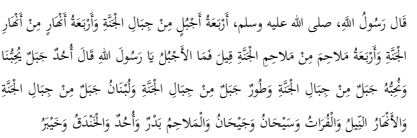
O Mensageiro de Allah ﷺ disse: “Quatro montanhas são das montanhas do Jannah (paraíso), quatro rios são dos rios do paraíso e quatro grandes batalhas ferozes serão das batalhas do paraíso.” Perguntaram: “Quais montanhas, ó Mensageiro de Allah?” Ele disse: “Uhud, uma montanha que nos ama e a qual amamos, é uma montanha das montanhas do paraíso; Tur é uma montanha das montanhas do paraíso; e Lubnan é uma montanha entre as montanhas do paraíso. E os rios são o Nilo, o Eufrates, o Saihan (Oxus) e o Jaihan (Jaxartes), enquanto as grandes batalhas ferozes são Badr, Uhud, Khandaq e Khaibar.”
The Messenger of Allah (peace be upon him) said: “Four mountains are from the mountains of Jannah (paradise) and four rivers are from the rivers of paradise and four fierce great battles will be from the battles of paradise” It was asked: “Which mountains O Messenger of Allah?” He said: “Uhud, a mountain that loves us and we love it, is a mountain from the mountains of paradise, Tur is a mountain from the mountains of paradise and Lubnan is a mountain from among the mountains of paradise. And the rivers are the Nile, Euphrates, Saihan (Oxus) and Jaihan (Jaxartes), while the fierce great battles are Badr, Uhud, Khandaq and Khaibar”.
- Muhammad bin ‘Ali bin Mu’aim Al-Baladi relatou-nos de Muhammad bin Abdullah bin ‘Umar, de Ma’afa bin ‘Imran, de Kathir bin Abdullah bin ‘Amr, de seu pai, de seu avô: Que o Profeta ﷺ disse:
- Muhammad bin ‘Ali bin Mu’aim Al-Baladi related to us from Muhammad bin Abdullah bin ‘Umar, from Ma’afa bin ‘Imran, from Kathir bin Abdullah bin ‘Amr, from his father, from his grandfather: That the Prophet (peace be upon him) said:

“Ó assembleia de Quraysh, lembrai-vos de mim em relação aos meus companheiros, aos seus filhos e aos filhos dos seus filhos”.
“O gathering of the Quraish, keep me in mind in respect to my companions, their sons and the sons of their sons”.
Muhammad bin Rabi’ bin Sulaiman Al-Jiziy relatou a nós, de Abu Umayyah At-Tarsusiy, de Mu’awiyah bin ‘Amr, de Abu Ishaq Al-Fazariy, de Ibn Kathir bin Abdullah, de seu pai, de seu avô, que disse:
- Muhammad bin Rabi’ bin Sulaiman Al-Jiziy related to us from Abu Umayyah At-Tarsusiy, from Mu’awiyah bin ‘Amr, from Abu Ishaq Al- Fazariy, from Ibn Kathir bin Abdullah, from his father, from his grandfather, who said:

O Mensageiro de Allah ﷺ disse: "Não há saque, nem pilhagem, nem roubo dos despojos; e quem roubar dos despojos virá no Dia do Juízo com aquilo que roubou".
The Messenger of Allah (peace be upon him) said: “There is no plundering, no looting and no stealing from the spoils and whoever steals from the spoils will come on the Day of Judgement with that which he stole”.
- Muhammad bin Ahmad bin Al-Hussein Al-Ahwaziy nos relatou, de ‘Amr bin ‘Ali, de Muhammad bin Khalid bin ‘Athmah, de Kathir bin Abdullah Al-Muzani, de seu pai, de seu avô, que disse:
- Muhammad bin Ahmad Bin Al-Hussein Al-Ahwaziy related to us from ‘Amr bin ‘Ali, from Muhammad bin Khalid bin ‘Athmah, from Kathir bin Abdullah Al-Muzani, from his father, from his grandfather, who said:

O Mensageiro de Allah ﷺ disse: “A Hora não virá até que Allah conquiste Constantinopla e Roma acompanhado de Tasbih e Takbir”.
The Messenger of Allah (peace be upon him) said: “The final hour will not come until Allah conquers Constantinople and Rome accompanied by Tasbih and Takbir”.
- Ahmad bin Muhammad bin Abdul ‘Aziz bin Al-Ja’d nos relatou, de Muhammad bin Ishaq Al-Masibi, de Abdullah bin Muhammad bin Salm, de Abdur Rahman bin Ibrahim, de Abdullah bin Nafi’, de Kathir bin Abdullah, de seu pai, de seu avô, do Profeta ﷺ:
- Ahmad bin Muhammad bin Abdul ‘Aziz bin Al-Ja’d related to us from Muhammad bin Ishaq Al-Masibi, from Abdullah bin Muhammad bin Salm, from Abdur Rahman bin Ibrahim, from Abdullah bin Nafi’, from Kathir bin Abdullah, from his father, from his grandfather, from the Prophet (peace be upon him):

"Aquele que dá a Zakat alcançou o sucesso." Ele disse: Zakat al-Fitr.
“The one who gives Zakah has attained success” He said: Zakat ul-Fitr.
- Ibn Salm nos relatou, por meio de Abdur Rahman, de Abdullah bin Nafi’, de Kathir bin Abdullah, de seu pai, de seu avô, que o Profeta ﷺ disse:
- Ibn Salm related to us from Abdur Rahman, from Abdullah bin Nafi’, from Kathir bin Abdullah, from his father , from his grandfather, that the Prophet (peace be upon him) said:

“Acautele-se contra o deslize ou tropeço do ‘Alim (sábio) e aguarde então a sua recorrência”. Ahmad bin Hafs nos narrou, a partir de Az-Zubair bin Bakkar, de Abdullah bin Nafi’, o mesmo que acima. Ahmad bin ‘Ali Al-Mada’ini nos narrou, a partir de Ahmad bin Muhammad Abu Bakr Al-Hatibi, de Ishaq Al-Janbiy, que disse: Kathir bin Abdullah Al-Muzani mencionou-o de seu pai, de seu avô, que disse: O Mensageiro de Allah ﷺ disse: O mesmo que acima (isto é, “Acautele-se contra o deslize do ‘Alim”).
“Take guard from the slip or lapse of the ‘Aalim (scholar) and so await its recurrence”. Ahmad bin Hafs related to us from Az-Zubair bin Bakkar, from Abdullah bin Nafi’ the same as above. Ahmad bin ‘Ali Al-Mada’ini related to us, from Ahmad bin Muhammad Abu Bakr Al-Hatibi, from Ishaq Al-Janbiy who said: Kathir bin Abdullah Al-Muzani mentioned it from his father, from his grandfather, who said: The Messenger of Allah (peace be upon him) said: The same as above (i.e. “Take guard from the lapse of the ‘Aalim”).
- Ahmad bin ‘Ali nos relatou, de Muhammad bin Khuraim Al-Qazzaz, de Hisham bin Khalid, de Marwan bin Mu’awiyah, de Kathir bin Abdullah Al-Muzani, de seu pai, de seu avô:
- Ahmad bin ‘Ali related to us from Muhammad bin Khuraim Al- Qazzaz, from Hisham bin Khalid, from Marwan bin Mu’awiyah, from Kathir bin Abdullah Al-Muzani, from his father, from his grandfather:

Que o Profeta ﷺ disse a Bilal bin Al-Harith: “Ó Bilal, saiba!”. Ele disse: “Estou pronto para saber, ó Mensageiro de Allah!” Ele disse (novamente): “Ó Bilal, saiba!” Ele disse: “Estou pronto para saber, ó Mensageiro de Allah!” Ele disse: “Ó Bilal, saiba que, de fato, quem reviver uma Sunnah da minha Sunnah que tenha desaparecido depois de mim, terá para si uma recompensa semelhante à de quem a praticar, sem que isso diminua em nada as recompensas deles. E quem introduzir uma inovação equivocada com a qual Allah não está satisfeito, nem o Seu Mensageiro, receberá pecados semelhantes aos de quem a praticar, sem que isso diminua em nada os pecados das pessoas”.
“That the Prophet (peace be upon him) said to Bilal bin Al-Harith: “O Bilal, Know!”. He said: “I am ready to know O Messenger of Allah!” He said (again) “O Bilal, know!” He said: “I am ready to know O Messenger of Allah!” He said: “O Bilal, know that indeed whoever revives a Sunnah from my Sunnah which has died out after me, then for him is a reward similar to whoever acts upon it without diminishing anything from their rewards. And whoever introduces an erroneous innovation which Allah is not pleased with, nor His Messenger, then he shall receive sins similar to whoever acts upon it, without that diminishing anything from the sins of the people”.
- Com a mesma cadeia de transmissão (isnad) de seu avô, que disse:
- With the same Isnad from his grandfather, who said:

"Memorizei do Mensageiro de Allah ﷺ 16 fundamentos dos fundamentos da Religião". Ele disse: O Mensageiro de Allah ﷺ disse:
“I memorised from the Messenger of Allah (peace be upon him) 16 foundations from the foundations of the Deen”. He said: The Messenger of Allah (peace be upon him) said:

"Não há responsabilidade (diya) por animais (ou seja, por ataques causados por eles), não há responsabilidade por poços (ou seja, por acidentes relacionados a eles), e um quinto é devido sobre o tesouro enterrado (rikaz)."
“There is no liability (blood money) for beasts (i.e. from being attacked), there is no liability for wells (i.e. accidents related to them) and a fifth is due from the buried treasure (Rikaz)”.

Ele disse: “Não há Jalab nem Janab (significando que os animais não devem ser afastados de seu local de pastagem até o cobrador de Zakat), não há obstrução e não há comércio de um habitante da cidade”.
He said: “There is no Jalab and no Janab (meaning that animals should not be moved away from their place of grazing to the collector of Zakah), there is no obstruction and there is no trade of a townsperson
"para um beduíno. E não há apropriação ilícita, nem pilhagem, nem saque, nem roubo dos despojos de guerra, e quem roubar dos despojos virá no Dia do Juízo com aquilo que roubou."
for a Bedouin. And there is no unlawful taking of possession, no plundering, no looting and no stealing from the spoils and whoever steals from the spoils will come with that which he stole on the Day of Judgement”.

Ele disse: “Quem se apresentar como senhor (mawla) de alguém que não seja seu patrono (mawali), então a maldição de Allah e Sua ira recairão sobre ele, e nada será aceito dele”.
He said: “Whoever takes charge of a Mawla from other than his Mawali, then the curse of Allah and His anger will be upon him, and nothing will be accepted from him”.

Ele disse: “Quem cometer um crime (ou seja, violar os direitos dos outros ou o pacto), sobre ele recairão a maldição de Allah e a Sua ira, e nada será aceito dele”.
He said: “Whoever commits a crime (i.e. breaching the rights of others or the covenant), then the curse of Allah and His anger will be upon him, and nothing will be accepted from him”.
- Com a mesma cadeia de transmissão (isnad) de seu avô, ele disse: O Mensageiro de Allah ﷺ disse:
- With the same Isnad from his grandfather, he said: The Messenger of Allah (peace be upon him) said:

"Os muçulmanos estão sujeitos às suas condições, exceto a condição que torna lícito o ilícito (Haram) ou uma condição que torna ilícito o lícito (Halal)."
“The Muslims are upon their conditions apart from the condition which makes the Halal (lawful) Haram (unlawful) or a condition that makes the Haram (unlawful) Halal (lawful)”.
- Abdul Wahhab bin Abu ‘Usmah nos relatou, a partir de Isma’il bin Yazid Al-Asbahani, de Ma’n bin ‘Eisa, de Kathir bin Abdullah Al-Muzani, de seu pai, de seu avô, que disse:
- Abdul Wahhab bin Abu ‘Usmah related to us from Isma’il bin Yazid Al-Asbahani, from Ma’n bin ‘Eisa, from Kathir bin Abdullah Al- Muzani, from his father, from his grandfather who said:

Ouvi o Mensageiro de Allah ﷺ dizer: "Ele se levantou, louvou a Allah e O exaltou. Em seguida disse: Ó povo, quem dentre os que realizam o Hajj e a 'Umrah e os que viajam sobre terras desertas tem mais direito à água e à sombra, e assim não impeçam as pessoas do acesso à terra."
I heard the Messenger of Allah (peace be upon him): “He stood, praised Allah and extolled Him. He then said: O people, whoever from those undertaking Hajj and ‘Umrah and those who are travelling are upon deserted land have more right to water and shade and so do not prevent the people from the land (i.e. access)”.
Em seguida, apareceram, nesta edição impressa, vários ahadith sem relação alguma com Kathir bin Abdullah. Parece que a origem do erro está no próprio manuscrito, e outros manuscritos podem ser revisados e comparados com este, caso possam ser encontrados… (Após a menção daqueles ahadith não relacionados, Ibn Adiy prossegue):
Following this, there came, in this printed edition, a number of unconnected Ahadeeth which had no relationship with Kathir bin Abdullah at all. It appears that the origin of the error is the manuscript itself and other manuscripts can be revised and compared to this one if they can be found … (Following the mention of those unrelated Ahadeeth Ibn Adiy continues):
Ele (Ibn ‘Adiy) disse: Ahmad bin Hafs As-Sa’diy nos relatou, de Ahmad bin Ibrahim Ad-Duraqiy, de Abdullah bin Nafi’, de Kathir bin Abdullah Al-Muzani, de seu pai, de seu avô, que disse:
- He (Ibn ‘Adiy) said: Ahmad bin Hafs As-Sa’diy related to us from Ahmad bin Ibrahim Ad-Duraqiy, from Abdullah bin Nafi’, from Kathir bin Abdullah Al-Muzani, from his father, from his grandfather, who said:

O Mensageiro de Allah ﷺ disse: “Deixai em paz os abissínios enquanto eles vos deixarem em paz”.
The Messenger of Allah (peace be upon him) said: “Leave be those Abyssinians as long as they leave you be”.
Muhammad bin Al-Hasan Al-Basriy transmitiu de Muhammad bin Bakkar Al-‘Aishi, de Muhammad bin Isma’il bin Abu Fadaik, de Kathir bin Abdullah Al-Muzani, de seu pai, de seu avô, que disse:
- Muhammad bin Al-Hasan Al-Basriy related from Muhammad bin Bakkar Al-‘Aishi, from Muhammad bin Isma’il bin Abu Fadaik, from Kathir bin Abdullah Al-Muzani, from his father, from his grandfather, who said:

O Profeta ﷺ ouviu um homem chamando-a de verde (exuberante), e então disse: "Estamos à sua disposição. Tomamos e você tem do que há entre vocês".
“The Prophet (peace be upon him) heard a man calling it green (luscious) and so he said: We are at your service. We have taken and you have from what is among you” .
- Muhammad bin Al-Hasan Al-Basriy transmitiu de Al-‘Abbas bin Abdul ‘Azhim, de Abdullah bin Ja’far bin Abu Kathir Al-Ansari, de Kathir bin Abdullah bin ‘Amr bin ‘Awf Al-Muzani, de seu pai, de seu avô, de Bilal bin Al-Harith Al-Muzani:
- Muhammad bin Al-Hasan Al-Basriy related from Al-‘Abbas bin Abdul ‘Azhim, from Abdullah bin Ja’far bin Abu Kathir Al-Ansari, from Kathir bin Abdullah bin ‘Amr bin ‘Awf Al-Muzani, from his father, from his grandfather, from Bilal bin Al-Harith Al-Muzani:

Que quando o Profeta ﷺ queria aliviar-se, ele se afastava a certa distância.
“That when the Prophet (peace be upon him) wanted to relive himself, he would move away at a distance”.
- Abdullah bin Abdul Hamid Al-Wasitiy relatou de An-Nadr bin Salamah, de Abu ‘Uziyyah Muhammad bin Musa Al-Ansari, o Qadi (Juiz) de Al-Madinah, de Kathir bin Abdullah, de seu pai, de seu avô ‘Amr bin ‘Awf, que disse:
- Abdullah bin Abdul Hamid Al-Wasitiy related from An-Nadr bin Salamah, from Abu ‘Uziyyah Muhammad bin Musa Al-Ansari, the Qadi (Judge) of Al-Madinah, from Kathir bin Abdullah, from his father, from his grandfather ‘Amr bin ‘Awf, who said:

“Eu vi o Mensageiro de Allah ﷺ de pé sobre o Maqam, e ele dizia: Ó povo, esta Qibla é a Qibla da Mesquita, e a Mesquita é a Qibla do Dunyaa (mundo)”.
“I saw the Messenger of Allah (peace be upon him) standing upon the Maqam and he was saying: O people, this Qiblah, it is the Qiblah of the Masjid and the Masjid is the Qiblah of the Dunyaa (world)”.
- Muhammad bin Yusuf bin ‘Asim Al-Bukhari narrou para nós, de Ahmad bin Isma’il Al-Qurashi, de Abdullah bin Nafi’, de Kathir bin Abdullah, de seu pai, de seu avô:
- Muhammad bin Yusuf bin ‘Asim Al-Bukhari related to us from Ahmad bin Isma’il Al-Qurashi, from Abdullah bin Nafi’, from Kathir bin Abdullah, from his father, from his grandfather:

Que o Mensageiro de Allah ﷺ estava na Masjid. Ele ouviu uma fala atrás de si, e quem a dizia estava dizendo: "Ó Allah, ajuda-me com aquilo que me salvará daquilo de que me fizeste temer". Então, o Mensageiro de Allah ﷺ disse, ao ouvir isso: "Não vais incluir junto a ela a sua irmã?". O homem então disse: "Ó Allah, concede-me o anseio dos verdadeiros por aquilo que tornaste desejável para eles". O Mensageiro de Allah ﷺ então disse a Anas bin Malik, que estava com ele: "Vai até ele, ó Anas, e diz-lhe que o Mensageiro de Allah ﷺ te diz: 'Pede perdão por mim'". Anas foi até ele e transmitiu-lhe isso. O homem então disse: "Ó Anas, tu és o mensageiro do Mensageiro de Allah ﷺ para mim?". Ele respondeu: "Assim como tu és". O homem voltou para verificar. Então o Mensageiro de Allah ﷺ disse: "Diz-lhe que sim". Assim, ele (o homem) disse-lhe: "Vai e diz-lhe que Allah te favoreceu sobre os Profetas, como favoreceu o mês de Ramadã sobre os outros meses, e que favoreceu a tua Ummah (nação) sobre as nações, como favoreceu o dia de Jumu'ah sobre todos os outros dias". Eles foram procurando e eis que era Khadir, que a paz esteja com ele.
“That the Messenger of Allah (peace be upon him) was in the Masjid. He heard speech behind him and the one saying it was saying: “O Allah assist me with which will save me from that which you have made me fearful of”. So, the Messenger of Allah (peace be upon him) said when he heard that: “Will you not include its sister alongside it?” The man then said: “O Allah bestow upon me the longing of the truthful to that which you have made desirable for them”. The Messenger of Allah (peace be upon him) then said to Anas bin Malik who was in his company: “Go to him O Anas and say to him that the Messenger of Allah (peace be upon him) says to you: “Seek forgiveness for me”. So, Anas went to him and conveyed that to him. The man then said: “O Anas, you are the messenger of the Messenger of Allah (peace be upon him), to me. He replied: “Just as you are”. He returned to verify it. The Messenger of Allah (peace be upon him) then said: “Say to him yes”. So, he (the man) said to him: “Go and say to him that Allah has favoured you over the Prophets like He has favoured the month of Ramadan over other months and that He has favoured your Ummah (nation) over the nations like He has favoured the day of Jumu’ah over all of the other days”. They went looking and behold it was Khadir, peace be upon him”.
- Ahmad bin Ja’far nos relatou, por meio de Ya’qub bin Ibrahim Ad-Duraqi, de Ibrahim bin Abdullah Ar-Rafa’iy, de Kathir bin Abdullah, de seu pai, de seu avô:
- Ahmad bin Ja’far related to us from Ya’qub bin Ibrahim Ad-Duraqi, from Ibrahim bin Abdullah Ar-Rafa’iy, from Kathir bin Abdullah, from his father, from his grandfather:

Que o Mensageiro de Allah ﷺ rezou sobre o Najashi (Negus da Abissínia) e proferiu cinco Takbirs.
“That the Messenger of Allah (peace be upon him) prayed over the Najashi (Negus of Abyssinia) and did five Takbirs”.
- ‘Imran bin Musa nos relatou, por meio de Ibrahim bin Al-Mundhir, por meio de Abu Al-Ja’d Abdur Rahman bin Abdullah As-Salmiy, por meio de Kathir bin Abdullah Al-Muzani, por meio de seu pai, por meio de seu avô, que disse:
- ‘Imran bin Musa related to us from Ibrahim bin Al-Mundhir, from Abu Al-Ja’d Abdur Rahman bin Abdullah As-Salmiy, from Kathir bin Abdullah Al-Muzani, from his father, from his grandfather, who said:

O Mensageiro de Allah ﷺ disse: “O cavalo é oferecido no dia da sua dessedentação”.
“The Messenger of Allah (peace be upon him) said: “the horse is offered the day of its watering”.
Ainda restam poucos Ahadith narrados por Kathir bin Abdullah, de seu pai, de seu avô, e a maior parte dos Ahadith que mencionei, e a maior parte do que ele narrou, não possui nada que o corrobore (ou o apoie), ou seja, ele está sozinho ao narrá-los. - Bahlul bin Ishaq nos relatou, de Isma'il bin Abu Uwais, de Kathir bin Abdullah Al-Muzani, de Rubaih bin Abdur Rahman bin Abu Sa'id Al-Kudri, de seu pai, de seu avô, que disse:
There are still a small number of Ahadeeth related by Kathir bin Abdullah from his father, from his grandfather remaining and most of his Ahadeeth which I mentioned and most of what he related, does not have that which conforms (or supports) them (i.e. he is alone in narrating them). - Bahlul bin Ishaq related to us from Isma’il bin Abu Uwais, from Kathir bin Abdullah Al-Muzani, from Rubaih bin Abdur Rahman bin Abu Sa’id Al-Kudri, from his father, from his grandfather, who said:

"Eu vi homens dentre os árabes (isto é, os beduínos) se aproximando do Mensageiro de Allah ﷺ. Eles disseram: “Ó Mensageiro de Allah, somos pessoas que possuem rebanhos, e tiramos deles a nossa Sadaqah (isto é, Zakat). Isso também nos cobre a Zakat do Ramadã?” O Mensageiro de Allah ﷺ disse: “Não, ela é tirada da criança e do adulto, do livre e do escravo. É uma purificação para vocês”. Abu Sa'id Al-Khudri disse: Eu vi, no ano em que os rebanhos eram abundantes e as culturas brancas diminuíram mais do que as negras, e depois, no ano seguinte, vi que as culturas eram abundantes e os rebanhos negros diminuíram mais do que os brancos”. Não conheço ninguém que tenha transmitido este Hadith de Rubaih, além de Kathir bin Abdullah] [Fim da citação de Ibn ‘Adiy]."
“I saw men from the Arabs (i.e. Bedouins) approaching the Messenger of Allah (peace be upon him). They said: “O Messenger of Allah, we are people possessing livestock and we take out from them our Sadaqah (i.e. Zakat) and so does that also cover for us the Zakat of Ramadan?” The Messenger of Allah (peace be upon him) said: “No, it is taken from the child and the adult, from the free and the slave. It is a purification for you”. Abu Sa’id Al-Khudri said: I saw in the year that the herds were plentiful and that the white crops diminished more than the black. I then saw in the year following that the crops were plentiful and that the black herds were diminished more than the white”. I do not know anyone relating this Hadith from Rubaih apart from Kathir bin Abdullah] [End of quote of Ibn ‘Adiy].
Quanto à declaração de Ibn ‘Adiy: “Ainda restam poucos Ahadeeth transmitidos por Kathir bin Abdullah, de seu pai, de seu avô, e a maioria dos Ahadeeth que mencionei, e a maior parte do que ele transmitiu, não tem aquilo que o confirme (ou o apoie), isto é, ele está sozinho ao narrá-los”, então isso não significa a declaração de falta de confiabilidade ou a classificação de fraqueza. Isso porque o mero fato de estar sozinho na transmissão de Ahadeeth, “a maior parte do que ele transmitiu não tem aquilo que o confirme (ou apoie)”, especialmente em relação a alguém que é um dos netos infames dos Sahabah (como o caso de Bahz bin Hakim, por exemplo), não implica fraqueza ou falta de confiabilidade. É como se Ibn ‘Adiy tivesse preferido manter-se seguro e escolhido evitar emitir um veredito sobre o homem. Isso porque, quando ele quer expressar a falta de confiabilidade ou a deficiência de um homem, costuma dizer: “E a fraqueza é evidente em seu Hadith”, ou palavras semelhantes a isso. Já quando quer declarar a confiabilidade e a solidez de um narrador, ele diz: “Não encontrei nada Munkar (rejeitável) em relação a ele”, ou “Não encontrei nada Munkar dele se um Thiqah (narrador confiável e digno de confiança) transmitiu dele”. É evidente que nada chegou até ele de Al-Bukhari, exceto o que seu Sheikh Isma’il bin Abu Uwais lhe transmitiu: “Ouvi (ou recebi de) Kathir bin Abdullah bin ‘Amr bin ‘Awf bin Yazid bin Milhah Al-Muzani no ano 158, depois no ano 161 ou 162”.


Que o Mensageiro de Allah ﷺ estava na Masjid. Ele ouviu uma fala atrás de si, e quem a dizia estava dizendo: "Ó Allah, ajuda-me com aquilo que me salvará daquilo de que me fizeste temer". Então, o Mensageiro de Allah ﷺ disse, ao ouvir isso: "Não vais incluir junto a ela a sua irmã?". O homem então disse: "Ó Allah, concede-me o anseio dos verdadeiros por aquilo que tornaste desejável para eles". O Mensageiro de Allah ﷺ então disse a Anas bin Malik, que estava com ele: "Vai até ele, ó Anas, e diz-lhe que o Mensageiro de Allah ﷺ te diz: 'Pede perdão por mim'". Anas foi até ele e transmitiu-lhe isso. O homem então disse: "Ó Anas, tu és o mensageiro do Mensageiro de Allah ﷺ para mim?". Ele respondeu: "Assim como tu és". O homem voltou para verificar. Então o Mensageiro de Allah ﷺ disse: "Diz-lhe que sim". Assim, ele (o homem) disse-lhe: "Vai e diz-lhe que Allah te favoreceu sobre os Profetas, como favoreceu o mês de Ramadã sobre os outros meses, e que favoreceu a tua Ummah (nação) sobre as nações, como favoreceu o dia de Jumu'ah sobre todos os outros dias". Eles foram procurando e eis que era Khadir, que a paz esteja com ele.
“That the Messenger of Allah (peace be upon him) was in the Masjid. He heard speech behind him and the one saying it was saying: “O Allah assist me with which will save me from that which you have made me fearful of”. So, the Messenger of Allah (peace be upon him) said when he heard that: “Will you not include its sister alongside it?” The man then said: “O Allah bestow upon me the longing of the truthful to that which you have made desirable for them”. The Messenger of Allah (peace be upon him) then said to Anas bin Malik who was in his company: “Go to him O Anas and say to him that the Messenger of Allah (peace be upon him) says to you: “Seek forgiveness for me”. So, Anas went to him and conveyed that to him. The man then said: “O Anas, you are the messenger of the Messenger of Allah (peace be upon him), to me. He replied: “Just as you are”. He returned to verify it. The Messenger of Allah (peace be upon him) then said: “Say to him yes”. So, he (the man) said to him: “Go and say to him that Allah has favoured you over the Prophets like He has favoured the month of Ramadan over other months and that He has favoured your Ummah (nation) over the nations like He has favoured the day of Jumu’ah over all of the other days”. They went looking and behold it was Khadir, peace be upon him”.
Procuramos esta narração em todos os lugares possíveis, mas não conseguimos encontrá-la a não ser por este caminho do Imam Ibn ‘Adiy. A narração também lhe é atribuída no livro “Unais As-Saari Fee Takhrij Ahadeeth Fat’h ul-Baari” (9/6578/4610).
We searched for this narration in every conceivable place but we were unable to find it except from this path of Imam Ibn ‘Adiy. The narration is also attributed to him in the book “Unais As-Saari Fee Takhrij Ahadeeth Fat’h ul-Baari” (9/6578/4610):

‘Amr bin ‘Awf relatou: “Que o Profeta ﷺ ouviu uma fala enquanto estava na Mesquita e então disse: ‘Ó Anas, vá até aquele que disse isso e peça-lhe que peça perdão por mim’. Anas foi até o homem e ele (o homem) lhe disse: ‘Diga-lhe (ou seja, ao Profeta ﷺ) que, na verdade, Allah o favoreceu sobre os Profetas com aquilo com que favoreceu o Ramadã sobre os demais meses’. Ele disse: Então foram ver e eis que era Khadir”. Al-Hafiz (Ibn Hajar) disse: “É um Hadith fraco, que Ibn ‘Adiy extraiu pela via de Kathir bin ‘Amr bin ‘Awf, de seu pai, de seu avô, e é uma cadeia de transmissão (isnad) fraca”. Ibn ‘Asakir relatou algo semelhante a ele, a partir do Hadith de Anas, com uma cadeia de transmissão que é mais fraca que ela” (7/245 – O livro dos Ahadeeth dos Profetas – Capítulo: O Hadith de Al-Khadir com Musa, a paz esteja com ele). É muito fraco. Ele relatou a partir do Hadith de ‘Amr bin ‘Awf e do Hadith de Anas. Quanto ao Hadith de ‘Amr bin ‘Awf, Ibn ‘Adiy o extraiu (6/2083) pela via de Abdullah bin Nafi’ As-Sa’igh, de Kathir bin Abdullah, de seu pai, de seu avô: “Que o Mensageiro de Allah ﷺ estava na Mesquita e então ouviu uma fala… etc…”.
[‘Amr bin ‘Awf related: “That the Prophet (peace be upon him) heard speech whilst he was in the Masjid and then said: “O Anas, go to the one who said that and ask him to seek forgiveness for me”. Anas went to the man and he (the man) said to him: “Say (to him i.e. the Prophet) that verily Allah has favoured you over the Prophets by that which he has favoured Ramadan over the remaining months”. He said: They then went to see and behold it was Khadir”. Al-Hafizh (Ibn Hajar) said: “It is a weak Hadith which Ibn ‘Adiy extracted via the path of Kathir bin ‘Amr bin ‘Awf, from his father, from his grandfather, and it is a weak Isnad (chain of transmission)”. Ibn ‘Asakir related similar to it from the Hadith of Anas, with a chain of transmission which is weaker than it” (7/245 – The book of the Ahadeeth of the Prophets – Chapter: The Hadith of Al-Khadir with Musa, peace be upon him). It is very weak. He related from the Hadith of ‘Amr bin ‘Awf and the Hadith of Anas. As for the Hsdith of ‘Amr bin ‘Awf, then Ibn ‘Adiy extracted it (6/2083) via the path of Abdullah bin Nafi’ As-Sa’igh from Kathir bin Abdullah, from his father, from his grandfather: “That the Messenger of Allah (peace be upon him) was in the Masjid and then he heard speech … etc …].
Como se pode ver, Al-Hafizh (Ibn Hajar) atribuiu a narração a Kathir bin Abdullah, enquanto Abu Hudhaifah Nabil bin Mansur bin Ya’qub bin Sultan Al-Bisarah Al-Kuwitiy, autor de “Unais As-Saari”, a atribuiu a Abdullah bin Nafi’ As-Sa’igh, a partir de Kathir bin Abdullah. No entanto, ambos incorrem em uma falha grave a esse respeito.
As can be seen, Al-Hafizh (Ibn Hajar) attributed the narration to Kathir bin Abdullah whilst Abu Hudhaifah Nabil bin Mansur bin Ya’qub bin Sultan Al-Bisarah Al-Kuwitiy, the author of “Unais As- Saari”, attributed it to Abdullah bin Nafi’ As-Sa’igh from Kathir bin Abdullah. However, both of them are guilty of an obscene shortcoming in respect to this.

Que o Mensageiro de Allah ﷺ disse: “Em verdade, a religião (Din) recolher-se-á para o Hijaz, como a serpente se recolhe à sua toca, e a religião buscará refúgio no Hijaz, como a cabra montanhesa busca refúgio no topo da montanha. A religião começou como algo estranho e voltará a ser algo estranho. Bem-aventurados sejam os estranhos; aqueles que restaurarão o que as pessoas depois de mim corromperam da minha Sunnah”.
That the Messenger of Allah (peace be upon him) said: “Verily, the Deen will retreat back to the Hijaz as a snake retreats back to its hole, and the Deen will seek refuge in the Hijaz as the mountain goat seeks refuge in the mountain top. The Deen began as something strange and will return as something strange. Blessed are the strangers; those who will rectify what the people after me have corrupted from my Sunnah”.
Alguns falaram sobre Kathir, e teria sido mais benéfico se tivessem permanecido em silêncio a respeito dele. Na verdade, só os ignorantes falaram sobre ele e sobre os seus motivos (ou relações). Ouvi Ibn Uwais dizer: Malik perguntou-me sobre o seu hadith, e Yahya bin Sa'id Al-Ansari transmitiu a partir dele. Não tenho dúvida de que ouvi Ibrahim bin Al-Mundhir (e se não o ouvi dele, então um thiqah me transmitiu) dizer: "Kathir costumava afirmar que o Profeta ﷺ havia concedido terras ao seu avô, e ele discutia com as pessoas daquela região. Discutia muito. Foi até Ibn 'Imran para litigar, e 'Imran disse-lhe: 'Ó Kathir, és realmente um homem ocioso que discute muito a respeito daquilo que não conhece; reivindicas o que não te pertence e não tens prova do que exiges. Portanto, não te aproximes de mim, e não me deixes ver-te, a menos que vejas que liberei o meu tempo para as pessoas da falsidade. Se vires isso, então vem'. Certo dia, Ibn 'Imran estava conosco, e eis que Kathir bin Abdullah se aproximou dele. Ele (Ibn 'Imran) disse: 'Não te disse para não vires a mim a menos que me vejas tendo liberado o meu tempo para as pessoas da falsidade?' Kathir respondeu: 'Disseste a verdade; que Allah faça prosperar os assuntos do Qadi. Na verdade, só vim a ti quando as pessoas da falsidade vieram a ti. Fulano e fulano vieram a ti. Ambos são pessoas da falsidade, e por isso vim junto com eles os dois'. Esta foi a ordem de Ibn 'Imran para ele. Abu Yusuf disse: 'Ordenou-lhe que permanecesse firme junto à coluna até que se levantasse dos procedimentos judiciais'. Abu Yusuf disse: 'Eles eram dos devotados a Ibn 'Imran'. Isto também foi registrado na transcrição de "Ash-Shamela Lil-Ma'rifah Wa At-Tarikh" (p. 62 – pela numeração da biblioteca eletrônica Shamela).
Some have spoken about Kathir who had they been silent about him it would have been more beneficial. Indeed, only the ignorant have spoken about him and his motives (or relations). I heard Ibn Uwais saying: Malik asked me about his Hadith and Yahya bin Sa’id Al-Ansari related from him. I have no doubt that I heard Ibrahim bin Al- Mundhir (And if I didn’t hear it from him, then a Thiqah related it to me) that he said: “Kathir used to claim that the Prophet (peace be upon him) had granted his grandfather land and he used to dispute with those in that area. He used to quarrel a lot. He went to Ibn ‘Imran to quarrel and so ‘Imran said to him: “O Kathir, indeed you are an idle man who quarrels a lot in respect to that which you don’t know, you claim that which does not belong to you and you have no evidence from what you demand. So, don’t approach me and I will not let me see you unless you see that I have freed my time for the people of falsehood. If you see that, then come”. One day Ibn ‘Imran was with us and then behold Kathir bin Abdullah had approached him. He (Ibn ‘Imran) said: “Did I not tell you to not come to me unless you see me having freed my time for the people of falsehood?” Kathir then replied: ““You have said the truth, may Allah make good the affair of the Qadi. Indeed, I only came to you when the people of falsehood came to you. So and so and so and so person came to you. They are both people of falsehood and so I came along with them both”. It was from the command of Ibn ‘Imran to him. Abu Yusuf said: “He commanded to remain fast to the column until he had stood from judicial proceedings”. Abu Yusuf said: “They were from those devoted to Ibn ‘Imran]. This has also been recorded in the transcript of “Ash-Shamela Lil- Ma’rifah Wa At-Tarikh” (p. 62 – by the numbering of the Shamela E- library).