6.6 Escolas estatais e o sistema de períodos letivos
6.6 State schools and the system of school terms
A divisão das escolas dentro do Estado é baseada na idade média dos alunos, e não nos períodos letivos, a fim de estar vinculada às regras da Shari'ah relacionadas ao ensino e à disciplina, de modo a lidar com os alunos de acordo com a sua idade. As escolas são divididas, conforme essas faixas etárias, em 3 tipos, como mostra o seguinte quadro:
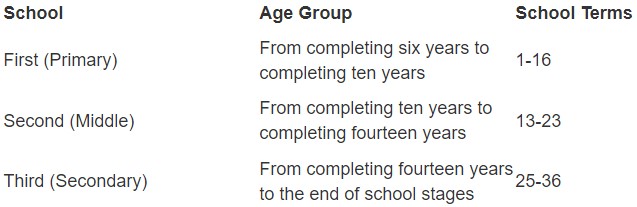
The division of schools within the State is built upon the basis of average student age rather than school terms in order to be bound by the Shari’ah rules related to teaching and discipline, so as to deal with students according to their age. Schools are divided according to these age groups into 3 types as shown in the following chart:
A escola não está exclusivamente limitada aos períodos letivos; ao contrário, ela se estende para se associar às escolas da etapa anterior e da etapa seguinte em alguns períodos, a fim de garantir a distribuição dos alunos nas 3 etapas de acordo com suas faixas etárias. A escola da primeira etapa de ensino é exclusivamente destinada a alunos com menos de dez anos, sendo que o aluno, ao completar dez anos, terá concluído 12 períodos letivos (4 anos vezes 3 cursos por ano = 12 cursos). No entanto, o aluno dedicado pode, nesta etapa, completar 16 períodos letivos (4 anos vezes 4 períodos por ano = 16 períodos). Assim, as escolas das duas primeiras etapas se sobrepõem no ensino dos períodos obrigatórios 13 a 16, destinados a alunos entre 9 e 12 anos. Por exemplo, o período número "15" é ensinado na primeira etapa ao aluno dedicado que não busca interrupção em nenhum período; sua idade será (6 + 4/15 = 9 ¾ anos), ou seja, dentro da faixa etária da primeira etapa. Já para o aluno que busca o descanso, sua idade será (6 + 3/15 = 11 anos), ou seja, dentro da faixa etária da segunda etapa. Essa sobreposição também existe entre a escola da segunda etapa e a escola da terceira etapa, que se sobrepõem no ensino dos períodos "25 a 32", obrigatórios para alunos entre 13 e 17 anos de idade. O 28º curso, por exemplo, é ensinado na segunda etapa ao aluno dedicado que não interrompe nenhum período; sua idade será (6 + 4/28 = 13 anos), ou seja, dentro da segunda etapa. Da mesma forma, o 28º curso é ensinado na escola da terceira etapa para os alunos que fazem uma pausa entre os cursos; sua idade será (6 + 3/28 = 15 1/3 anos), ou seja, dentro das faixas etárias da terceira etapa. Isso ocorre em todos os períodos sobrepostos entre as etapas mencionadas no quadro da página 74.
The school is not exclusively bound by school terms only; rather it extends to associate with schools of the previous and following stage in a number of terms in order to guarantee distribution of students in the 3 stages according to their age groups. The first stage school of teaching is exclusively for students less than ten years old, with the student having completed 12 school terms upon attaining ten years (4 yrs times 3 courses per year=12 courses). However, the serious student can at this stage complete 16 school terms (4 years times 4 terms per year=16 terms). Accordingly, schools of the first 2 stages overlap in teaching the required terms 13-16 to students between 9 and 12 years, for instance, term number “15” is taught in the first stage to the serious student who is not seeking a break in any term, his age will be (6+4/15= 9 ¾ years) i.e. within the first stage group. The second stage for the student who seeks the holiday, he will be (6+3/15=11 years) i.e. within the second stage age group. This overlap exists also between the second stage school and the third stage school, they overlap in teaching the term “25-32” which are mandatory for students between 13 and 17 years of age. The 28th course for example, is taught in the second stage for the serious student who does not take a break from any term; his age will be (6+4/28=13 years) i.e. within the second stage. Similarly, the 28th course is taught in the third stage school for the students who take a break between courses: his age will be (6+3/28=15 1/3 years) i.e. within the third stage age groups. This is the case for all the overlapping terms between the mentioned stages in the chart on page 74.