6.3 学期
6.3 School terms
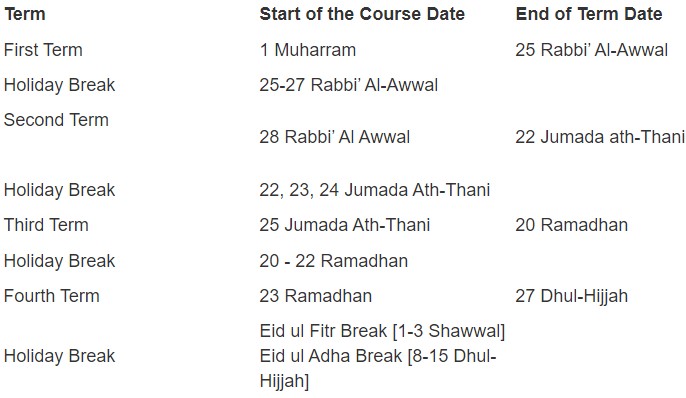
学习阶段由三十六(36)个连续的学期组成,每个学期为八十三(83)天。每个学期分配一组教学单元。学生从第一学期开始学习阶段。他在完成一门课程后升入下一学期,直至成功完成全部三十六个学期,从而结束学习阶段。伊斯兰历一年被均分为四个学期,每两个学期之间有三(3)天的学生假期间隔。下表列出了每个学期的开始和结束日期,以及分隔各门课程的假期间隔:
School stages are composed of thirty-six (36) consecutive terms, each being eighty-three (83) days. Each term is assigned a group of teaching units. The student commences school stages with the first term. He is promoted upon succeeding in a course to the next one until he completes the school stages by successfully completing all thirty-six terms. The Hijri year is divided into four periodically equal terms, with a student holiday break interval of three (3) days between each term. The following chart demonstrates the commencement and completion dates of each term, and the break intervals separating the courses:
图表:年度学校课程与假期
CHART: ANNUAL SCHOOL Courses and HOLIDAYS
儿童满六岁(按伊斯兰历计算)后即可入学。因此,公立学校将在每学年的四个学期中每个学期开学之初接收新生,即大约每三个月一次。儿童可以入读最接近其满六岁(按伊斯兰历计算)的那个学期(一年四个学期中的其一)。
The child enters school immediately upon completing six years of age according to the Hijri calendar. Accordingly, State schools will accept new students at the beginning of each school term of the four terms of each year i.e. approximately every three months. The child is able to enter the first school term (of the four available in the year) nearest to his attaining six years of age according to the Hijri calendar.
学生只有在连续三个学期之后,才可以休息一个学期;但他也可以不休息,继续学习。因此,这一制度使认真的学生能够比同龄人更快地完成各个学段:他在学期内顺利地继续学习,不休息,或者减少休息。学习的时间单位是学期,每个学期为83天,而不是以年为单位;每个学期都有其自身的科目课程和学生。
The student can rest one school term only after every three consecutive terms at the least, but he can also continue his study without any such rest. Thus the system enables the serious student to complete the school stages in a shorter time than his contemporaries by continuing his studies within the school terms successfully without taking the rest periods or reducing them. The study time unit is the school term which is composed of 83 days and not the annual year; each term has its own subject curriculum and students.
按照这一学制,一名学生若连续学习而不请假,并顺利完成各学期,则可在九年内修完三十六个学期(36/4=9年),届时他将在十五岁时完成学校阶段的学业。若他每年平均只学三个学期,即通常每连续学习三个学期后休息一个学期,同时顺利完成所有学期,则需十二年方可修完三十六个学期(36/3=12年),届时他将在十八岁时完成学校阶段的学业。
The student who continues his school terms successfully without taking any leave can complete thirty-six terms in nine years (36/4=9 years) whereupon he would have completed the school stages upon completing 15 years of age. If he studies the thirty-six terms at an average of only three school terms every year i.e. by usually resting one school term after every three consecutive terms, together with successfully completing all terms, he would complete the school stages in twelve years (36/3=12 years) whereupon he would complete the school stages upon attaining 18 years of age.
有些学生在年满18岁后可能需要一两年时间才能完成三个学段。如果他们年满20岁仍未通过学段的公开考试,则可免于常规学习,并可在参加职业院校或再次参加公开考试之间做出选择,若考试通过,便可进入大学接受教育。
Some students may need a year or two after attaining 18 years to complete the three school stages. If they attain 20 years without passing the school stages’ public examinations, they are excused from regular study and choose between joining vocational institutes or retaking the public examinations again so as to join university education if successful.
这种学期制度,除了考虑到学生之间的个体差异外,还十分重视时间的价值以及学生的学业成就。
This system of school terms, apart from taking into account individual differences between students, also takes great care over the importance of time and their academic achievement.
本书末尾所附的图表展示了36个学期在各学生年龄组中的分布情况。图表还显示了学生在完成各学段并毕业时的最低年龄和平均年龄。
The chart attached at the end of this book demonstrates the distribution of the 36 school terms among student age groups. It also demonstrates the lowest as well as the average age of students upon graduation and completion of school stages.
在若干小村庄之间建立一所“综合学校”建筑群,以实施这一学期制度,并保障学生往返于家与学校之间的交通。
A “Comprehensive school” complex is established between small villages to implement this term system, and transportation of students from their homes to and from school will be secured.