6.2 Hatua za elimu ya shule
6.2 School education stages
Wakati wa kugawanya elimu katika hatua, lazima tuzingatie hali halisi ya mwanafunzi katika kila hatua, kama ni mtoto au mtu mzima aliyebaleghe (baaligh). Pia lazima turejelee dalili za Shari'ah na hukumu zinazohusiana na mtoto au mtu mzima aliyebaleghe, kuhusu jinsi walii wake (waliyy al-amr) anavyomshughulikia, na kwa hivyo jinsi mwalimu na mlezi wanavyomshughulikia, kwa kuwa katika Uislamu, Muumba Mpangaji (Al-Mudabir), Mola wa viumbe vyote, ameweka mfumo wa lazima wa kudhibiti jinsi binadamu wanavyoshughuliana.
While dividing teaching into stages, we must pay attention to the student’s reality as a child or mature (baaligh) person at each stage. And we must refer to the Shari’ah evidences and rules they denote as related to the child or mature person with respect to how his guardian (waliyy al-amr), and consequently the teacher and educator deals with him, since in Islam, the Creator the Director (Al-Mudabir), the Lord of the World, has brought a binding system to regulate how humans deal with each other.
Miongoni mwa dalili zinazohusiana na somo hili ni kauli ya Allah Ta'ala (Surat An-Nur Aya 58):
Among the evidences related to this subject is Allah Ta’ala’s saying (Surah An-Nur Ayah 58):
﴿Enyi nyinyi mlioamini, na waombe ruhusa wale ambao mikono yenu ya kulia inamiliki, na wale ambao bado hawajafikia ubalehe miongoni mwenu, wakati wa nyakati tatu: kabla ya Sala ya alfajiri, na wakati mnapoweka nguo zenu chini kwa ajili ya kupumzika adhuhuri, na baada ya Sala ya isha. Hizi ni nyakati tatu za faragha kwenu. Hakuna dhambi juu yenu wala juu yao baada ya nyakati hizi, kwani wao huzunguka kwenu, baadhi yenu kwa wengine. Hivyo ndivyo Allah anavyowabainishia Aya, na Allah ni Mjuzi, Mwenye hekima.﴾ “Enyi mlioamini, waombe ruhusa…” Na Ta’ala Yake amesema katika Aya ifuatayo:
﴿يََ أَيُّ هَا الَّ ي ذينَ آمَنُوا لييَسْتَأْيذنكُمُ الَّ ي ذينَ مَلَكَتْ أَيَْْانُكُمْ وَالَّ ي ذينَ لََْ يَ بْ لُغُوا الُْْلُمَ يمنكُ مْ ثَلََثَ مَرَّا ت يمِّن قَ بْيل صَلََية الْفَجْير وَي حينَ تَضَعُونَ ثييَابَكُم يمِّنَ الظَّيهيرَية وَيمن بَ عْ ي د صَلََية الْيعشَايء ثَلََثُ عَوْرَا ت لَّكُمْ لَيْسَ عَلَيْكُمْ وَلَا عَلَيْيهمْ جُنَاحٌ بَ عْدَهُنَّ طَوَّافُونَ عَلَيْكُم بَ عْضُكُمْ عَلَىٰ بَ عْ ض كَذَٰليكَ ي بَُييِّنُ اللَّ هُ لَكُمُ الْآيََ ي ت وَاللَّ هُ عَلييمٌ حَ ي كيمٌ ﴾ “O you who have believed, let those whom your right hands possess and those who have not [yet] reached puberty among you ask permission of you [before entering] at three times: before the dawn prayer and when you put aside your clothing [for rest] at noon and after the night prayer. [These are] three times of privacy for you. There is no blame upon you nor upon them beyond these [periods], for they continually circulate among you - some of you, among others. Thus does Allah make clear to you the verses; and Allah is Knowing and Wise.” And He Ta’ala said in the following Ayah:
﴿وَإيذَا بَ لَغَ الْأَطْفَالُ يمنكُمُ الُْْلُمَ فَ لْيَسْتَأْيذنُوا كَمَا اسْتَأْذَنَ الَّ ي ذينَ يمن قَ بْيليهمْ كَذَٰليكَ ي بَُييِّنُ اللَّ هُ لَكُمْ آيََتييه وَاللَّ هُ عَلييمٌ حَ ي كيمٌ ﴾ “Na watoto wenu watakapofikia balehe, basi na waombe ruhusa [wakati wote] kama walivyoomba ruhusa wale waliokuwa kabla yao. Hivyo ndivyo Allah anavyowabainishia Aya zake; na Allah ni Mjuzi, Mwenye hekima.” [An-Nur: 59] Na Nabii ﷺ alisema:
﴿وَإيذَا بَ لَغَ الْأَطْفَالُ يمنكُمُ الُْْلُمَ فَ لْيَسْتَأْيذنُوا كَمَا اسْتَأْذَنَ الَّ ي ذينَ يمن قَ بْيليهمْ كَذَٰليكَ ي بَُييِّنُ اللَّ هُ لَكُمْ آيََتييه وَاللَّ هُ عَلييمٌ حَ ي كيمٌ ﴾ “And when the children among you reach puberty, let them ask permission [at all times] as those before them have done. Thus does Allah make clear to you His verses; and Allah is Knowing and Wise.” [An-Nur: 59] And the Prophet (SAW) said:
Kalamu huondolewa kwa watu watatu: mwenye wazimu aliyeshindwa na akili yake mpaka apone, mwenye kulala mpaka aamke, na mtoto mpaka abaleghe. (Imepokewa na Abu Dawud katika Sunan yake.) Na yeye (SAW) alisema: » Ee Asma, mwanamke anapobaleghe kipindi cha hedhi, haifai kuonekana kwake isipokuwa hiki na hiki « akionyesha uso wake na viganja vyake. (Imepokewa na Abu Dawud katika Sunan yake.) Na kutoka kwa ‘Atiyya Al-Quradhi aliyesema:
رفع القلم عن ثلَثة، عن المجنون المغلوب على عقله حتى يفيق، وعن النائم حتى « » يستيقظ، وعن الصبي حتى يحتلم “The pen (i.e. accountability) is lifted from three persons: The insane whose mind is overcome until he recovers, the sleeper until he awakes and the child until he attains puberty.” (Narrated by Abu Dawud in his Sunan). And he (SAW) said: » يَ أسماء إن المرأة إذا بلغت المحيض لَ تصلح أن يرى منها إلا هذا وهذا « “‘O Asma, when the female reaches the age of menstruation, nothing should be seen of her except this and this’ and he indicated his face and palms.” (Narrated by Abu Dawud in his Sunan). And from ‘Atiya Al-Quradhi who said:
Tulionyeshwa kwa Nabii ﷺ siku ya Quraydha, na aliyekuwa ameota nywele za sehemu za siri aliuawa, na asiyeota aliachiwa. Mimi nilikuwa miongoni mwa wasiotoa nywele, hivyo niliachiwa.” (Amepokewa na Tirmidhi katika Sunan yake). Pia amepokea,
)عُيرضنا على النبي يوم قريظة فكان من أنبت قُتيل، ومن لَ ينبت خُلِّى سبيله، فكنت ممن لَ ينبت فخُلِّى سبيلي( “We (i.e. Bani Quraydha) were shown to the Prophet on the Day of Quradhya. Whoever had grown pubic hairs was killed while the one without growth was released. I was among those without growth so I was released.” (Narrated by Tirmidhi narrated in his Sunan). He also narrated,
Kwamba baada ya Sa'd kutoa hukumu kuhusu Banu Quraydha, Nabii ﷺ aliamuru wafunuliwe nguo zao za kujifunika (kufunua sehemu zao za siri).” Na Uthman alisema alipoletewa kijana mdogo: “Mtazameni nguo yake ya kujifunika.” Wakaona kwamba hakuwa ameota nywele za sehemu za siri, basi hakumkata (mkono wake). Na hakuna Maswahaba aliyekanusha hili. Naye ﷺ alisema: “Waamuru watoto wenu waswali wanapofikia umri wa miaka saba, na wapigeni kwa ajili yake (kwa kutosali) wanapofikia umri wa miaka kumi. Na watenganisheni katika vitanda.” (Amepokewa na Imam Ahmad katika Musnad yake). Dalili hizi zinaonyesha kwamba utoto unaisha watoto wanapobaleghe, yaani umri wa kukomaa. Uislamu uliweka alama dhahiri zinazotofautisha utoto na kukomaa: kutokwa na manii au kuota nywele za sehemu za siri kwa wanaume, na hedhi au ujauzito kwa wanawake. Pia ulionyesha kwamba sheria zinazowahusu waliobaleghe hazitumiki kwao kabla ya hapo. Na Nabii ﷺ alisema: “Waamuru watoto wenu waswali wakiwa na umri wa miaka saba, na wapigeni kwa ajili yake (kwa kutosali) wakiwa na umri wa miaka kumi.” (Amepokewa na Imam Ahmad katika Musnad yake). Hadithi hii inaonyesha kwamba nidhamu ya watoto imegawanyika katika hatua mbili: Hatua ya kabla mtoto hajafikia umri wa miaka kumi, ambapo kupigwa hakutumiki kumwadhibu kwa kuwa hadithi inazuia kumwamuru tu kusali bila kumpiga. Hivyo, kwa hoja nzito zaidi, hapigwi kwa kufundishwa mambo mengine zaidi ya swala. Nidhamu yake inabaki katika mbinu za kuonya na kutishia bila kupiga. Na hatua ya baada ya kufikia umri wa miaka kumi hadi kubaleghe, nidhamu yake inajumuisha kupigwa inapohitajika. Hata hivyo, adhabu za hudud na adhabu za Shari'ah ('uqoobaat) hazimtumikii mtu hadi abalughe, yaani hatua inayofuata ukomavu, kwa sababu ya kauli yake ﷺ:
» أنَّ النبي لما حكَّم سعد اً فِ بني قريظة كان يكشف عن مؤتزرهم « “That after S’ad adjudicated regarding Quraydha, the Prophet commanded with exposing their wrappings (covering their private parts).” And Uthman said when a young boy was brought to him: » انظروا إلى مؤتزره، فوجدوه لَ ينبت فلم يقطع « “Look at his wrapper. They found him without pubic hair so they did not cut (his hand)” and no Sahabah denied this. And he (SAW) said: مروا صبيانكم بالصلَة إذا بلغوا سبعاً، واضربوهم عليها إذا بلغوا عش راً، وفرقوا بينهم « » فِ المضاجع “Command your children to pray when they attain seven years, and beat them over it (not praying) when they attain ten years. And separate between them in the beds.” (Narrated by Imam Ahmed in his Musnad). These evidences indicate that childhood ends when children attain puberty i.e. the age of maturity. Islam assigned distinctive tangible milestones separating childhood from maturity: when wet dreams occur or pubic hairs appear in males, and menstruation or pregnancy for females. It also indicated that the rules that are applied upon those attaining puberty do not apply upon them beforehand. And he (SAW) said: » مُ ر وا أبناءكم بالصلَة لسبع سنين واضربوهم عليها لعشر سنين « “Command your children to pray when they attain seven years, and beat them over it (for not praying) when they attain ten years” (Narrated by Imam Ahmed in his Musnad). The hadith shows that disciplining children is divided into two stages: The stage before the child attains ten years where beating is not used to discipline him because the hadith restricts one to command him with prayer without beating him. Thus, by greater reason, he is not beaten for being taught other than the prayer. His discipline is restricted to styles of exhortation and threats without beating. And the stage after he attains ten years until puberty his discipline includes beating him if necessary. However the hudood and Shari’ah punishments (‘uqoobaat) do not apply upon him until after attaining puberty i.e. the stage after maturity due to his (SAW) saying:
"Kalamu imeinuliwa (yaani, kutowajibishwa) kwa watu watatu: mtoto mpaka abalighe, aliyelala mpaka aamke, na mwenye kichaa mpaka apone." (Amepokewa na Abu Dawud katika Sunan yake). Maana ya « رُفع القلم عن ثلَثة » hapa ni kutowajibishwa. Watoto wanapofikia baleghe, Shari'a inawachukulia kuwa wanawajibishwa, hivyo wanaadhibiwa kwa hukumu ya kisheria iwapo watafanya ukiukaji (wa kanuni za Shari'a) au haramu. Hili linahitaji uwepo wa majaji katika shule za wanafunzi waliokomaa na elimu ya ngazi ya juu.
رُفع القلم عن ثلَثة، عن الصبيِّ حتى يبلغ، وعن النائم حتى يستيقظ، وعن المعتوه « » حتى يبرأ “The pen (i.e. accountability) is lifted from three persons: The child until he matures, the sleeper until he awakes and the imbecile until he recovers” (Narrated by Abu Dawud in his Sunan). The meaning of » رُفع القلم عن ثلَثة « “lifting the pen” here is non-accountability. When children attain puberty, the Shar’a deems them accountable so they are punished by judicial decree if they commit a violation (of the Shari’ah rules) or a haram. This requires the presence of judges in schools of mature students and higher level education.
Kanuni hizi kuhusu mtoto na mtu mzima lazima zizingatiwe wakati wa kubuni hatua za kufundisha, kwa kuwa malezi (tarbiyyah) ya watoto na nidhamu ni sharti la elimu. Hatua ya kwanza huanza mtoto anapoingia shuleni hadi anapofikia umri wa miaka kumi. Hatua ya pili huanza anapofikia miaka kumi hadi balehe, ambayo kwa kawaida hutokea akiwa na miaka kumi na tano katika nchi zenye hali ya hewa ya wastani. Na hatua ya tatu huanza akiwa na miaka kumi na tano hadi anapomaliza elimu yake ya shule.
These rules with respect to the child and mature person must be observed when devising teaching stages since tarbiyyah (raising of children) and discipline are prerequisites of education. The primary stage extends from the child’s entry into school until he reaches ten years. The second stage extends from his attaining ten years until puberty which normally occurs at fifteen years of age in countries of moderate climate. And the third stage extends from fifteen years until he completes school education.
Kulingana na ushahidi na kanuni hizi, hatua za elimu ya shule katika Dola ya Khilafah zimegawanywa kwa kuzingatia umri wa wanafunzi, na si kwa masomo yanayotolewa shuleni. Shule zimegawanywa katika aina tatu kama ifuatavyo:
Based upon these evidences and rules, school teaching stages in the Khilafah State are divided upon the basis of student ages and not subjects offered by the school. Schools are divided into three types in the following manner:
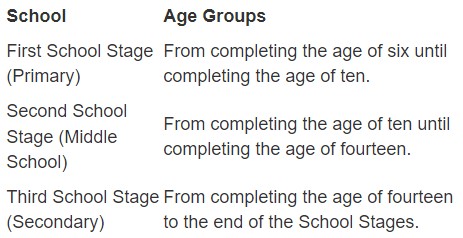
Mara tu mwanafunzi anapotimiza umri wa miaka kumi, huangaliwa kwa makini ili ahamishiwe katika hatua ya pili ya elimu, bila kujali kiwango chake cha kitaaluma. Na mara tu anapofikia balehe, huhamishiwa katika hatua ya tatu ya shule (shule za wanafunzi ambao wamefikia balehe), iwe amefikia hatua hiyo kitaaluma au la. Hivi karibuni tutaonyesha jinsi mfumo wa mihula ya shule utakaotekelezwa na Idara ya Elimu katika shule za serikali unavyohakikisha kwamba wanafunzi wanapangwa katika shule kulingana na makundi yao ya umri.
Once the student completes ten years of age, care is taken to transfer him to the second stage of schooling irrespective of his academic achievement. And once he attains puberty, he is transferred to the third school stage (schools of students who reached puberty) whether or not he has attained that stage academically. We shall soon demonstrate how the system of school terms that will be implemented by the Education Department in State schools, guarantees the assigning of students to schools according to their age groups.
Kuhusu elimu kabla ya umri wa miaka sita (shule za chekechea na za watoto wadogo), hili liko kwa hiari ya watu. Mtu akitaka kuanzisha shule binafsi kwa ajili hiyo, anaruhusiwa kufanya hivyo, mradi Dola isimamie ufundishaji huu kwa kuzingatia masomo yanayofundishwa na kuhakikisha kwamba yanaendana na sera ya elimu iliyopitishwa na Khalifah.
As for education before six years, (Nurseries and Kindergarten), this is at the people’s discretion. If one wishes to establish a private school for this purpose, one is allowed to do so provided the State supervises this teaching with respect to study subjects and their conformity to the education policy adopted by the Khalifah.